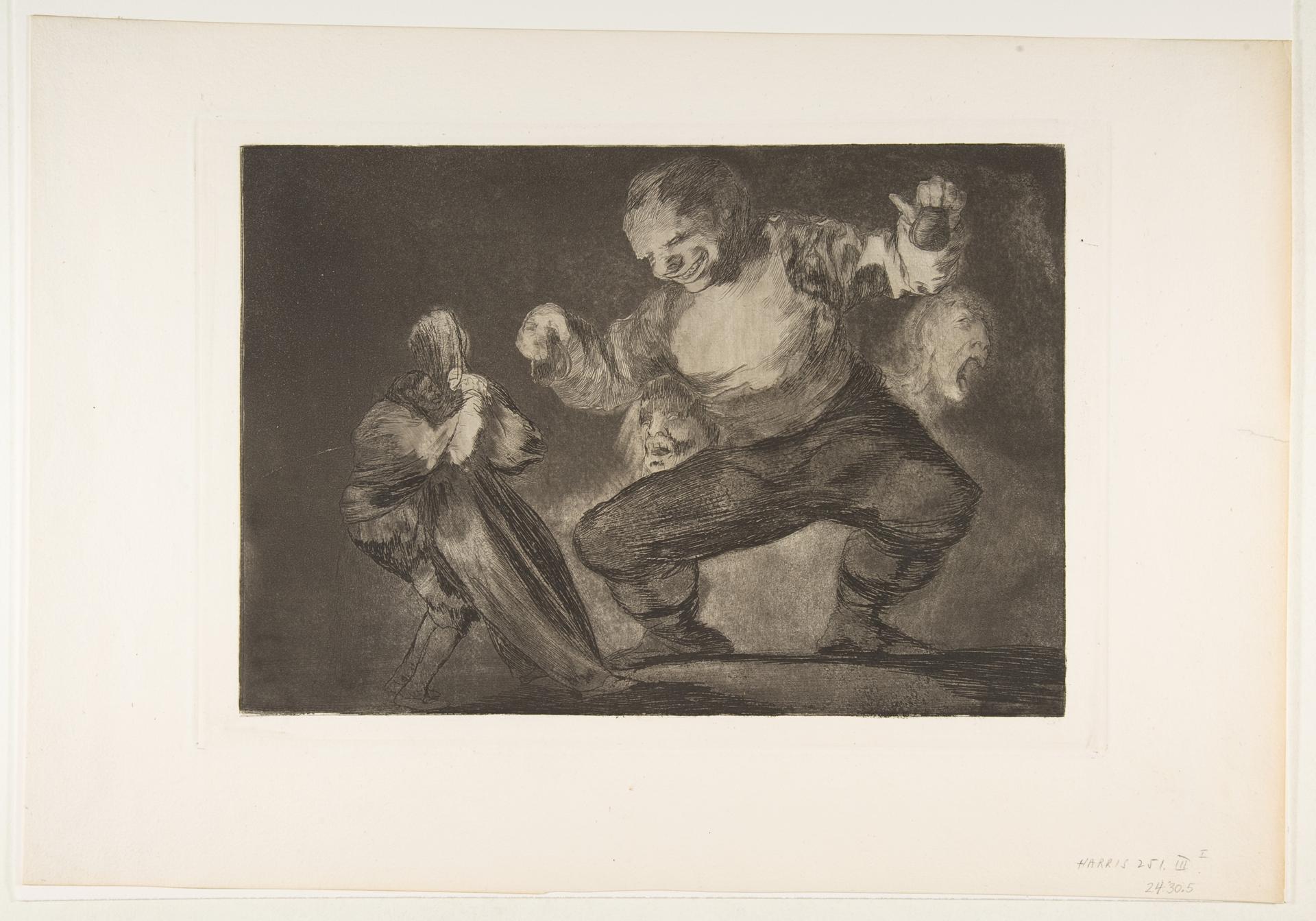
Dancing Giant (ca. 1815–19 (published 1864))
Original title: 'Dancing Giant' from the 'Disparates' (Follies / Irrationalities)
kurzbeschreibung
Created around 1815–19, Francisco de Goya's etching 'Tanzender Riese' (Dancing Giant) belongs to the 'Disparates' series, which was not published until 1864. The print presents a drastic encounter among three figures in a dark, colorless space. It was executed as an etching with burnished aquatint and drypoint.
Description
In the foreground crouches a powerful figure, tense, arms outstretched, hands clenched into fists, dressed in simple clothing. Beside him stands a smaller person, back turned to the viewer, wrapped in a cloak, seemingly fending something off or worrying. Between them acts a third figure with a distorted, clownish facial expression, as if laughing or screaming. Dark tones dominate the image and heighten the drama; the figures are grouped centrally, emphasizing their confrontation. Black and gray prevail, with no color variations at all.
Context
The 'Disparates' were made in Goya's late years, when Spain was politically unstable after the Napoleonic Wars. They were only published in 1864, long after the artist's death, by the Academia de San Fernando. Originally they were not intended for an audience but served personal, often mocking reflections. What the series was meant to achieve cannot be said with certainty, for Goya left no explanatory notes.
Impact
An oppressive, almost dreamlike mood emanates from the print, caused by the dark tonality and distorted figures. The tense posture of the crouching giant and the deformed face of the middle figure give the image a turbulent, violent energy. Because only black and gray are used, everything appears even gloomier and resembles a nightmare.
Technique
The print was made as an etching with burnished aquatint and drypoint, allowing for delicate lines and rich tonal values. The aquatint provides soft, graduated shading, while drypoint creates sharp, rough contours. The plate measures 24.3 × 35.2 cm, the sheet 33 × 47.6 cm.
AI-generated description text
Source: Metropolitan Museum of Art · Public Domain (CC0 1.0)