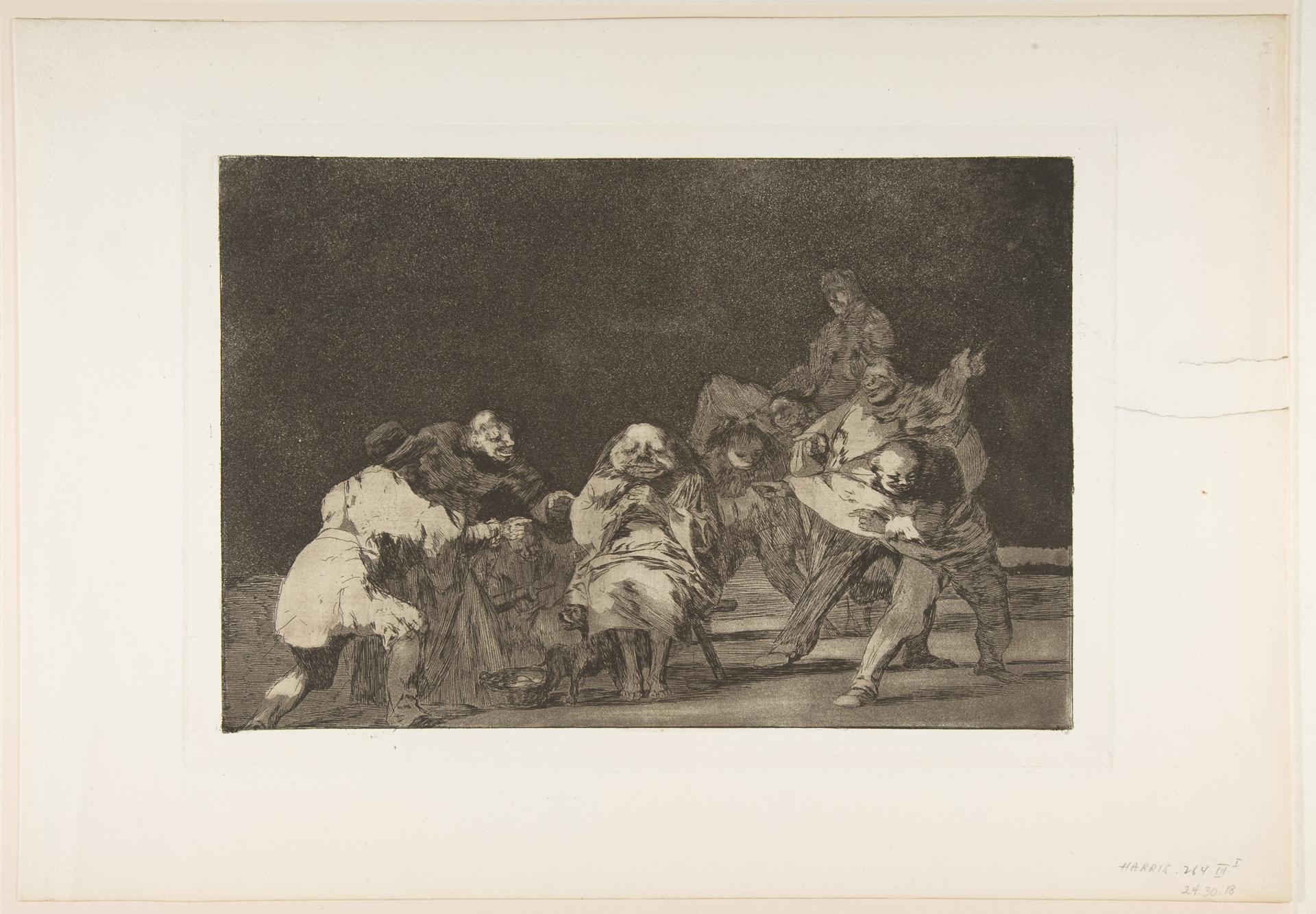
Loyalty, from "The Disparates" (Follies / Irrationalities)
Original title: Loyalty, from "The Disparates" (Follies / Irrationalities)
kurzbeschreibung
Unlike many sheets in the 'Disparates', 'Loyalty' centers on a group of people who seem less grotesque than enigmatic. Francisco de Goya made the etching around 1815–19; it was not published until 1864. He executed it as a drypoint with aquatint, which gives the scene a peculiar density.
Description
The layout feels asymmetrical, drawing the eye to a central figure carrying a plate or bowl. The other figures sit or stand in various poses; their faces are distorted and expressive, suggesting psychological tension. The garments look plain but rich in detail, recalling traditional clothing. A dark, undefined background makes the people stand out. Diffuse light and the monochrome gray scale of the aquatint create a gloomy mood.
Context
The 'Disparates' emerged in Goya's final years in Spain, a period of political repression after the liberal constitution was revoked. The series was only published posthumously in 1864 by the Academy in Madrid. Why and for what purpose Goya made these sheets is not recorded; they are considered his most puzzling graphic works. 'Loyalty' belongs to the 22 plates that deal with themes such as folly, violence, and human abysses.
Impact
The distorted faces and unclear setting convey a sense of oppression and threat. The dark lighting and monochrome technique heighten the unease and psychological tension. The viewer is pulled into a world of the irrational, characteristic of Goya's late work.
Technique
Drypoint with burnished aquatint allows fine tonal gradations and a velvety texture. The plate measures 24.5 × 35.1 cm, the sheet 33.5 × 48 cm. Goya used aquatint for soft transitions and a dark, atmospheric effect, while drypoint provides the bold lines of the figures.
AI-generated description text
Source: Metropolitan Museum of Art · Public Domain (CC0 1.0)