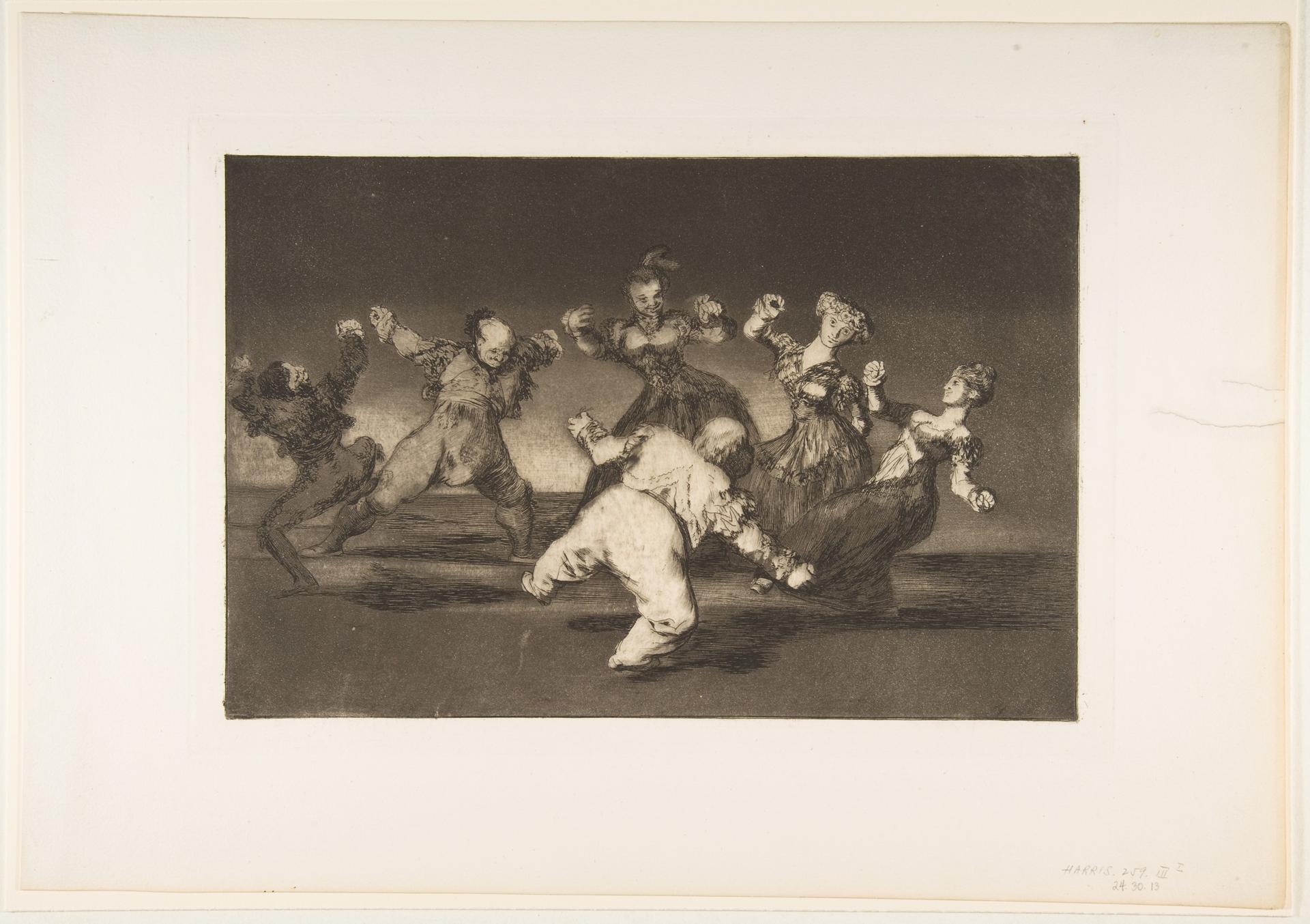
Merry Folly, from 'The Disparates' (Follies / Irrationalities)
Original title: Merry Folly, from "The Disparates" (Follies / Irrationalities)
kurzbeschreibung
Francisco de Goya y Lucientes made the etching Lustige Torheit (Follies / Irrationalitäten) between about 1815 and 1819, though it was not published until 1864. A group of dancing and agitated figures appears in a chaotic jumble, rendered in aquatint and drypoint.
Description
A swarm of figures dancing or moving abruptly fills the center of the sheet. Their faces and bodies turn in various directions, revealing joy, astonishment, perhaps also bewilderment. Some wear traditional garments, others appear in shrill, almost grotesque costumes. The background remains dark and indeterminate, focusing all attention on the figures and heightening the drama. The arrangement emphasizes a certain symmetry.
Context
The series Los Disparates (The Follies) belongs to Goya's late period, when he withdrew increasingly from society. Only in 1864, 36 years after Goya's death, did the Real Academia de Bellas Artes de San Fernando publish the etchings. To this day, the series ranks among the artist's most enigmatic works, as its exact meaning has not been fully deciphered.
Impact
The dynamic distribution of the figures and the stark black-and-white contrast give the sheet an immediate energy. Festive movement and grotesque elements mix into an unsettling, ambivalent mood that draws the viewer right into the action.
Technique
Goya combined etching, aquatint, and drypoint. Aquatint creates fine tonal gradations and soft transitions, while drypoint provides strong, varying lines that carry the abundance of detail and drama of the scene. The plate measures 24.5 × 35.3 cm, the sheet 33.5 × 48 cm.
AI-generated description text
Source: Metropolitan Museum of Art · Public Domain (CC0 1.0)