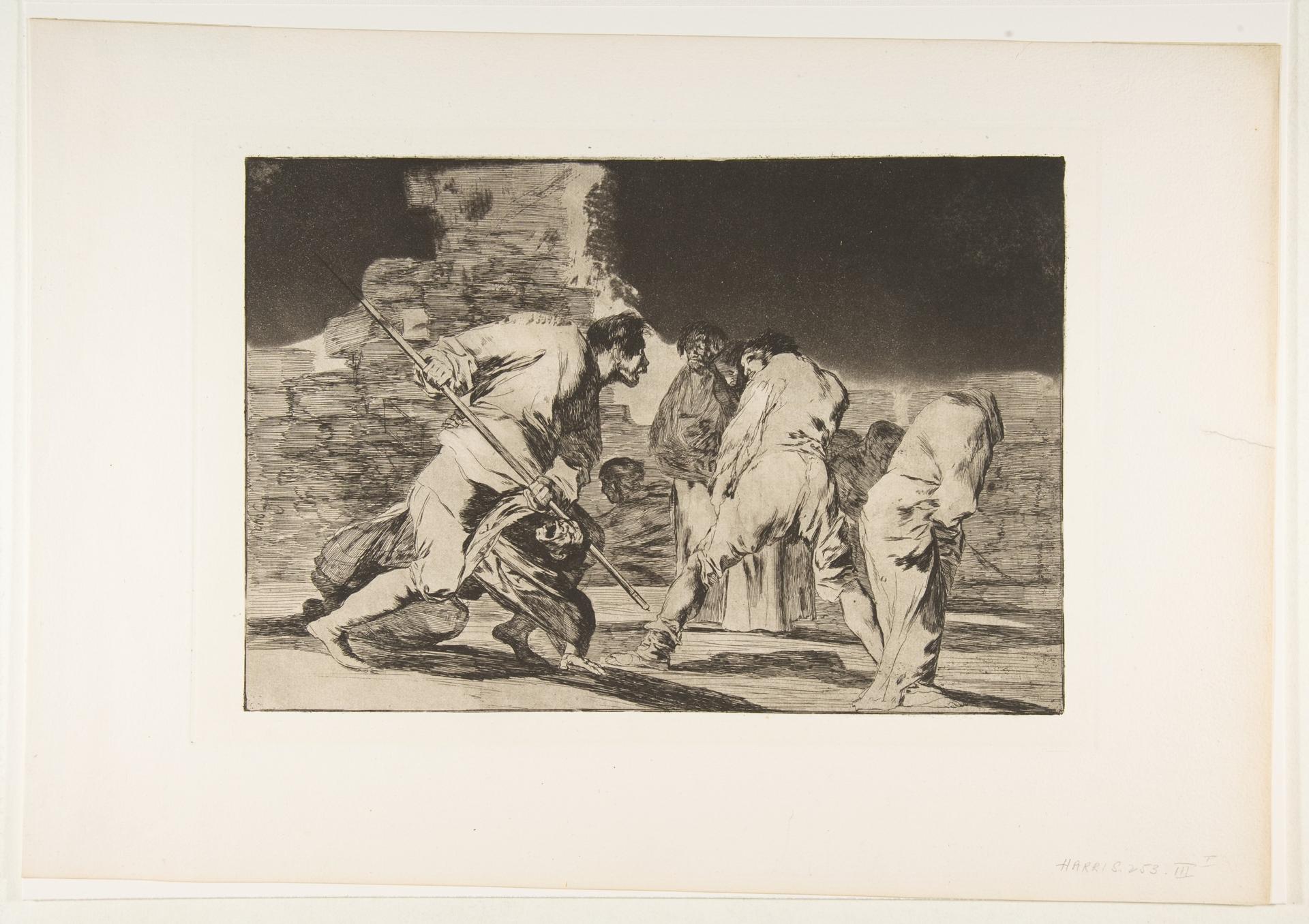
Cruel Folly, from 'The Disparates' (Follies / Irrationalities)
Original title: Cruel Folly, from "The Disparates" (Follies / Irrationalities)
kurzbeschreibung
Goya's etching Cruel Folly belongs to the Disparates series, made around 1815–19 but not published until 1864. A crowd of people gathers in a gloomy setting, though what exactly is happening stays puzzling, reading like a distorted parable of human foolishness. The plate was executed as an etching with burnished aquatint.
Description
At the front a man in plain, soiled clothing sinks to his knees, a tool or device in his hand, his gaze fixed rigidly on the ground. Others in similar dress stand around him, their features partly swallowed by shadow. Behind them rises an indistinct dark mass that suggests a wall or a tower. Light falls in from the side, and the graded greys deepen the murky mood while drawing out the outlines of the figures. The arrangement has the close, observed realism typical of the nineteenth century.
Context
The Disparates were made between 1815 and 1819 but did not appear until 1864, long after Goya's death. Those years fell in a period of political and social unrest in Spain following the Napoleonic Wars. The plates are regarded as a bleak meditation on human unreason and violence. That the series remained unpublished in the artist's lifetime suggests it was not meant for the public.
Impact
The dark tonality and hidden faces produce an oppressive, uncanny feeling. The figures' contorted postures hover between composure and violence and will not let the viewer go. The imagery feels at once timeless and disturbing.
Technique
Etching and burnished aquatint meet here, the latter allowing finely graded tones. Aquatint creates soft, grainy areas that bring out shadow and gloom. Combining the two processes makes possible both precise lines and painterly effects.
AI-generated description text
Source: Metropolitan Museum of Art · Public Domain (CC0 1.0)