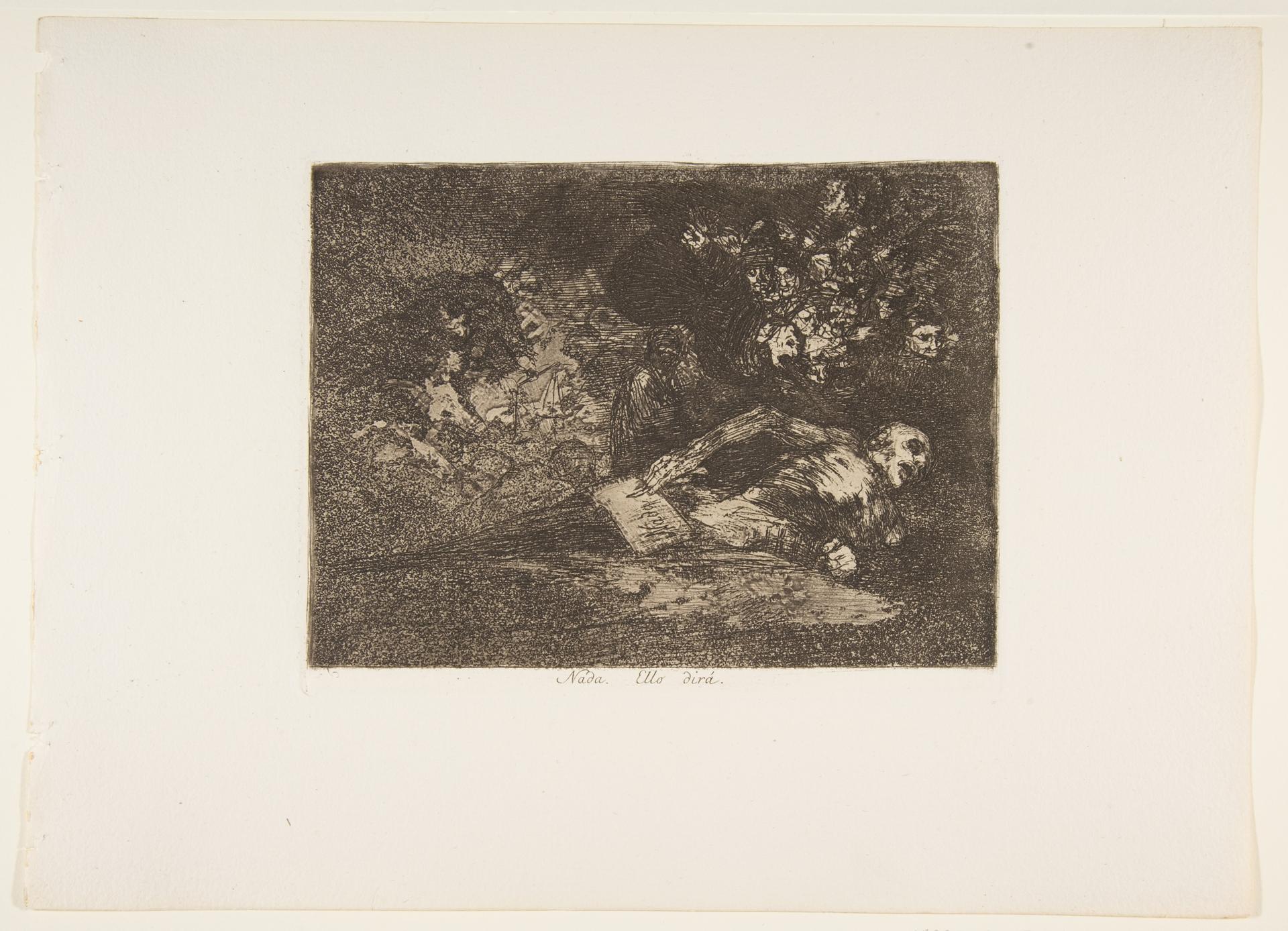
Nothing. The event will tell (Nada. Ello dirá)
Original title: Plate 69 from "The Disasters of War" (Los Desastres de la Guerra): Nothing. The event will tell (Nada. Ello dirá)
kurzbeschreibung
Goya made plate 69 of his etching series 'The Disasters of War' between 1810 and 1820; it was not printed until 1863. To create the image, he combined etching, burnished aquatint, lavis, drypoint, and burin. A wounded or exhausted figure in the foreground holds a piece of paper, while behind them several people stand in a ruined landscape.
Description
At the bottom, a person lies on the ground, holding a sheet of paper; their condition appears battered or drained. Behind them, several figures rise, looking in different directions, visibly unsettled. The surroundings look devastated and dark, dominated by blacks and grays. The arrangement is uneven: the front figure occupies the center, the others frame the scene. Hatching and details come from fine etching, producing delicate lines and soft tonal gradations.
Context
Goya worked on 'The Disasters of War' during and after the Spanish War of Independence (1808–1814) against Napoleon. The plates remained unpublished in his lifetime; the first edition appeared in 1863. Plate 69 belongs to the later works of the cycle, which also address allegorical and civilian aspects of war. It is part of a group that shows the consequences of violence and hunger without direct battle scenes.
Impact
A somber, hopeless mood arises from the dark tonality and the nearly motionless arrangement. The figure with the paper seems isolated, while those standing around point to a shared suffering. The use of only black and gray underscores the seriousness of the subject.
Technique
The plate was executed as a drypoint etching with etching and burnished aquatint, supplemented by lavis and burin. This mixture allows both fine linear details and gentle tonal transitions. The plate measures 15.5 × 19.9 cm, the sheet 25.2 × 34.5 cm.
AI-generated description text
Source: Metropolitan Museum of Art · Public Domain (CC0 1.0)