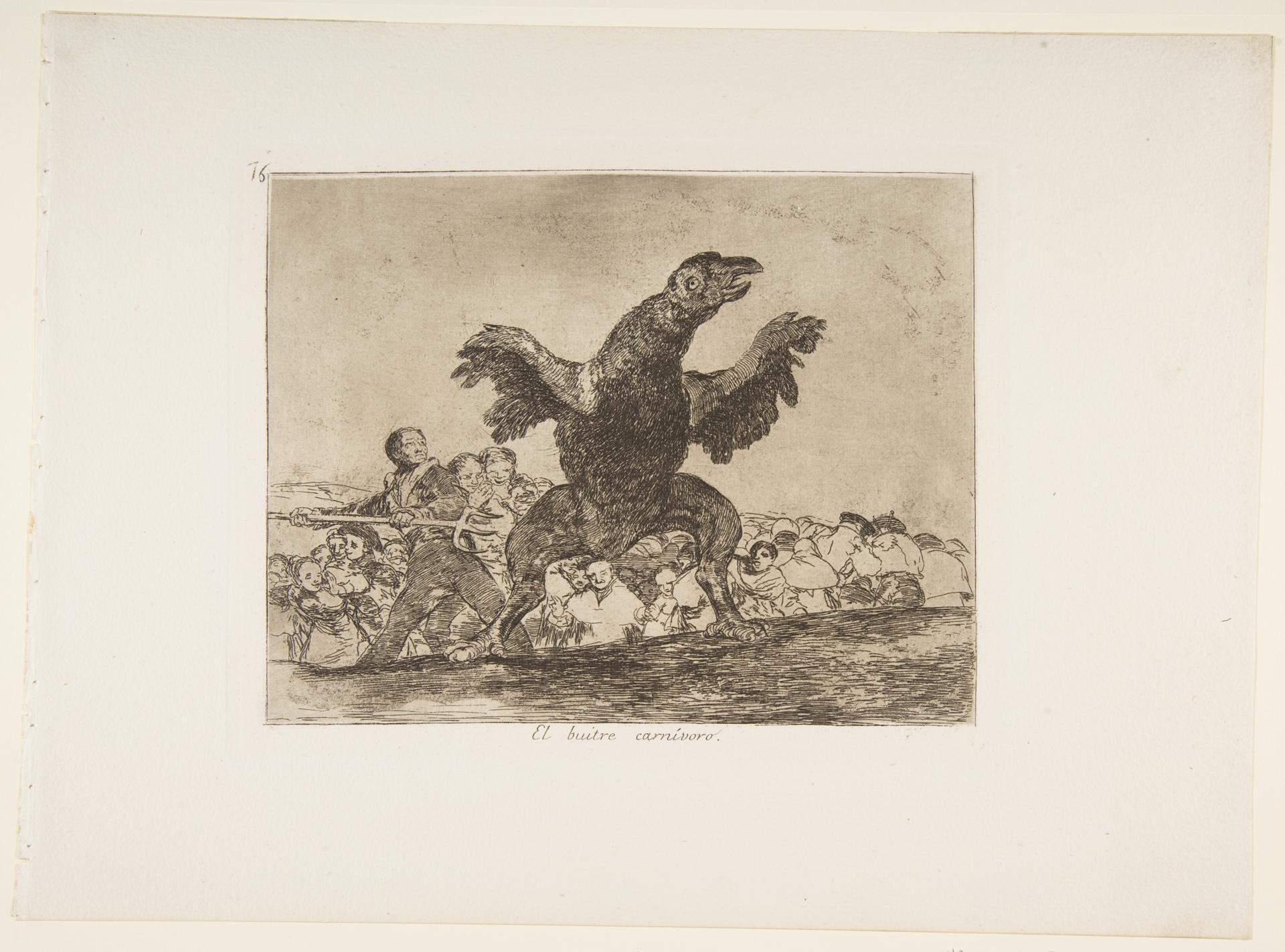
The Carnivorous Vulture
Original title: Plate 76 from "The Disasters of War" (Los Desastres de la Guerra): 'The carnivorous vulture' (El buitre carnívoro)
kurzbeschreibung
Unlike most sheets from Goya's etching series The Disasters of War (Los Desastres de la Guerra) of 1814–15, first published in 1863, this print puts a gigantic bird of prey at its centre: it crouches on a person lying on the ground, while other figures appear in a threatening environment.
Description
A large, dark vulture-like bird dominates the image. With spread wings and open beak, it presses down on the back of a person collapsing beneath it. Around them, several figures stand or lie in various poses: some look horrified, others seem to fight back or flee. A few hold rifles; their clothing suggests military or civilian status. The background remains bare and dark, making the figures stand out. The arrangement is strongly unbalanced, underlining the urgency of the event.
Context
Goya worked on the series between 1810 and 1820, in response to the Napoleonic occupation of Spain and the civil war that followed. The plates remained unpublished during his lifetime; the first edition appeared in Madrid in 1863. This sheet, plate 76, belongs to a group that interprets the consequences of war allegorically and symbolically. It was made in a phase when Goya increasingly developed pessimistic and visionary visual languages.
Impact
A menacing, oppressive mood arises from the dark tonality and the bird's aggressive posture. The unbalanced layout and contorted body positions heighten the impression of violence and exposure. Without narrative embellishment, the viewer is confronted directly with the brutality of the subject.
Technique
The print combines etching with drypoint and burin work, as well as burnishing in places. Goya used these means to achieve fine tonal gradations and deep blacks that carry the gloomy mood. The plate measures 17.3 × 22 cm, the sheet 25.2 × 34.3 cm.
AI-generated description text
Source: Metropolitan Museum of Art · Public Domain (CC0 1.0)