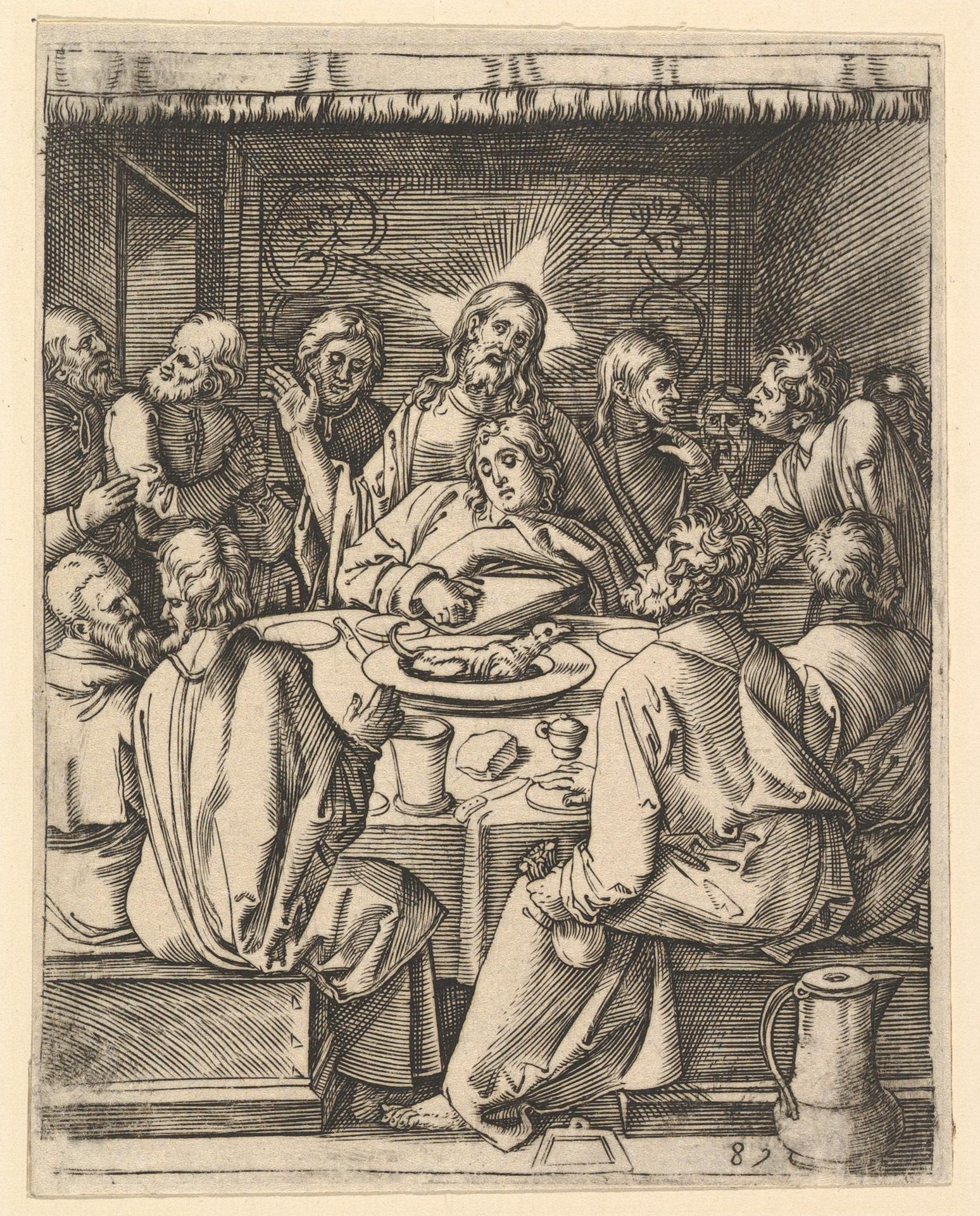
The Last Supper (ca. 1500–34)
Original title: The Last Supper; The last supper with Christ sitting in the center embracing John, from "The Passion of Christ", after Dürer
kurzbeschreibung
Marcantonio Raimondi's engraving The Last Supper, made between 1500 and 1534, stands apart from related Supper depictions because Christ draws John into an embrace while the apostles sit around the table. This impression is the second of three states and derives from a composition by Albrecht Dürer.
Description
Where most Supper images isolate Christ, Raimondi places the embrace of John at the fore, with Christ also holding a bread bowl. The disciples are distributed symmetrically around the table, their robes marked by pronounced folds and shading. A decorated window admits light from behind. The layout is strictly symmetrical, Christ as the central figure flanked by the apostles. The black-and-white reproduction brings out the precise linework and subtle gradations characteristic of the Renaissance.
Context
Marcantonio Raimondi, an Italian Renaissance engraver, is known for his reproductive prints after other artists. This sheet was made after a model by Albrecht Dürer from his series The Passion of Christ. Raimondi probably produced the engraving in the first decades of the sixteenth century in Rome, where he worked with artists such as Raphael. Prints of this kind spread artworks widely and encouraged artistic exchange between northern and southern Europe.
Impact
The calm, solemn arrangement underscores the religious meaning of the meal. Exact lines and a balanced distribution of figures create a clear, harmonious effect. Areas of light and shadow give the sheet plastic depth that draws the viewer into the event.
Technique
As an engraving, the sheet belongs to intaglio processes: lines are incised into a metal plate and then transferred with ink to paper. Raimondi used fine, parallel hatching to model shadow and volume. The present impression comes from the second state of the plate, indicating later reworking.
AI-generated description text
Source: Metropolitan Museum of Art · Public Domain (CC0 1.0)