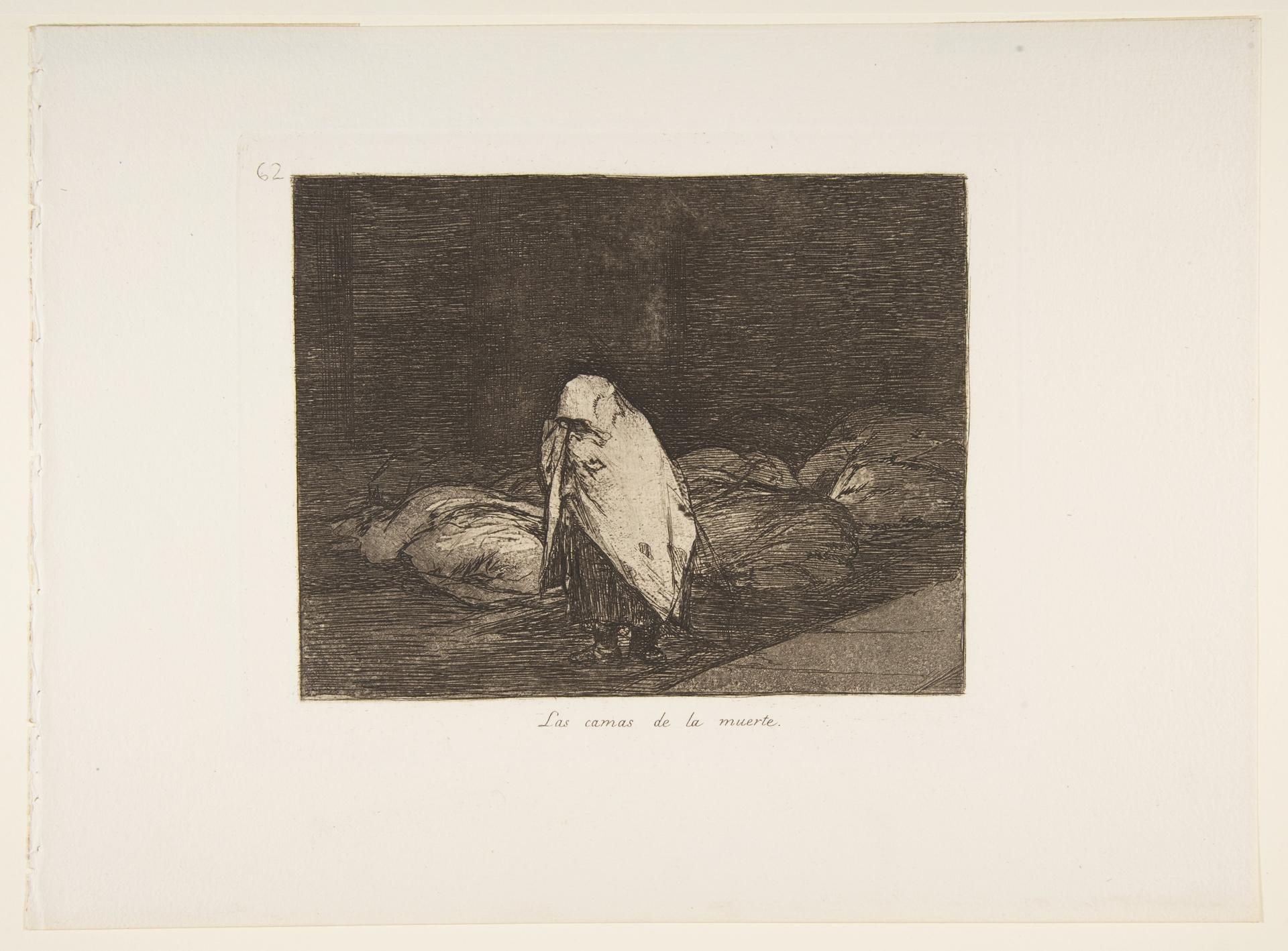
The Beds of Death
Original title: Plate 62 from "The Disasters of War" (Los Desastres de la Guerra): 'The beds of death' (Las camas de la muerte)
kurzbeschreibung
Goya's etching 'The Beds of Death' (plate 62 from 'The Disasters of War') presents a row of the deceased on simple pallets. It belongs to the works created between 1811 and 1812, but they were not published until after his death in 1863. Goya used etching, lavis, drypoint, burin, and burnisher.
Description
In the foreground lies a body shrouded in a white sheet; behind it, a row of dead on beds is partly hidden by a dark curtain. Gloomy tones dominate the composition, making grief and oppression palpable. Light falls on the white cloths, which stand out sharply against the black background. The sight feels heavy and monumental at the same time.
Context
Between 1810 and 1820, Goya responded with this series to the horrors of the Napoleonic Wars in Spain. During his lifetime, the prints remained unpublished; the first edition appeared in 1863. Plate 62 does not show a battle but the quiet victims in a makeshift hospital or death room. Goya avoids heroic exaltation and presents death as a sober, everyday reality.
Impact
The dark coloring and motionless bodies create an oppressive atmosphere. High-contrast white cloths provide accents that intensify the horror at the anonymity of death. The viewer is confronted with the raw reality of war, without Goya moralizing or becoming sentimental.
Technique
Through the interplay of etching, lavis, drypoint, burin, and burnisher, Goya achieved fine gradations of tone and deep shadows. The lavis allowed him large dark areas, while drypoint and burin provided precise lines. With the burnisher, he obtained soft transitions and highlights.
AI-generated description text
Source: Metropolitan Museum of Art · Public Domain (CC0 1.0)