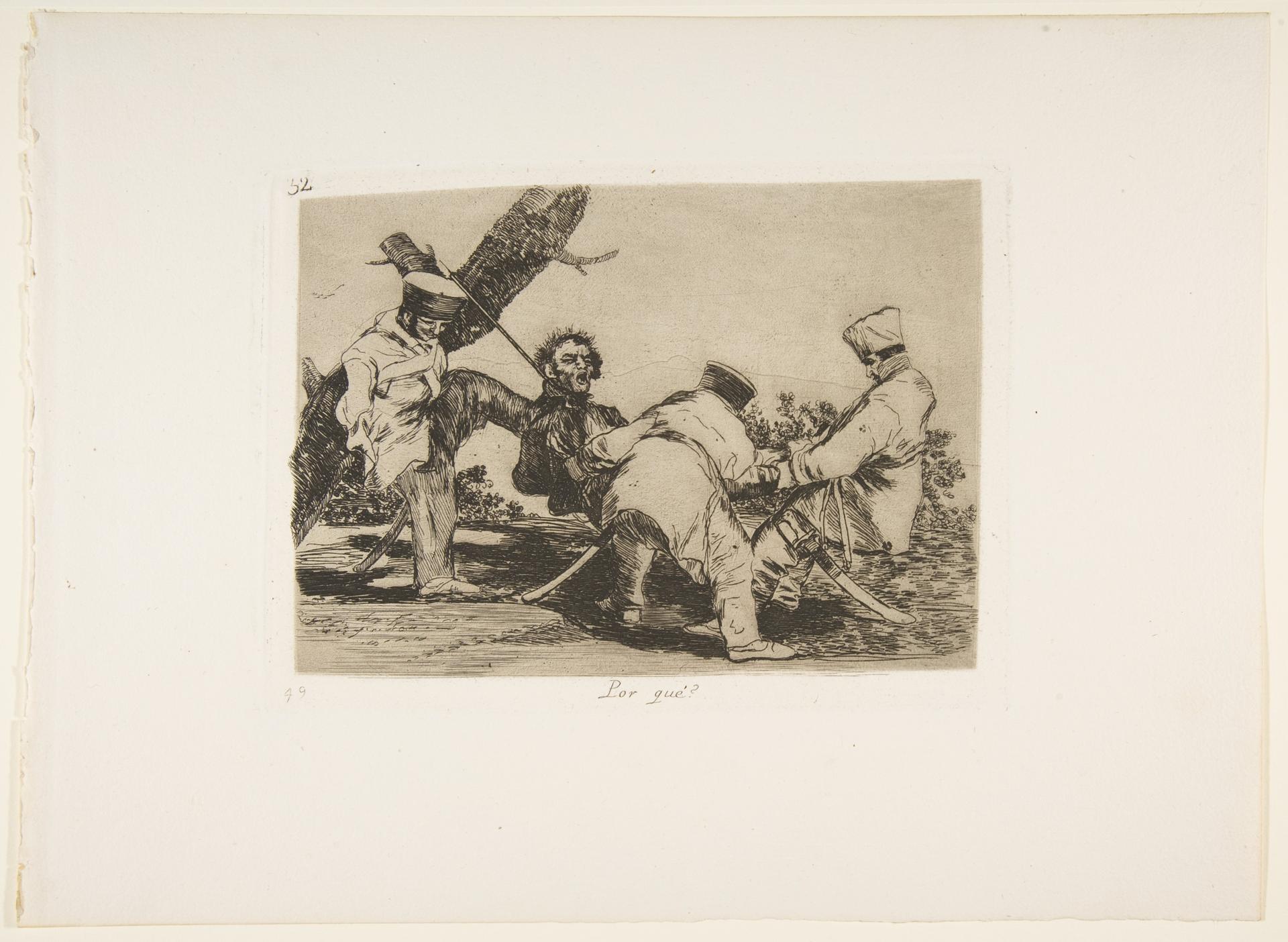
The Disasters of War (Los Desastres de la Guerra): Plate 32: 'Why?' (Por qué?)
Original title: Plate 32 from "The Disasters of War" (Los Desastres de la Guerra): 'Why?' (Por qué?)
kurzbeschreibung
Plate 32 from Francisco de Goya's etching series 'Los Desastres de la Guerra' was made in 1810 but only published in 1863. Combining etching, lavis, drypoint, burin and burnisher, it depicts an assault on a civilian by two uniformed men.
Description
Four men inhabit an open-air scene, with trees and sky closing off the top. Two uniformed figures press in on a third in civilian clothes, who crouches with his mouth open to scream. Another uniformed man stands nearby, holding a long feathered staff that resembles a sword. The bodies are in violent motion, heightening the drama. The black-and-white print shows even light that makes contours and shading stand out clearly.
Context
Between 1810 and 1820, Goya responded to the Napoleonic Wars in Spain and the subsequent restoration with the series 'Los Desastres de la Guerra'. The plates were not published until 1863, long after the artist's death, by the Real Academia de Bellas Artes de San Fernando in Madrid. Plate 32 is titled 'Por qué?' and belongs to a group of etchings dealing with the effects of violence.
Impact
The expressive faces and agitated postures immediately provoke fear and aggression in the viewer. The title 'Warum?' deepens the oppressive mood and brings the senselessness of violence into focus. Through the monochrome execution, the scene feels both documentary and timeless.
Technique
Etching, lavis, drypoint, burin and burnisher came together in this print on paper. They allowed fine transitions from light to shadow and precise lines. The plate measures 15.5 × 20.5 cm, the sheet 25 × 34.3 cm.
AI-generated description text
Source: Metropolitan Museum of Art · Public Domain (CC0 1.0)