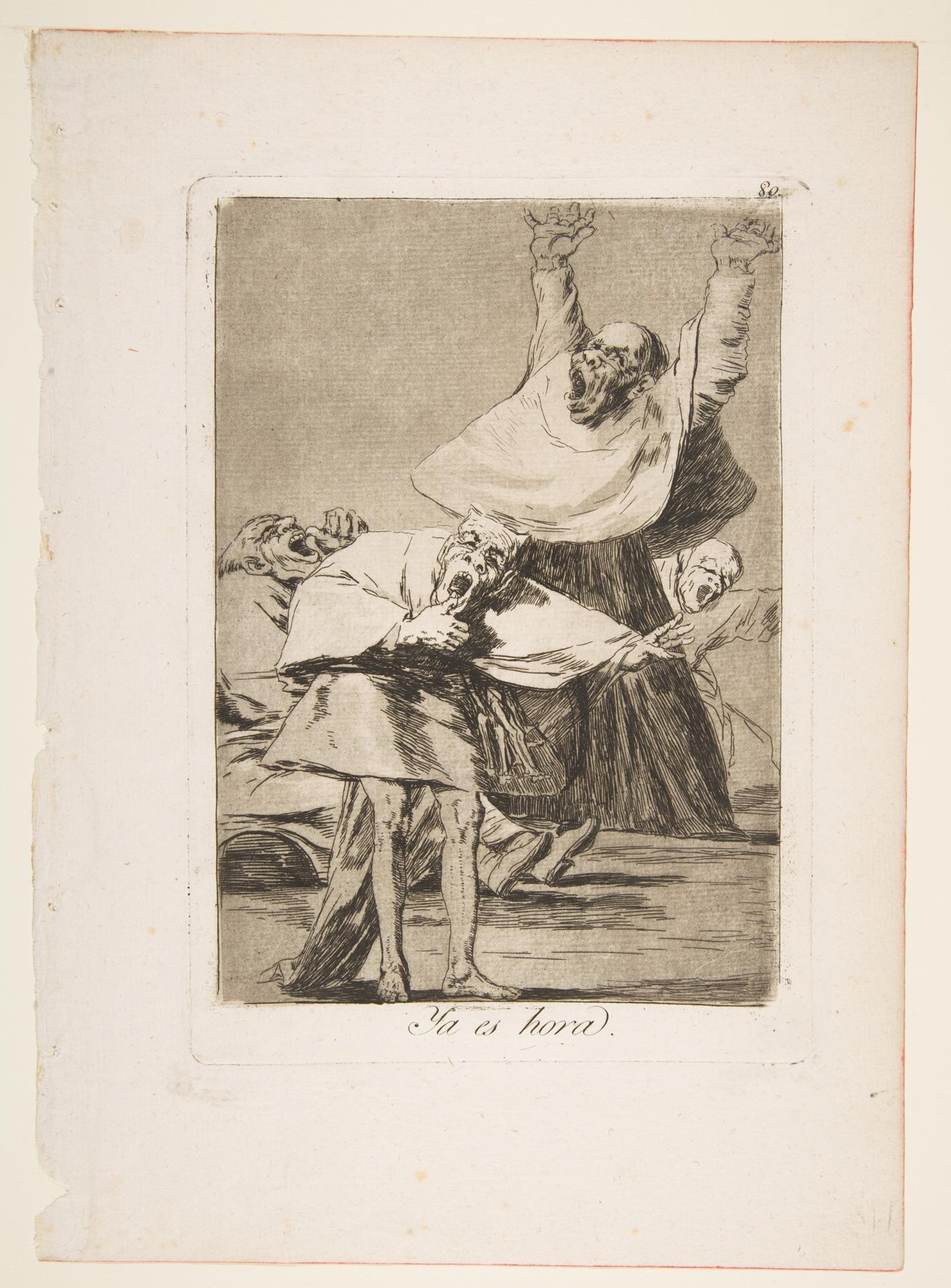
It is time (Ya es hora)
Original title: Plate 80 from "Los Caprichos": It is time (Ya es hora)
kurzbeschreibung
Created in 1799, this sheet is number 80 in Francisco Goya's series 'Los Caprichos.' An etching with burnished aquatint, drypoint, and burin, it measures 21.5 x 15.1 cm. A group of people appears in a tumultuous, dramatic moment, with a shouting, barefoot man taking the foremost plane.
Description
In front, a barefoot man in billowing robes throws both arms upward and lets out a scream; his face reflects intense agitation. Behind him, other figures crowd together, also shouting and in motion, their distorted features full of horror and despair. The dark, blurred background pushes the front figures into view. Light falls from above, highlighting shadows and outlines, while the gray tonalities result from etching and aquatint.
Context
Created in 1799 in Spain, the series 'Los Caprichos' attacks social ills, superstition, and human follies. This sheet, number 80, titled 'It Is Time,' stands at the end of the series, which grapples with reason and madness. Goya conceived the 80 prints as independent works and published them in 1799 in an edition of 300 copies. Because of their biting social criticism, the Spanish court withdrew the series shortly after its release.
Impact
The print feels immediate and disturbing because the distorted faces and the front man's expansive gestures build strong emotional tension. The contrast of light and dark heightens the gloomy, almost nightmarish mood, drawing the viewer into the action.
Technique
Goya combined etching, burnished aquatint, drypoint, and burin to achieve both delicate lines and soft shading. Aquatint allows flat gray tones, while drypoint and burin work out details like faces and surfaces precisely. The plate measures 21.5 x 15.1 cm, the sheet 29.5 x 20.9 cm.
AI-generated description text
Source: Metropolitan Museum of Art · Public Domain (CC0 1.0)