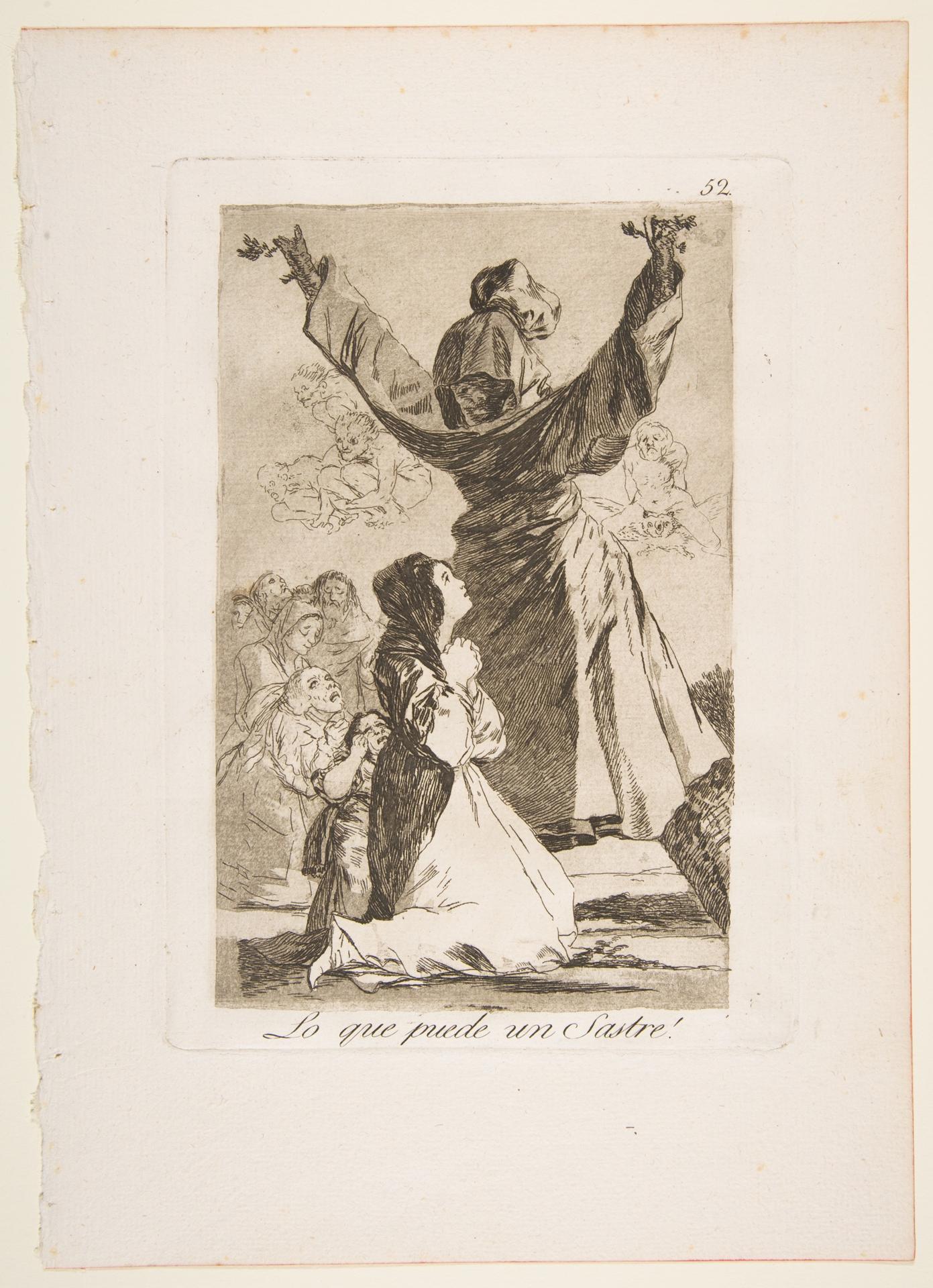
What a tailor can do! (Lo que puede un Sastre!)
Original title: Plate 52 from "Los Caprichos": What a tailor can do! (Lo que puede un Sastre!)
kurzbeschreibung
This print belongs to Francisco de Goya's etching series Los Caprichos, published in 1799. It depicts an oversized figure pointing upward with raised arms, surrounded by frightened people. The etching was executed in aquatint, drypoint, and burin.
Description
A gigantic male figure dominates the image, gesturing with both arms into the air. Around him stand women and children, smaller and clearly terrified or bewildered. Other people in the background are caught up in the event. The layout is governed by the central figure, to whom all others are oriented. The grays with their harsh shadows create a gloomy atmosphere.
Context
In 1799, the etching appeared within the series Los Caprichos, which exposes social ills and superstition with biting irony. Goya chose the medium of printmaking to criticize society and politics without directly exposing himself to censorship. The motif alludes to the power of clothing and the deceptive appearance of social conduct—a theme that runs through many of Goya's works.
Impact
The enormous figure and dark tonality evoke an oppressive, almost eerie mood. The contrast between the giant and the small, frightened people underscores the absurdity of the situation depicted.
Technique
The print was executed as an etching with burnished aquatint, drypoint, and burin. Aquatint allows fine tonal gradations, while drypoint and burin provide precise lines and shading. The paper measures 29.5 × 20.9 cm, the plate 21.3 × 15.1 cm.
AI-generated description text
Source: Metropolitan Museum of Art · Public Domain (CC0 1.0)