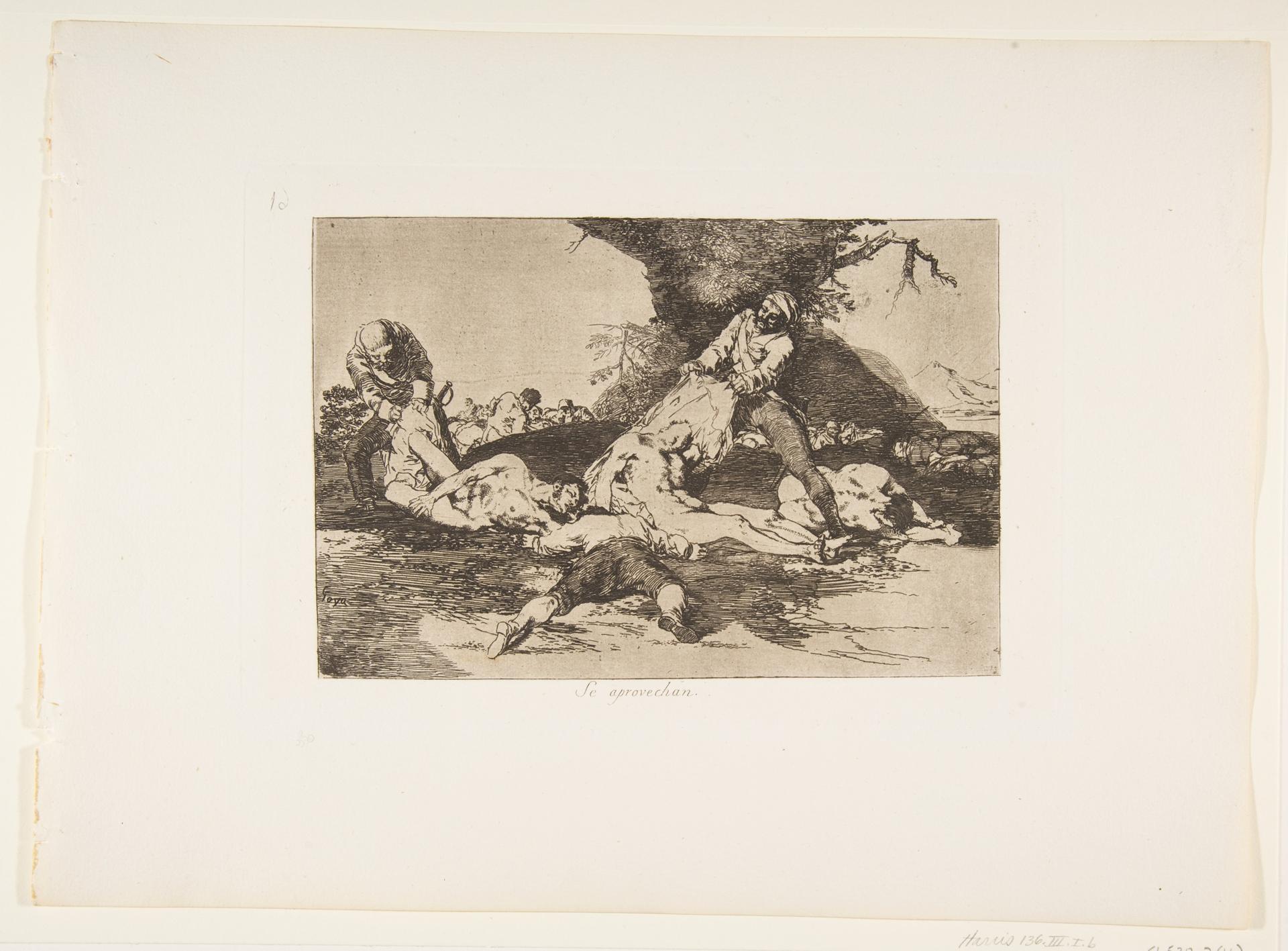
They make use of them (Se aprovechan)
Original title: Plate 16 from "The Disasters of War" (Los Desastres de La Guerra): They make use of them (Se aprovechan)
kurzbeschreibung
Francisco de Goya y Lucientes made Plate 16 of his etching series 'The Disasters of War' (Los Desastres de la Guerra) around 1810; it was not printed until 1863. The etching, enhanced with lavis, drypoint, burin, and burnisher, shows a group of people in a barren landscape bending over a man lying on the ground. At its core is an unflinching portrayal of brutality and moral insensitivity during the Spanish War of Independence.
Description
In the foreground, two figures lean over a wounded or dying man on the ground; further back, other people watch the event. The setting is a natural but joyless environment with no identifiable location. The gray tones and soft, diffuse light create an oppressive mood. The lines and hatching of the etching bring out depth and surface texture. The realistic, dramatically charged style directs attention to the contrast between the living and the dead.
Context
Between 1810 and 1820, Goya worked on the 82 plates of the series, responding to the Napoleonic Wars in Spain and the subsequent restoration. The prints remained unpublished during his lifetime; only in 1863 did the Real Academia de Bellas Artes de San Fernando in Madrid issue them. The title 'They make use of it' alludes to looting and exploitation of victims by survivors. Goya pursued the series alongside paintings such as 'The Third of May 1808' and used printmaking as a means of ruthless social critique.
Impact
The etching provokes immediate distress because it presents violence and indifference without embellishment. Dark lighting and coarse lines create a raw, urgent immediacy that does not hold the viewer at a distance. The layout forces the question of compassion and survival instinct without offering a simple answer.
Technique
For fine tonal gradations and strong contrasts, Goya combined etching with lavis (ink wash), drypoint, burin, and burnisher. The acid etching allowed him linear and flat shading, which he supplemented with the burred lines of drypoint. The plate measures 16 × 23.5 cm, the sheet 25.3 × 34.5 cm; the print was presumably reworked in several stages to intensify the gloomy atmosphere.
AI-generated description text
Source: Metropolitan Museum of Art · Public Domain (CC0 1.0)