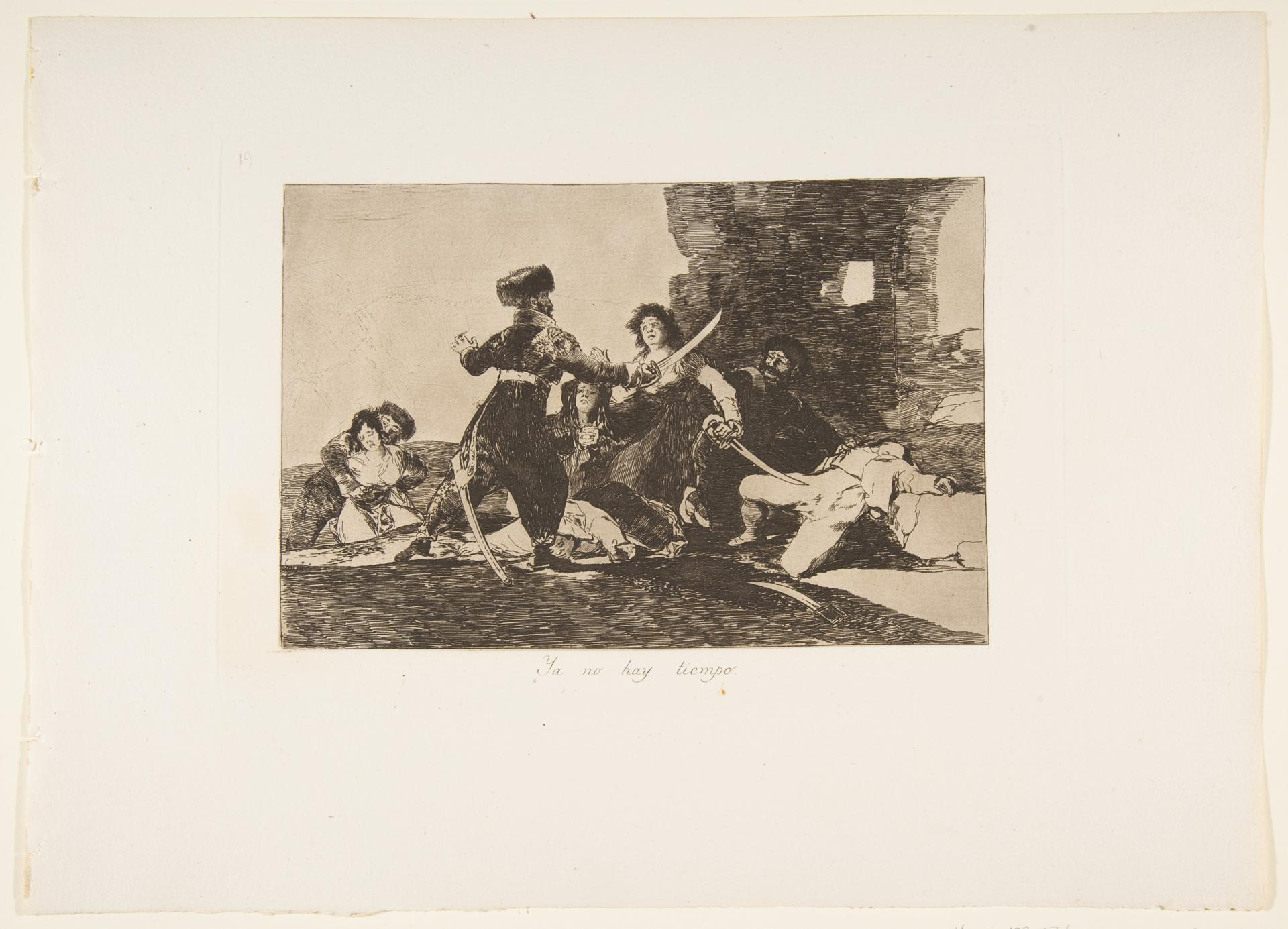
There isn't time now (Ya no hay tiempo)
Original title: Plate 19 from "The Disasters of War" (Los Desastres de la Guerra): There isn't time now (Ya no hay tiempo)
kurzbeschreibung
A soldier with a drawn sword dominates plate 19 from Goya's print series 'The Disasters of War' (ca. 1810, published 1863). Beside him stands a woman in dark clothing, her gaze full of worry directed at the threat. On the ground lies another person, while tense figures act in the surroundings. The work is executed as an etching with lavis, drypoint, burin, and burnisher.
Description
A man in military uniform holds a sword and points it at another person—whether as a threat or for protection remains ambiguous. To his right, a woman in a dark dress looks on with a sorrowful expression. More figures in contorted poses populate the background, and a man lying on the ground suggests injury or death. A damaged building frames the action. Strong, dynamic lines and diffuse light that emphasizes shadows and contours drive the intensity.
Context
Goya's etchings in this series were created during the Spanish War of Independence (1808–1814) against Napoleon. They remained unpublished during the artist's lifetime; only in 1863 did the Royal Academy of San Fernando in Madrid issue them. Plate 19 is titled 'Ya no hay tiempo' (There is no time now) and belongs to a group of works dealing with the direct consequences of violence and death. Goya drew on his own experiences and observations of the horrors of war.
Impact
A dark tonality and energetic linework create an oppressive, immediate mood. The layout conveys chaos and threat without stylizing the figures into heroes. Viewers are drawn into the horrors of war.
Technique
Etching with lavis, drypoint, burin, and burnisher on paper. The combination of etching and lavis allows fine tonal gradations and a dramatic chiaroscuro effect. Drypoint leaves strong, irregular lines that heighten the dynamism of the scene.
AI-generated description text
Source: Metropolitan Museum of Art · Public Domain (CC0 1.0)