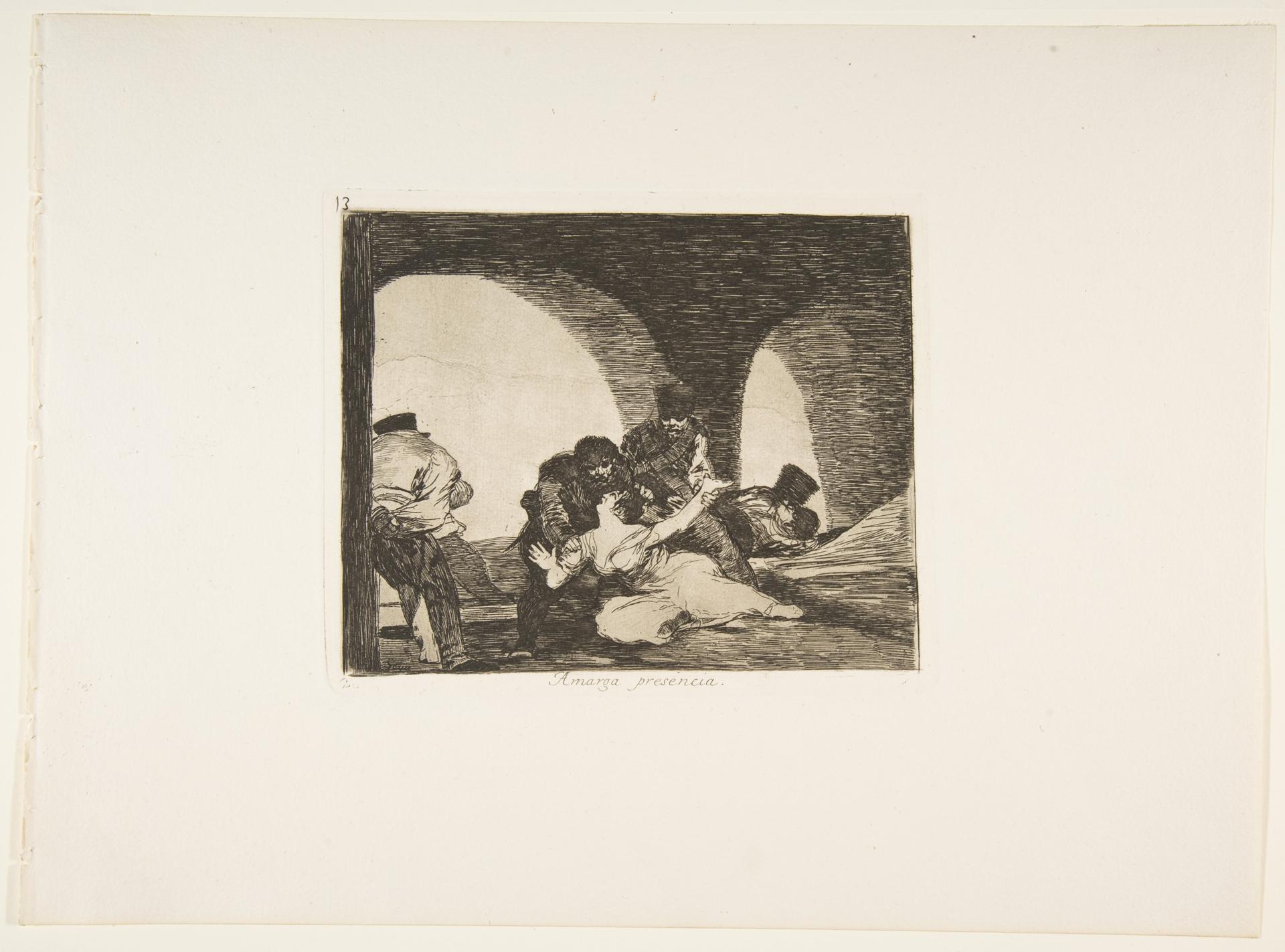
The Disasters of War: Plate 13: Bitter to be Present (Amarga presencia)
Original title: Plate 13 from "The Disasters of War" (Los Desastres de la Guerra): 'Bitter to be Present' (Amarga presencia)
kurzbeschreibung
Plate 13 from Goya's 'The Disasters of War' (Los Desastres de la Guerra), made in 1810 but not published until 1863. This etching with lavis, drypoint, burin, and burnisher depicts a crowd in a gloomy vaulted space, with a man stretched out on the ground as the focal point.
Description
A dark, subterranean room with rounded arches in the background sets the stage. A man lies on the ground, while around him others stand and move; some wear hats. The arrangement feels restless, with figures pulling in different directions. Black and gray tones dominate, and light falls sparsely from above, emphasizing shadows and outlines. Nuanced gradations and precise rendering of people and setting define the overall impression.
Context
Between 1810 and 1820, Goya created the series 'The Disasters of War' in response to the Napoleonic Wars in Spain and their aftermath. The prints were not published until 1863, long after Goya's death, by the Real Academia de San Fernando in Madrid. Plate 13 is titled 'Amarga presencia' (Bitter presence) and is one of those works that foreground the suffering of civilians. Goya, then a court painter, drew on his own experiences and reports of the war's atrocities.
Impact
The somber palette and sparse lighting evoke an oppressive, tense mood. The unsettled distribution of figures and the man lying in the middle make the suffering feel immediate, without pathos or gloss.
Technique
The print is an etching with lavis (ink wash), drypoint, burin, and burnisher on paper. These techniques allow for fine shading and subtle light and dark areas, reinforcing the gloomy effect. The plate measures 13.9 × 17.1 cm, the sheet 25.2 × 34.3 cm.
AI-generated description text
Source: Metropolitan Museum of Art · Public Domain (CC0 1.0)