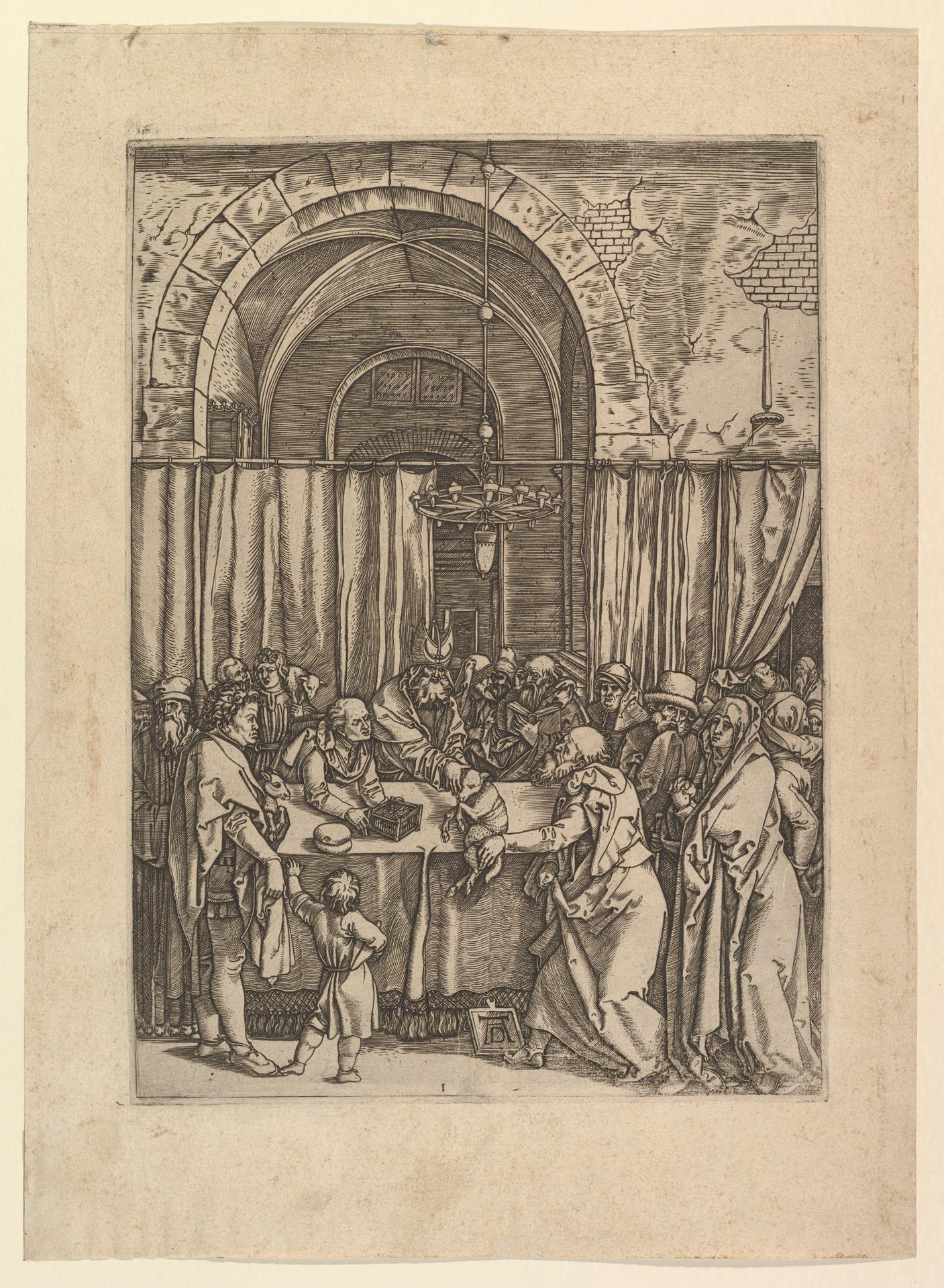
High priest refusing sacrificial lamb from Joachim, after Dürer
Original title: High priest refusing sacrificial lamb from Joachim, after Dürer
kurzbeschreibung
Joachim is refused at the temple because he is childless. This apocryphal episode from the prehistory of Mary was translated into an engraving by Marcantonio Raimondi. Made between about 1500 and 1534, the print exists in the second of two states and derives from an invention by Albrecht Dürer. It was printed in black and white.
Description
A table dominates the foreground; on it a child holds a small lamb. A man in traditional robes—the high priest—touches the child or directs his gaze at the animal. Other figures in historical dress stand around the table and take part in the religious action. Arches and curtains divide the interior, and another arch opens onto a side room. A ceiling lamp provides light, modeled entirely through fine lines and hatching.
Context
Raimondi based the work on a piece by Albrecht Dürer, likely from his Life of the Virgin cycle. The artist was known for his reproductive engravings after Dürer and other masters. The biblical account tells how Joachim was denied the offering at the temple because he had no children. The print was made during a heyday of printmaking, when engravings circulated widely.
Impact
The layout convinces through clear spatial staging and the calm, dignified posture of the figures. Raimondi's linework gives the print an almost painterly plasticity and draws the viewer into the biblical narrative.
Technique
For this engraving, lines were cut into the metal plate with a burin. The present second state shows a later reworking of the plate. It was printed on paper; the plate measures 29.3 × 21.1 cm, the sheet 37.2 × 27 cm.
AI-generated description text
Source: Metropolitan Museum of Art · Public Domain (CC0 1.0)