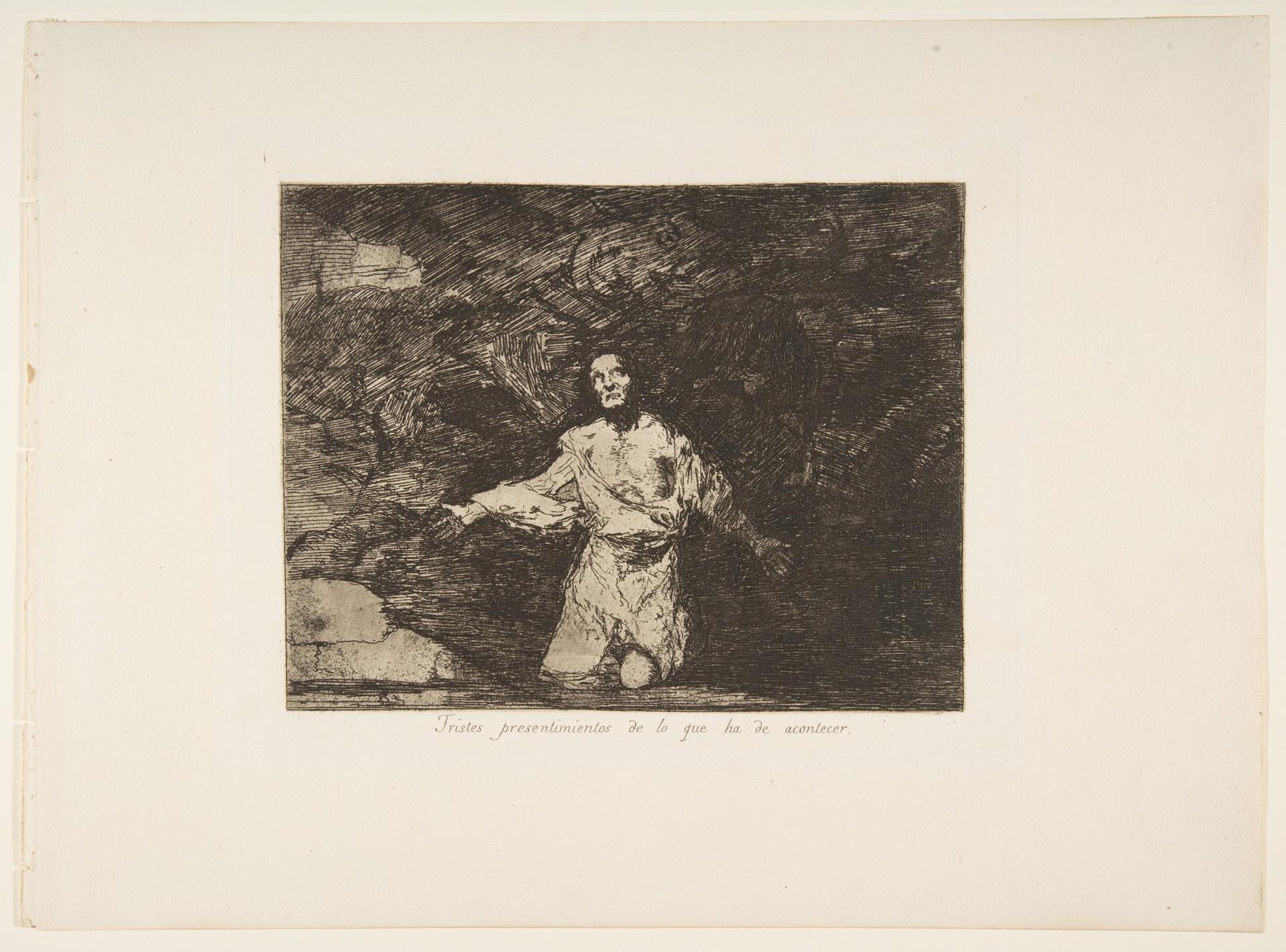
Sad forebodings of what is going to happen (Tristes presentimientos de lo que ha de acontecer)
Original title: Plate1 from "The Disasters of War" (Los Desastres de la Guerra): 'Sad foreboding of what is going to happen' (Tristes presentimientos de lo que ha de acontecer)
kurzbeschreibung
This print, 'Sad Forebodings of What Is to Come' (Tristes presentimientos de lo que ha de acontecer), opens Francisco de Goya's series 'The Disasters of War' (Los Desastres de la Guerra). It was made around 1815 and published in 1863. The etching, combined with burin, drypoint and burnisher, shows a single man in a gloomy setting.
Description
A man stands in the half-light of an almost cave-like room, dressed in simple, nearly ragged cloth, holding a cloth in his hands. His face expresses seriousness and worry, while he is positioned centrally in the foreground. Deep, almost black shading in the background suggests dirt and decay. Sparse light falls from the upper left and emphasizes the figure; otherwise the arrangement remains monochrome and dark.
Context
Between 1810 and 1820, Goya responded to the Napoleonic Wars and the Spanish War of Independence with the series 'Los Desastres de la Guerra'. 'Sad Forebodings' is the first plate of this sequence and shows a man desperately covering his eyes in the face of impending war. Only in 1863, after Goya's death, did the Royal Academy of San Fernando publish the series; during his lifetime, political reasons prevented publication.
Impact
Darkness and threat in this print hit the viewer directly. The central figure with its worried expression and the almost complete darkness around it evoke a sense of approaching catastrophe and powerlessness. The etching technique heightens this intensity through precise hatching that gives clothing and background a sculptural presence.
Technique
The plate was laid out as an etching and reworked with burin, drypoint and burnisher. This combination allowed fine lines and hatching to model shadows and textures of figure and space. The plate measures 17.5 × 21.9 cm; the print was made on a sheet of 25.2 × 34.3 cm.
AI-generated description text
Source: Metropolitan Museum of Art · Public Domain (CC0 1.0)