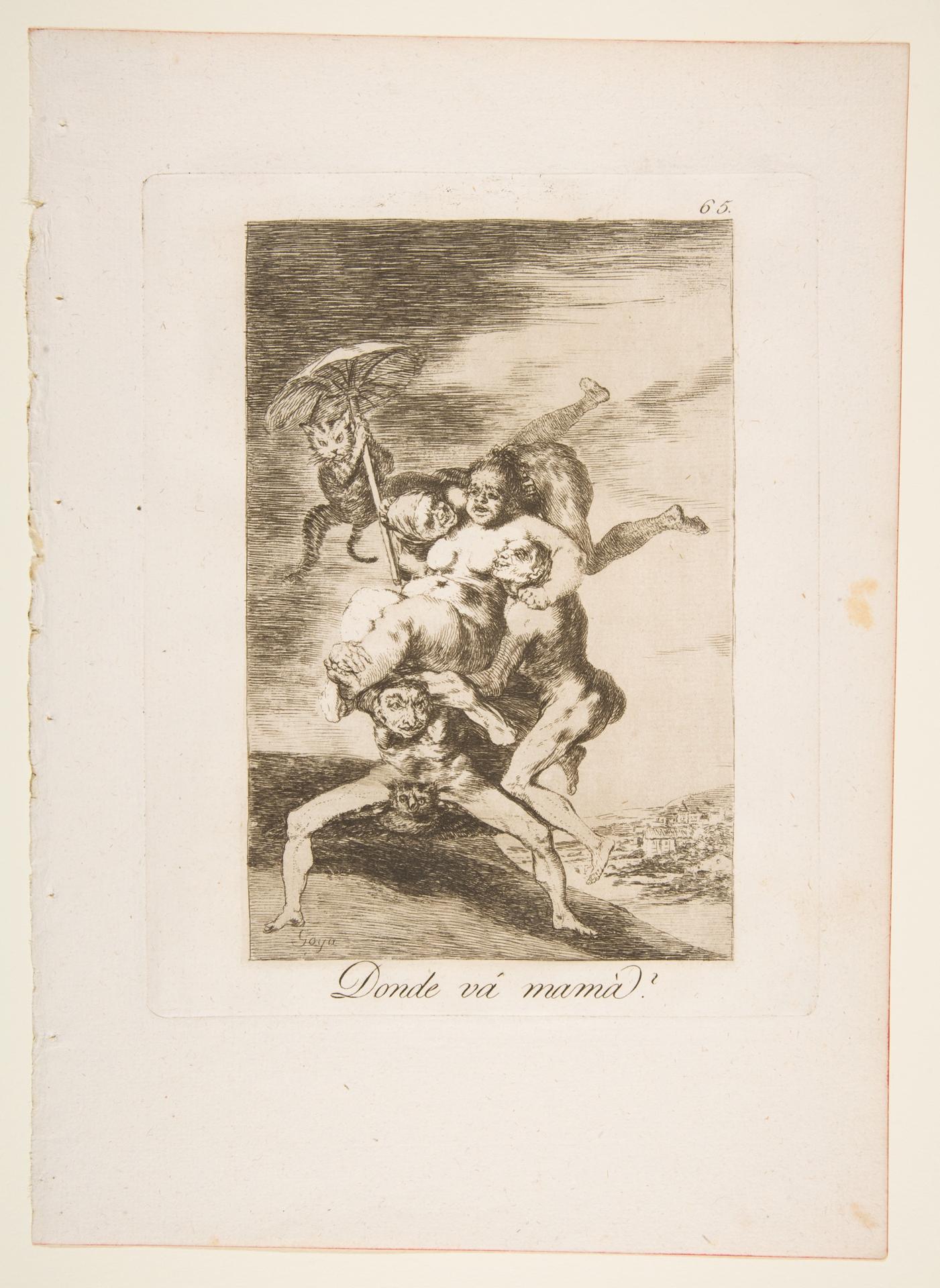
Where is mom going? (Donde vá mamá?)
Original title: Plate 65 from "Los Caprichos": Where is mom going? (Donde vá mamá?)
kurzbeschreibung
Francisco de Goya y Lucientes takes a distinctive stance within his 1799 series Los Caprichos with the plate titled "Where Is Mama Going?" (Donde vá mamá?). A chaotic jumble of figures in violent motion fills the image, rendered through a combination of etching, aquatint, and drypoint.
Description
The picture plane is packed and restless: in the foreground a man drags a naked woman, her mouth open in a scream. Close behind, a figure with an open umbrella thrusts upward, while deeper in the space more figures hurry away. Deep shadows and a predominantly dark tonality, produced by aquatint, give the scene its oppressive mood.
Context
Los Caprichos belongs to an era of political and social upheaval in Spain; in it Goya targeted superstition, folly, and social ills. The suite was published as a collection in 1799 but soon disappeared from sale because of its sharp criticism. The precise meaning of this individual plate is not reliably documented; it is often read as a mockery of recklessness and prostitution.
Impact
A sense of oppression and near-nightmare emanates from this confusion, drawing the viewer in immediately. The distorted bodies and their frantic movements have something grotesque about them, leaving one perplexed and pensive.
Technique
The plate was printed on paper from the copper plate using etching, aquatint, and drypoint. Fine tonal gradations and rich darks come from aquatint, while drypoint contributes scratchy lines that emphasize the surfaces of the figures and the nervous energy of the whole.
AI-generated description text
Source: Metropolitan Museum of Art · Public Domain (CC0 1.0)