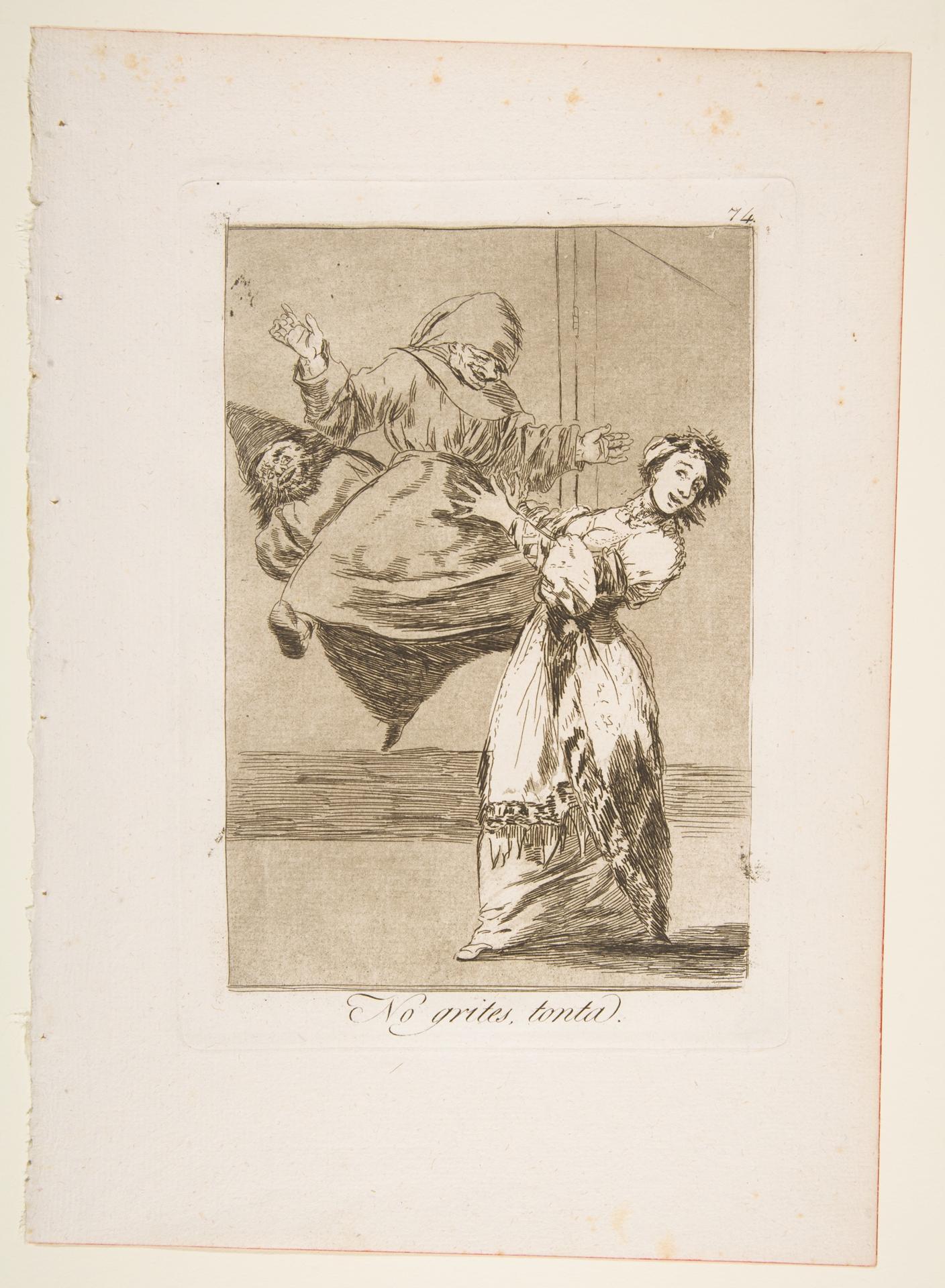
Don't scream, stupid (No grites, tonta)
Original title: Plate 74 from "Los Caprichos": Don't scream, stupid (No grites, tonta)
kurzbeschreibung
This sheet, titled "Don't shout, you fool" (No grites, tonta), belongs to Francisco de Goya's eighty-part etching series "Los Caprichos," published in 1799. Made as a drypoint etching with burnished aquatint, it presents a threatening encounter between two figures. Like the rest of the series, the print takes aim at human folly and social ills.
Description
A woman in a long, pale grey dress leans away, arms raised to fend something off, while a second person steps up from behind and reaches for her. She looks anxious and tries to shield herself; the other figure adopts an intrusive, intimidating stance. The background stays dark and bare, heightening the tension of the meeting. Grey tones and dim light give the whole a sombre, strained mood. The arrangement is restless and built entirely around the confrontation between the two figures.
Context
"Los Caprichos" appeared in 1799, during a period of political and social upheaval in Spain under Charles IV. Goya worked into it his critical view of superstition, church power and human stupidity. The seventy-fourth plate counts among the later works of the cycle, where violence and oppression come forward more strongly. Goya offered the series as a collected set but withdrew it from sale shortly after publication, presumably because of its biting criticism of the nobility and clergy.
Impact
The dark field and the menacing posture of the rear figure create immediate tension. The viewer is pulled into the action and feels the woman's vulnerability. Because so few elements are present, the emotional force hits all the harder; the sheet becomes a piercing comment on assault and powerlessness.
Technique
Goya combined drypoint etching with burnished aquatint to bring fine lines and soft tonal gradations together. Aquatint allowed him flat areas of grey, which he lightened in places with a burnisher. The print was pulled on paper measuring 29.5 × 20.8 cm; the plate itself measures 21.2 × 14.9 cm.
AI-generated description text
Source: Metropolitan Museum of Art · Public Domain (CC0 1.0)