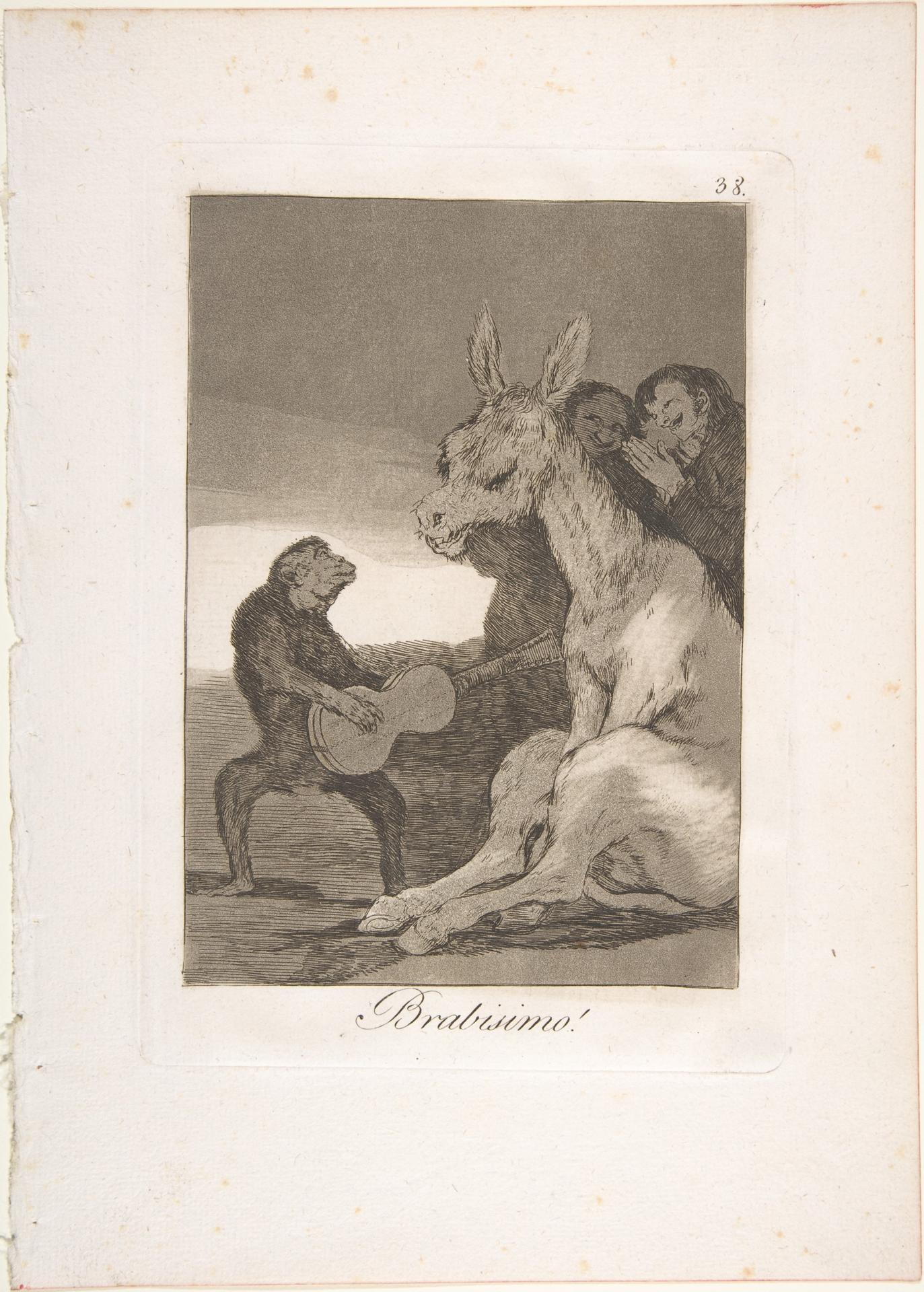
Bravo! (Brabisimo!)
Original title: Plate 38 from "Los Caprichos": Bravo! (Brabisimo!)
kurzbeschreibung
Two ape-like figures ride a donkey while one plucks a guitar. This motif comes from Francisco de Goya's print series Los Caprichos, plate 38, dated 1799. The technique combines etching, aquatint, and drypoint. The satirical sheet belongs to Goya's famous graphic series, where social critique and visual wit meet.
Description
Two human-like apes sit on a donkey, one playing a guitar. Three figures populate the scene, set in a barren, reduced landscape. Harsh hatching and a mostly gray tonal palette dominate the impression, while diffuse light deepens the somber mood. At the bottom, the title "Brabisimo!" appears in elegant typography, and at the upper right is the number "38". The drawing of the figures feels realistic, yet the stylization lends them a comic edge.
Context
Created between 1797 and 1799, Los Caprichos was published in 1799 as a series of 80 etchings. Goya used printmaking to denounce social ills, superstition, and the follies of Spanish society. Plate 38 likely mocks the admiration of stupidity or uncritical praise. Within Goya's development, the series marks a turning point toward a freer, more subjective visual language.
Impact
Between satire and menace, an ambivalent mood arises. The ape-like figures seem grotesque and amusing at once, while the dark etching adds a serious undertone. Humor and a gloomy aesthetic combine, making this sheet a prime example of Goya's ability to fuse social critique with artistic ambiguity.
Technique
Goya combined etching, burnished aquatint, and drypoint. Aquatint produces fine gray tones and soft transitions, while drypoint sets bold, dark lines. The plate measures 21.4 × 15 cm and was printed on a sheet of 29.5 × 21 cm.
AI-generated description text
Source: Metropolitan Museum of Art · Public Domain (CC0 1.0)