Underweysung der Messung (Nuremberg, 1538)
Original title: Underweysung der Messung (Nuremberg, 1538)
kurzbeschreibung
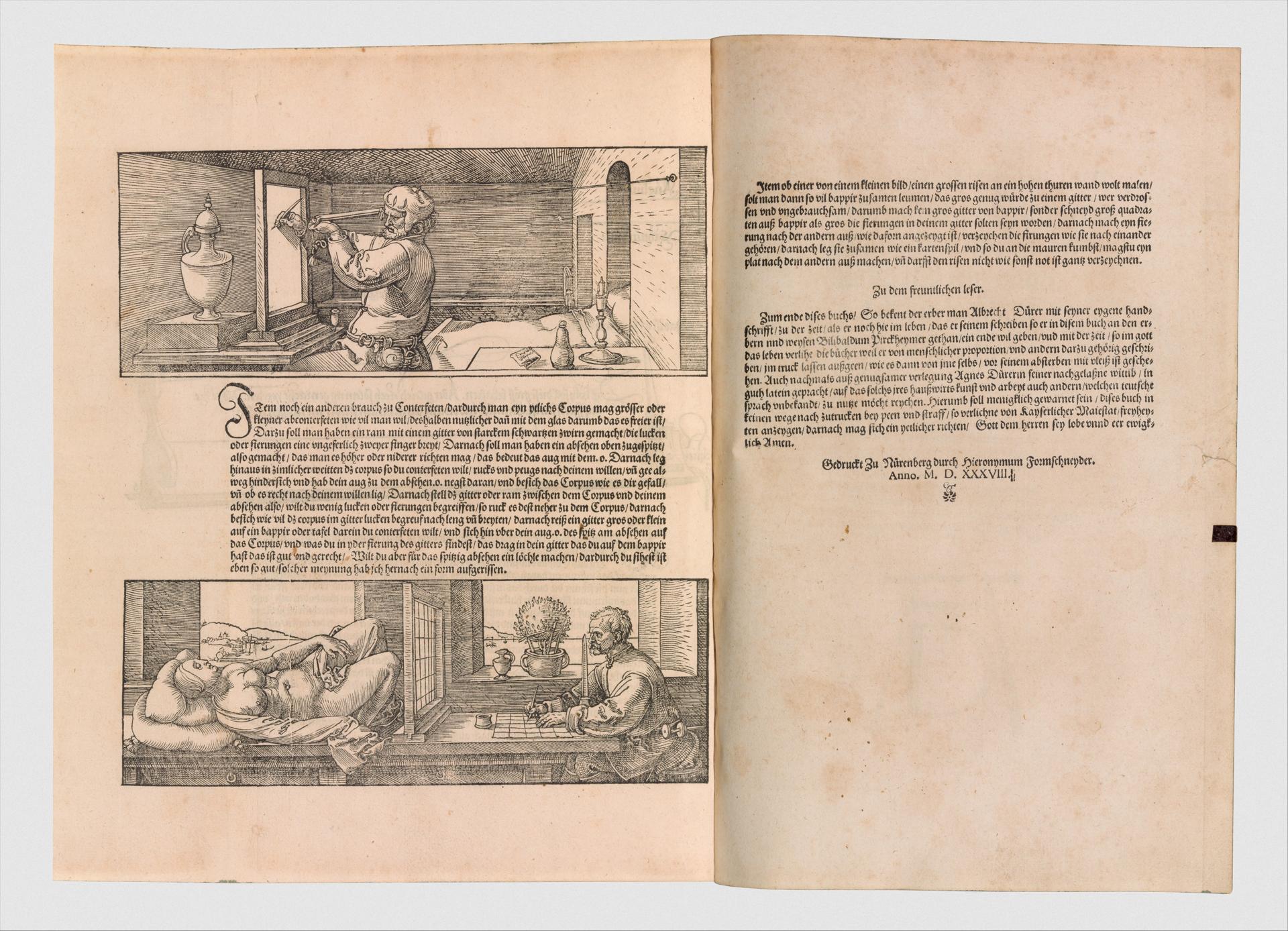
This is a page spread from Albrecht Dürer's Underweysung der Messung (Nuremberg, 1538), a treatise on measurement and perspective. The woodcuts illustrate practical methods for drawing and measuring, featuring figures in interior settings. The work, first published in 1525, was revised and reissued in 1538.
Description
The left woodcut shows a man seated at a table, using a ruler to measure an object, with a vessel and bottle beside him. The room is sparse, featuring a wall and a window that opens onto a landscape with trees and a river. The right woodcut depicts two figures: one reclining on a bench, the other standing and measuring something in a vessel. The scene shares the same simple interior with a window and landscape view. Both pages include text blocks that provide instructions or commentary on the illustrations.
Context
Dürer wrote Underweysung der Messung as a practical guide for artists and craftsmen, covering geometry, perspective, and proportion. It was one of the first printed works to systematically present these subjects in a vernacular language. The 1538 edition was published posthumously, as Dürer died in 1528, and includes revisions and additions made by the artist before his death. The book reflects Renaissance efforts to merge artistic practice with mathematical theory.
Impact
The woodcuts combine instructional clarity with a sense of quiet, orderly domesticity. The figures are engaged in focused, methodical tasks, reinforcing the idea that measurement is a calm, rational discipline. The open windows with landscape views add a contemplative dimension, suggesting a connection between the interior world of study and the natural world outside.
Technique
The illustrations are woodcuts, a relief printing technique that Dürer mastered. The sharp, clean contours and detailed hatching are characteristic of his mature graphic style. The prints are in black ink on white paper, with even lighting and no visible shadows, typical of the medium's linear, graphic quality.
AI-generated description text
Source: Metropolitan Museum of Art · Public domain (CC0)