To rise and to fall (Subir y bajar) (1799, Met-Objekt 1550)
Original title: Plate 56 from "Los Caprichos": To rise and to fall (Subir y bajar)
kurzbeschreibung
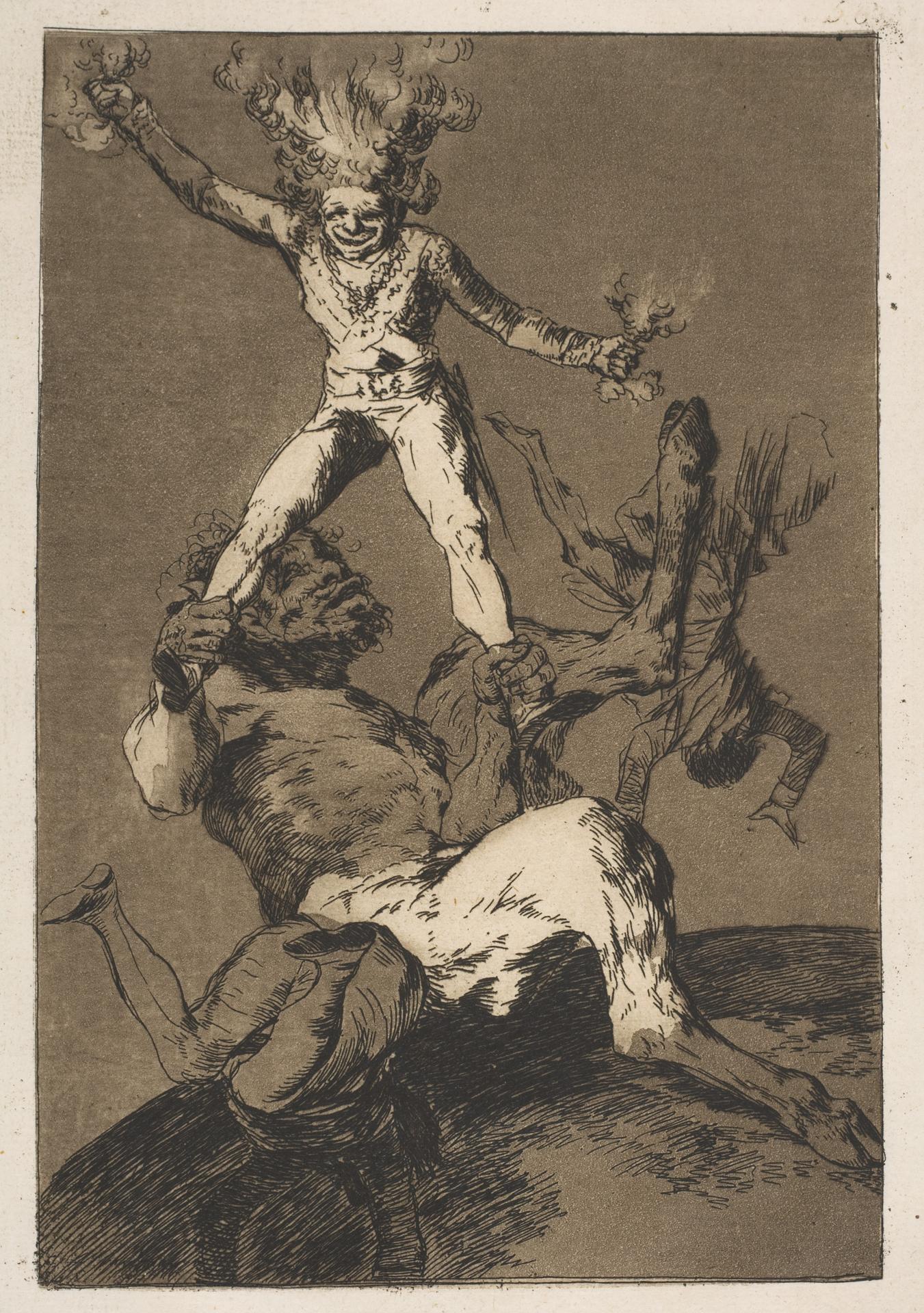
A man stands in the foreground of plate 56 from Francisco de Goya's 1799 series Los Caprichos, arms thrown up in triumph and hair bristling upward. Behind him lies a dead cow, and beside it a smaller, fallen fragment of a figure. The print combines line etching with burnished aquatint.
Description
Up front a man acts out a forceful pose, both arms yanked high, his face carrying an expressive, almost smiling cast. His hair takes on a striking, nearly flag-like shape that seems lifted along by the arms. A tight shirt and trousers stress his muscular build, and the legs are drawn in an energetic, restless stance. Toward the back a dead cow lies on its back, next to it a smaller, darker fragment of a figure in a toppled position. The layout is asymmetrical: the main motif in front, the fallen piece behind. The figures stay strongly sketch-like, worked out in hatching.
Context
Goya published Los Caprichos in 1799 as an album of 80 etchings. The series lashes out at social ills, superstition, and human folly in late eighteenth-century Spain. Plate 56 belongs among the Caprichos that set ascent against downfall without offering a clear moral lesson. Shortly after publication the series was withdrawn from sale, probably because of its sharp criticism of the nobility and clergy.
Impact
A tense ambivalence between triumph and collapse speaks from the image, sharpened by the high-contrast arrangement. The sketchy linework and the dark aquatint tones give the scene something unsettling, almost grotesque. The protagonist's unusual hair reads as surreal and draws attention to the motif of rearing up against gravity.
Technique
The plate was made as an etching with burnished aquatint, a process in which resin powder is applied to the plate and partly etched away to achieve fine tonal gradations. Distinct hatching defines the figures and emphasizes texture and movement. The monochrome palette of various grays results from combining line etching and aquatint on the paper.
AI-generated description text
Source: Metropolitan Museum of Art · Public Domain (CC0 1.0)