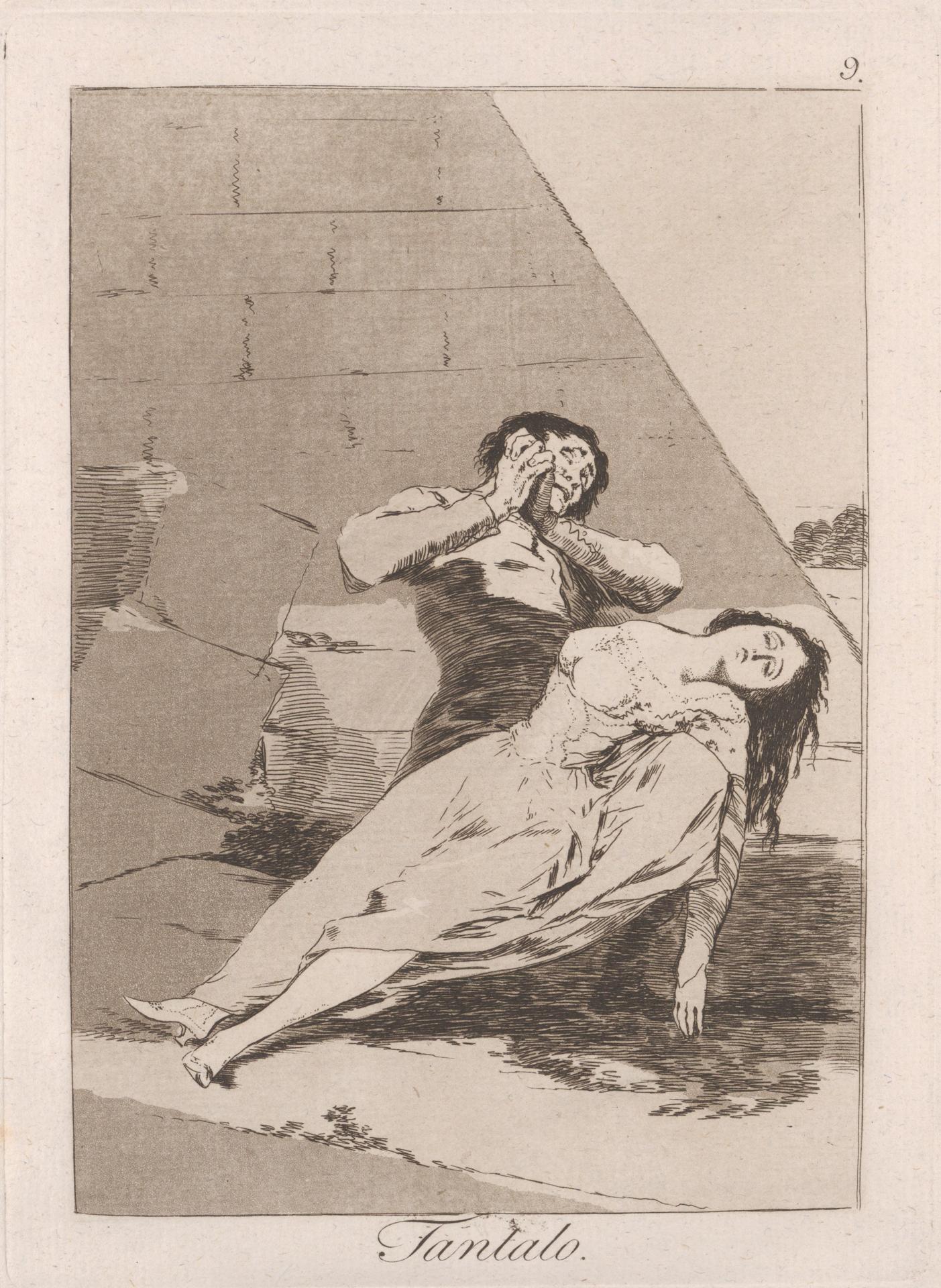
Tantalus (Tantalo)
Original title: Plate 9 from "Los Caprichos": Tantalus (Tantalo)
kurzbeschreibung
Unlike many plates in Los Caprichos that parade grotesque figures or dream creatures, Goya's Tantalus of 1799 foregrounds quiet physical suffering: a man digs his hands into his cheeks, while a motionless woman lies beside him. The etching with burnished aquatint measures 20.5 × 14.9 cm (plate).
Description
A man presses both hands to his cheeks, as if to hold back pain. Beside him on the ground, a female figure lies without movement, perhaps unconscious. Both wear traditional garments. The space remains bare; a step or pyramid shape hints and leads back. The scant light falls on the bodies, sharpening the contrast between bright areas and deep shadows.
Context
Published in Madrid in 1799, Los Caprichos ranks among the key works of the Spanish Enlightenment. In it, Goya settles accounts with social ills, superstition, and human folly. The motif of Tantalus refers to the ancient myth: in the underworld, Tantalos suffers eternal hunger and thirst. Goya transfers this torment to conditions he observed in his own society—hopelessness and suffering.
Impact
An oppressive, almost surreal mood hangs over the plate and draws the viewer into the figure's pain. Realistic details and symbolic elevation combine to give the work an immediate, timeless intensity.
Technique
Made in etching with burnished aquatint, the process allows fine tonal gradations and soft transitions. Goya used it to achieve harsh light-dark contrasts and to make the figures stand out plastically. The plate measures 20.5 × 14.9 cm, the sheet 29.4 × 21.1 cm.
AI-generated description text
Source: Metropolitan Museum of Art · Public Domain (CC0 1.0)