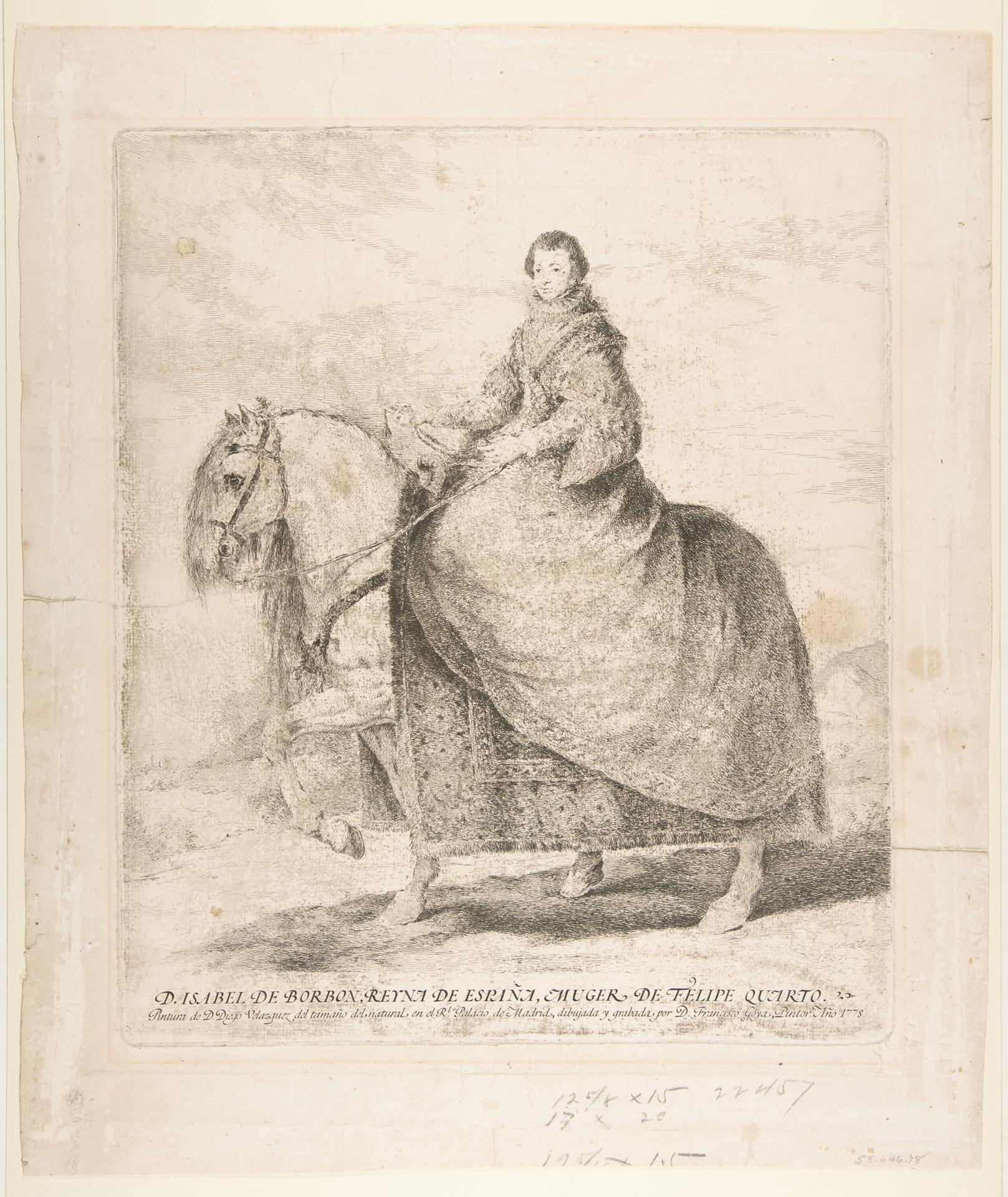
Isabel of Bourbon, Queen of Spain on horseback, after Veláquez
Original title: Isabel of Bourbon, Queen of Spain on horseback, after Veláquez
kurzbeschreibung
In 1778, Francisco de Goya produced this etching after a painting by Diego Velázquez. It portrays Isabella of Bourbon, depicted as Queen of Spain on horseback. The work was executed using the etching technique.
Description
Upright in the saddle of a motionless horse, the queen forms the center of the image. She wears a long-sleeved, fur-trimmed robe; her expression is serious and introspective. A plain, flat landscape with scattered trees forms the background. Black-and-white tonal values, nuanced grays, and precise linework define the print.
Context
This etching was made in 1778 as a reproduction after a painting by Diego Velázquez. The original shows Isabella of Bourbon (1602–1644), wife of Philip IV. During this period, Goya engaged closely with Velázquez's oeuvre, which he copied for the royal court. This print belongs to a series of etchings Goya created after works by Velázquez.
Impact
The queen appears calm and dignified, emphasized by the symmetrical layout and subtle shading. The sparse landscape and serious facial expression draw attention to the figure and give her a majestic presence.
Technique
This etching is an intaglio process in which the drawing is incised into a metal plate and then etched with acid. Goya used this technique to achieve fine lines and graduated gray tones, resulting in a detailed translation of the original painting.
AI-generated description text
Source: Metropolitan Museum of Art · Public Domain (CC0 1.0)