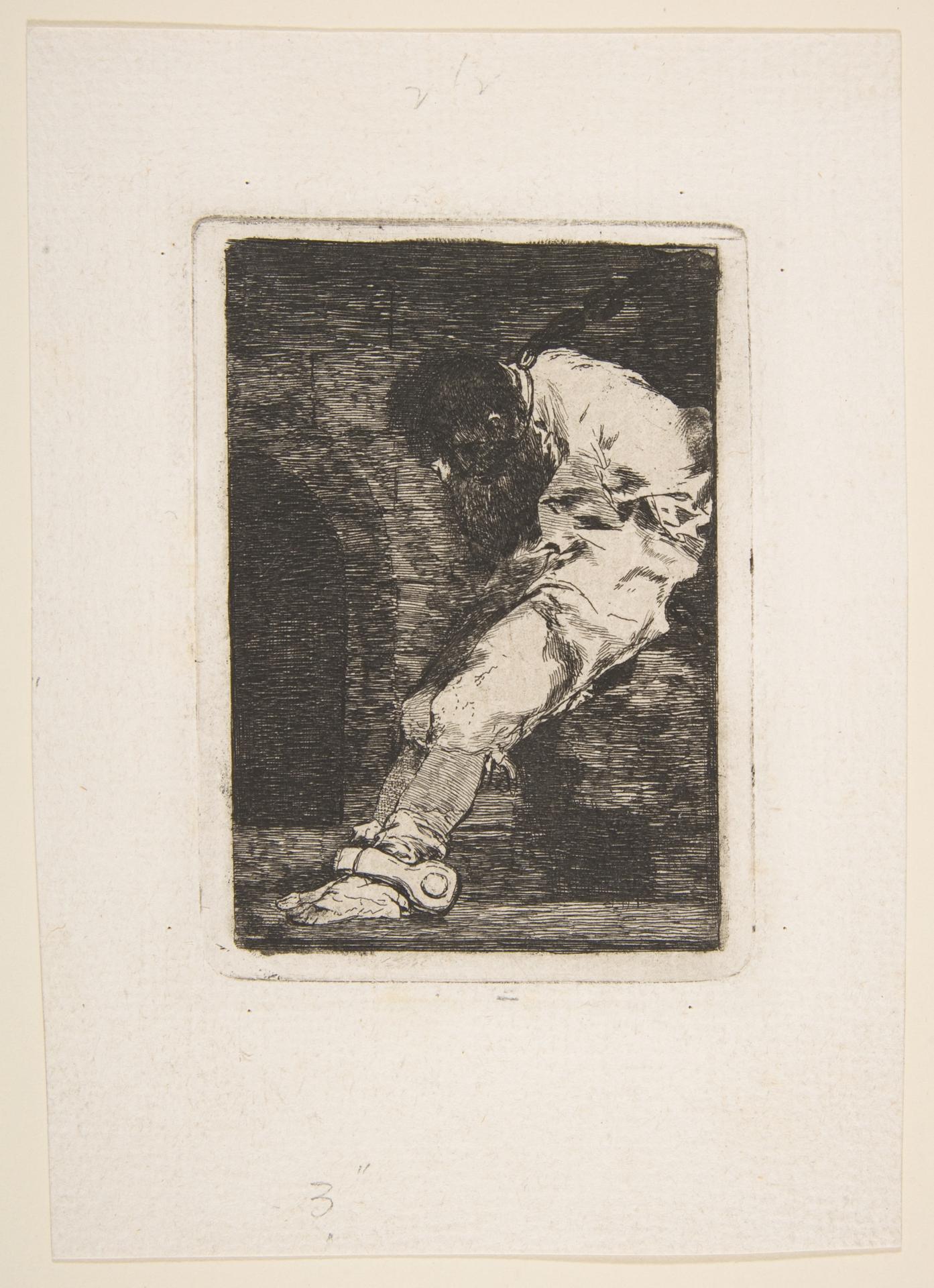
If he is guilty, let him die quickly (Si es deliquente qe, muera presto)
Original title: If he is guilty, let him die quickly (Si es deliquente qe, muera presto)
kurzbeschreibung
Unlike many war pictures that parade battles or marching columns, this print turns its full attention to one prisoner. 'Si es deliquente qe, muera presto' belongs to Goya's 'Desastres de la guerra,' etched around 1815 but not printed until about 1859. The image lays bare the harshness and arbitrariness of wartime justice.
Description
A man leans against a bare wall, his head tipped back, arms folded across his chest. He wears a plain shirt and trousers buttoned at the knees; his feet rest on the naked ground. The arrangement pulls everything toward the middle, and the figure dominates the sheet while a subdued light falls on him, underscoring his isolation. Dense, biting lines in monochrome greys give the view its structure and depth.
Context
This subject comes from Goya's series 'Desastres de la guerra,' which between 1810 and 1820 addressed the horrors of the Spanish War of Independence and its aftermath. The etching was first published in 1863, long after Goya's death, by the Real Academia de Bellas Artes de San Fernando in Madrid. The title points to the summary justice to which countless civilians and prisoners were subjected. Goya conceived the series as a personal indictment of violence and inhumanity, without a patron and with no thought of immediate publication.
Impact
A crushing mood of hopelessness hangs over the picture. The central figure seems utterly alone and resigned, stirring compassion and reflection in the viewer. The barren setting and the directed light heighten the emotional force of the sheet.
Technique
This work is an etching on paper: a metal plate was bitten with acid to create the lines. Goya used dense, sharp hatching to build shadow and texture, as is characteristic of his late graphic work. The impressions were pulled posthumously around 1859, which reveals the technical condition of the printing plate.
AI-generated description text
Source: Metropolitan Museum of Art · Public Domain (CC0 1.0)