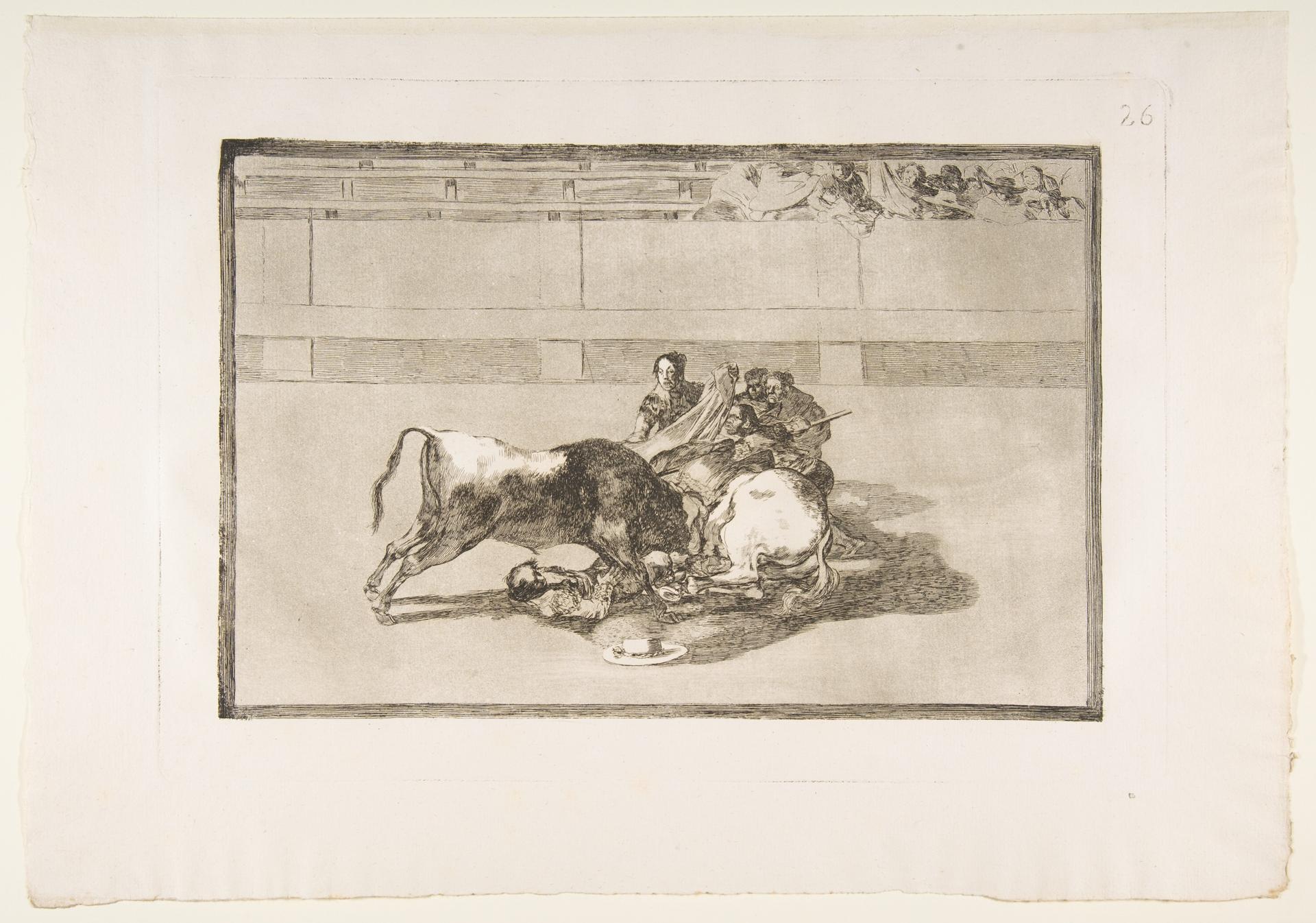
Plate 26 from 'La Tauromaquia': A picador is unhorsed and falls under the bull
Original title: Plate 26 from "La Tauromaquia": A picador is unhorsed and falls under the bull
kurzbeschreibung
Francisco de Goya y Lucientes gives over the 26th plate of his etching series 'La Tauromaquia', made in 1816, to a fall: a picador is thrown to the ground by a bull. The subject is worked in etching, burnished aquatint and drypoint. It belongs among the 33 scenes of Spanish bullfighting gathered in the series.
Description
A bull dominates the foreground, its body in violent motion, carrying a picador on its back while a second bull attacks. The picador lies on the ground, the horse is left out entirely, and everything is concentrated on the instant of the fall. On a stand in the background spectators can be made out following the action. The layout feels asymmetrical, with the bull and the fallen man forming the weight of the image; sharp contours and precisely placed shadows define the view.
Context
Between 1814 and 1816 Goya worked on 'La Tauromaquia', in the years after the Spanish War of Independence, when his view of violence and human cruelty grew steadily more critical. The series appeared in Madrid in 1816 and brings together historical as well as contemporary scenes of bullfighting. Plate 26 joins those prints that stress the danger and the victims of the fight, a theme that recurs in other works by Goya too. These etchings fall in a phase when the artist turned away from court painting and toward graphic work.
Impact
Immediate drama arises from the bull's agitated posture and the picador's hopeless position. The greys stay restrained, and the strong contrasts heighten the sense of menace. Looking at the print, one is placed in the middle of the bullfight's turmoil, with no heroic elevation offered.
Technique
The plate was printed as an etching with burnished aquatint and drypoint on paper. Fine gradations of grey come from the aquatint, while the drypoint contributes strong, dark lines. The interplay of the two techniques yields a nuanced rendering of light and shadow that carries the intensity of the subject.
AI-generated description text
Source: Metropolitan Museum of Art · Public Domain (CC0 1.0)