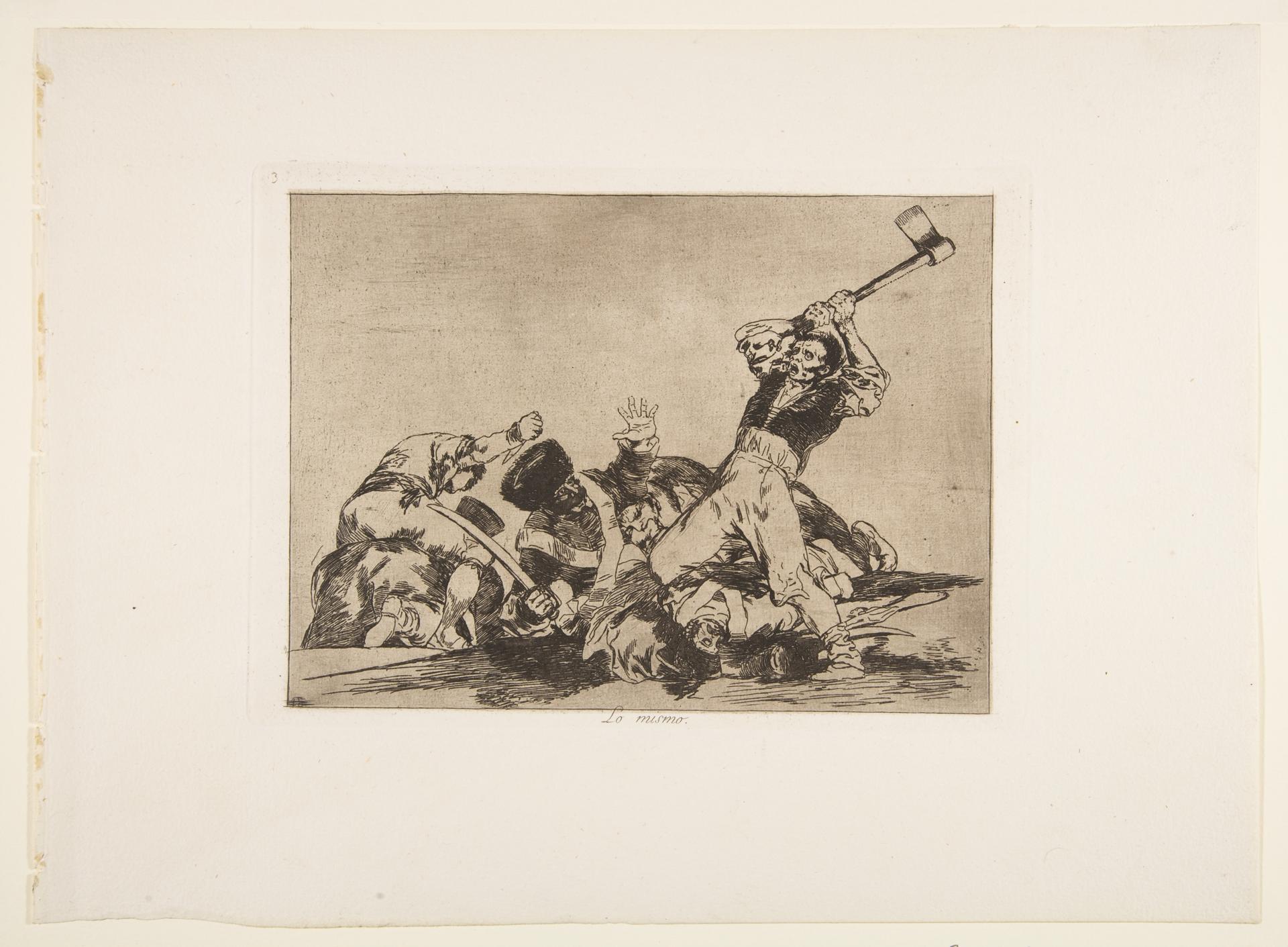
The Disasters of War, Plate 3: The same (Lo mismo)
Original title: Plate 3 from "The Disasters of War" (Los Desastres de la Guerra): 'The same' (Lo mismo)
kurzbeschreibung
This print belongs to Francisco de Goya's etching series 'The Disasters of War,' created in 1810 and published posthumously in 1863. Executed with lavis, drypoint, burin, and burnisher, the image presents an act of violence: a man raises a hammer to strike someone lying on the ground.
Description
Your eye is pulled straight into a tangle of bodies. At the front, a figure swings a hammer down on a fallen man who tries to fend off the blow. Around them lie others, some still, some twisted. The arrangement drives everything toward the center, where the bodies collide. Gray tones and a flat, almost shadowless light deepen the somber mood.
Context
Made between 1810 and 1820, the series responds to the Napoleonic wars in Spain and the restoration that followed. During Goya's lifetime the plates stayed unpublished; they appeared only in 1863 under the title 'Los Desastres de la Guerra.' This print carries the caption 'Lo mismo' (The same), pointing to the repetition of violence. The cycle stands as a piercing record of war's atrocities and human brutality.
Impact
A sense of oppression sets in because the violence is shown directly, almost like a report. Nothing is softened; the raw physicality of the figures brings out the chaos and suffering. The restrained gray palette and even light make the event feel factual and, at the same time, deeply unsettling.
Technique
As an etching, the plate was worked with lavis (tonal wash), drypoint, burin, and burnisher. This mix allowed Goya to combine fine lines with soft tonal areas. The plate measures 15.8 × 21.8 cm; the sheet is 25.2 × 34.3 cm.
AI-generated description text
Source: Metropolitan Museum of Art · Public Domain (CC0 1.0)