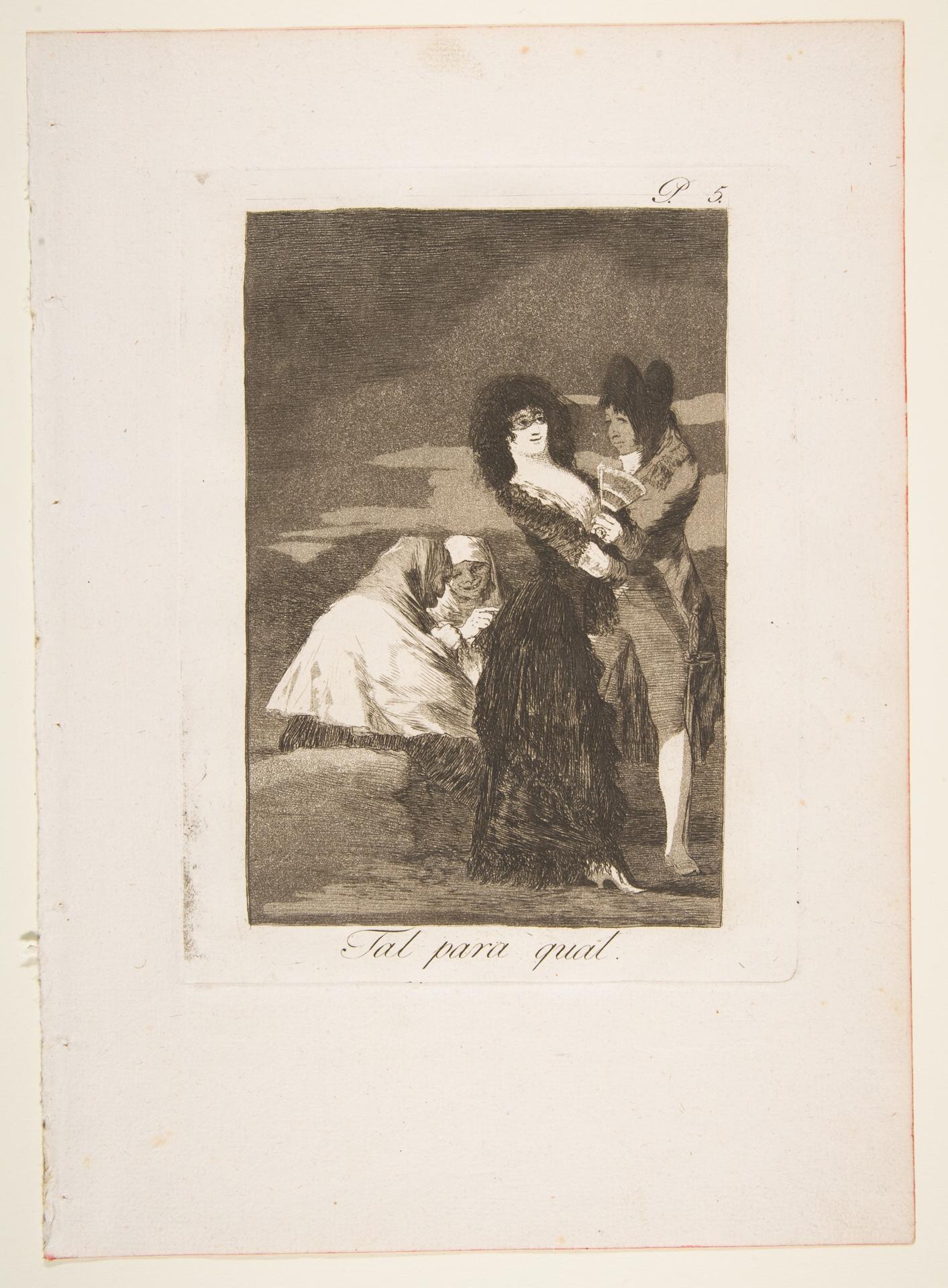
Two of a kind (Tal para qual)
Original title: Plate 5 from "Los Caprichos": Two of a kind (Tal para qual)
kurzbeschreibung
This print belongs to Los Caprichos and is the fifth in the series that Francisco de Goya created in 1799. In the etching with aquatint and drypoint, three figures appear in a dark, abstract setting, with a woman in a feather boa dominating the foreground. The title 'Tal para qual' points to the satirical intent of the cycle.
Description
In the foreground, a woman in a long dark dress with a feather boa is seen; she holds a sheet of paper in her hand, her hair long and dark. To the side, a person in white clothing kneels, turning toward her, while a third person in light garments looks from the background toward the woman. The surroundings remain dark and abstract, emphasizing the figures. At the bottom is the inscription 'Tal para qual'. Clear lines and hatching outline the bodies.
Context
Between 1797 and 1799, Goya produced his series Los Caprichos, first published in 1799. It attacks social ills, superstition, and human follies in Spain of that time. The fifth plate is among the early Caprichos that target social types and behaviors. Goya worked on it as he increasingly turned away from court painting and toward critical themes.
Impact
An intimate, almost theatrical scene emerges, made oppressive by the gloomy environment. The contrast between the light garment of the kneeling figure and the dark dress of the woman draws the eye to their interaction. The satirical note of the title reinforces the ironic effect of the print.
Technique
For this work, Goya used etching, supplemented by aquatint and drypoint, on paper. Aquatint allows fine tonal gradations and soft shading, while drypoint yields bold, deep lines. This combination results in a rich graphic texture with nuanced light-dark contrasts.
AI-generated description text
Source: Metropolitan Museum of Art · Public Domain (CC0 1.0)