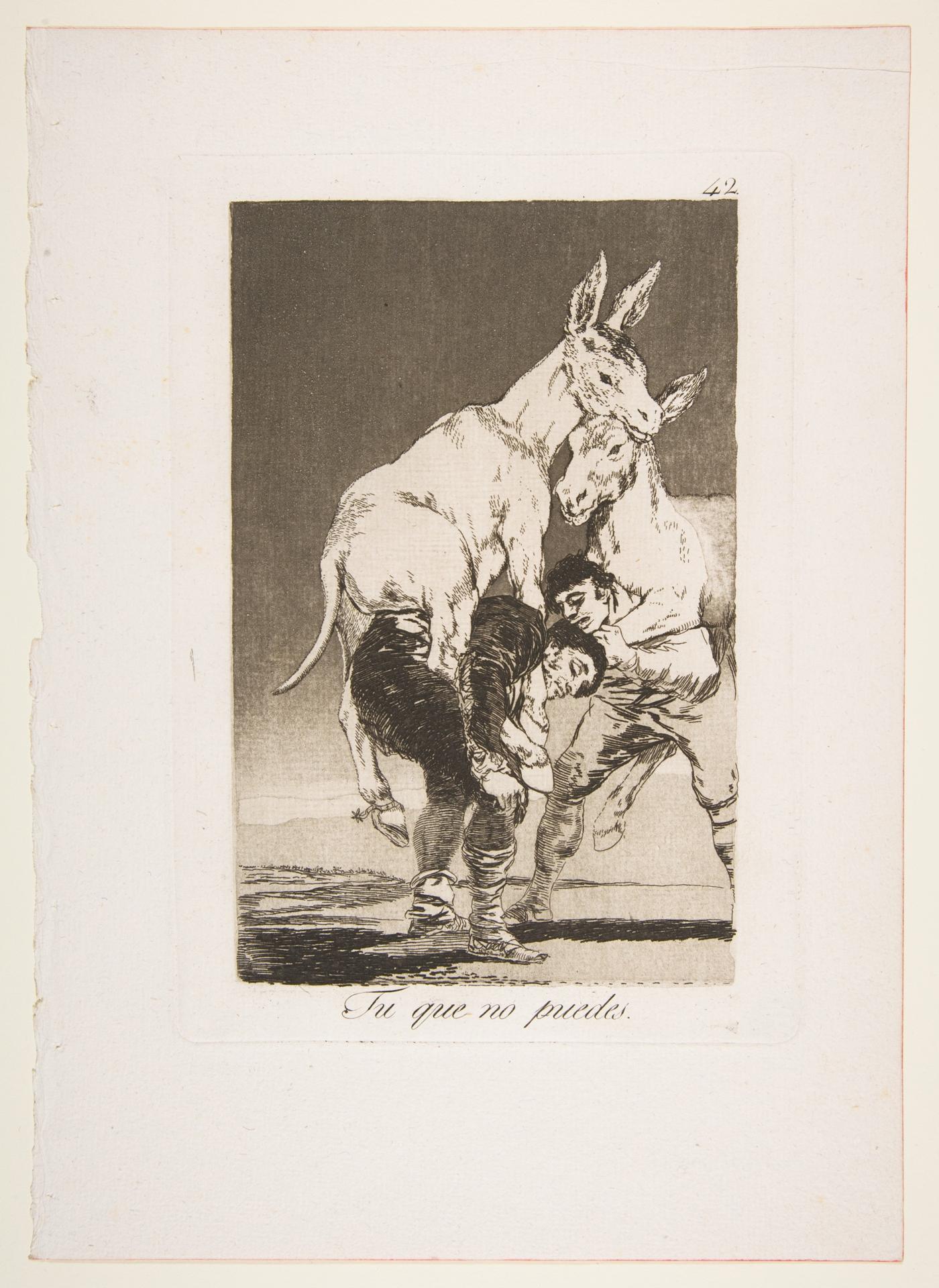
Thou who canst not (Tu que no puedes)
Original title: Plate 42 from "Los Caprichos": Thou who canst not (Tu que no puedes)
kurzbeschreibung
Plate 42 from Francisco Goya's etching series Los Caprichos (1799) presents two donkeys propped up on two humans in fighting stances. The image, measuring 21.5 × 15.1 cm and executed as an etching with aquatint, belongs to a set of 80 prints that satirically comment on social ills and human follies.
Description
Two donkeys and two humans face off in a confrontational arrangement. The animals bear down on the human figures, who appear in simple contemporary dress and ready-to-fight poses. A plain, dark background makes the group stand out. The rendering stays monochrome in shades of gray, with even lighting and no harsh shadows or strong contrasts. Realistic and detailed, the emphasis falls on the interplay between the figures.
Context
Los Caprichos emerged between 1797 and 1799, a period of social and political upheaval in Spain. The series attacks superstition, ignorance, and the ills of late 18th-century Spanish society. Plate 42 highlights the exploitation of the weak by the powerful—a theme that runs through Goya's work. The etchings were published as a bound set in 1799 but soon disappeared from sale, likely because of their sharp criticism of the nobility and clergy.
Impact
The print creates an oppressive, almost grotesque mood that unsettles viewers and prompts reflection. The unusual pairing of humans and animals feels absurd and sharpens the satirical edge of the critique. At the same time, the spare, dark layout gives the scene a timeless urgency.
Technique
Etching with burnished aquatint—a process that allows fine tonal gradations. In aquatint, rosin powder is applied and heated, creating an even grain. Goya used this method to achieve soft gray transitions and atmospheric depth.
AI-generated description text
Source: Metropolitan Museum of Art · Public Domain (CC0 1.0)