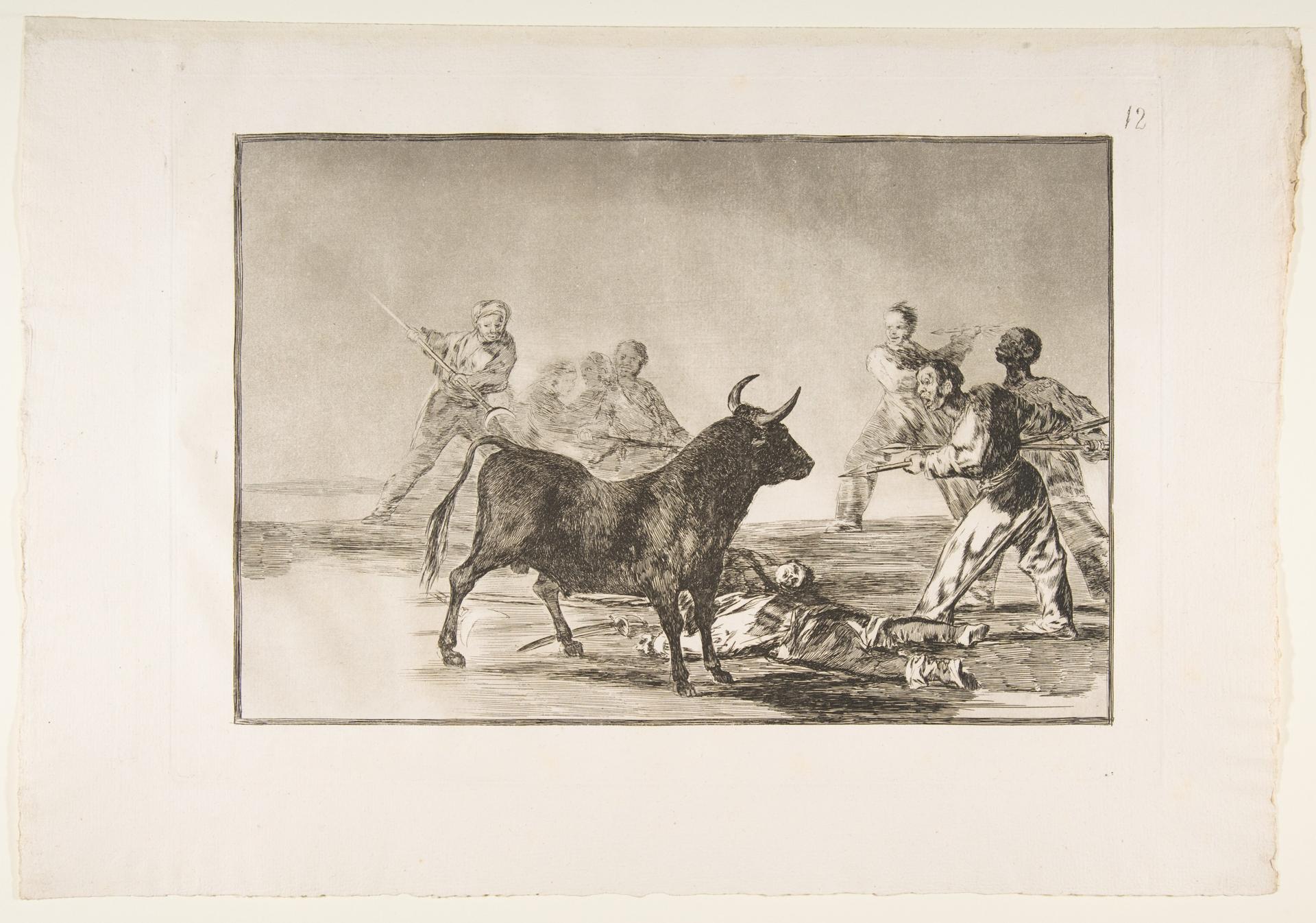
Plate 12 from 'La Tauromaquia': The crowd hamstrings the bull with lances, sickles, banderillas and other arms
Original title: Plate 12 from "La Tauromaquia": The crowd hamstrings the bull with lances, sickles, banderillas and other arms
kurzbeschreibung
In 1816 Francisco de Goya made this etching of a crowd attacking a bull with lances, sickles, and banderillas, wounding it in the leg. The print belongs to his series 'La Tauromaquia', in which he recorded bullfighting in its many forms. The technique combines etching, aquatint, and drypoint.
Description
A bull in motion anchors the image, surrounded by a group of men thrusting lances, sickles, and banderillas into it. Some figures still hold their weapons ready; others have already struck. The participants wear traditional clothing, their faces tense and purposeful. Behind the group, a flat landscape is suggested. Black and white dominate the sheet, with aquatint creating strong contrasts and etching adding fine lines.
Context
The series 'La Tauromaquia' was made between 1815 and 1816 and first published in 1816. In it, Goya captured various bullfighting scenes, from historical events to contemporary practices. The portrayal of a crowd attacking the bull with unusual weapons highlights the raw and violent aspects of bullfighting that Goya closely observed. During this period, the artist increasingly turned away from court art and devoted himself to personal, often somber subjects.
Impact
The dynamic arrangement and tightly packed group of figures create immediate tension. Precise linework and flat aquatint give the action a menacing atmosphere. The viewer is confronted directly with the brutality of the event, without any explicit moral judgment.
Technique
Goya combined etching, aquatint, and drypoint to achieve fine lines and soft tonal values. Aquatint allowed him to create large areas with different shades of gray, while drypoint added fine, scratchy accents. The sheet is printed on paper and measures 25 x 35 cm in the plate.
AI-generated description text
Source: Metropolitan Museum of Art · Public Domain (CC0 1.0)