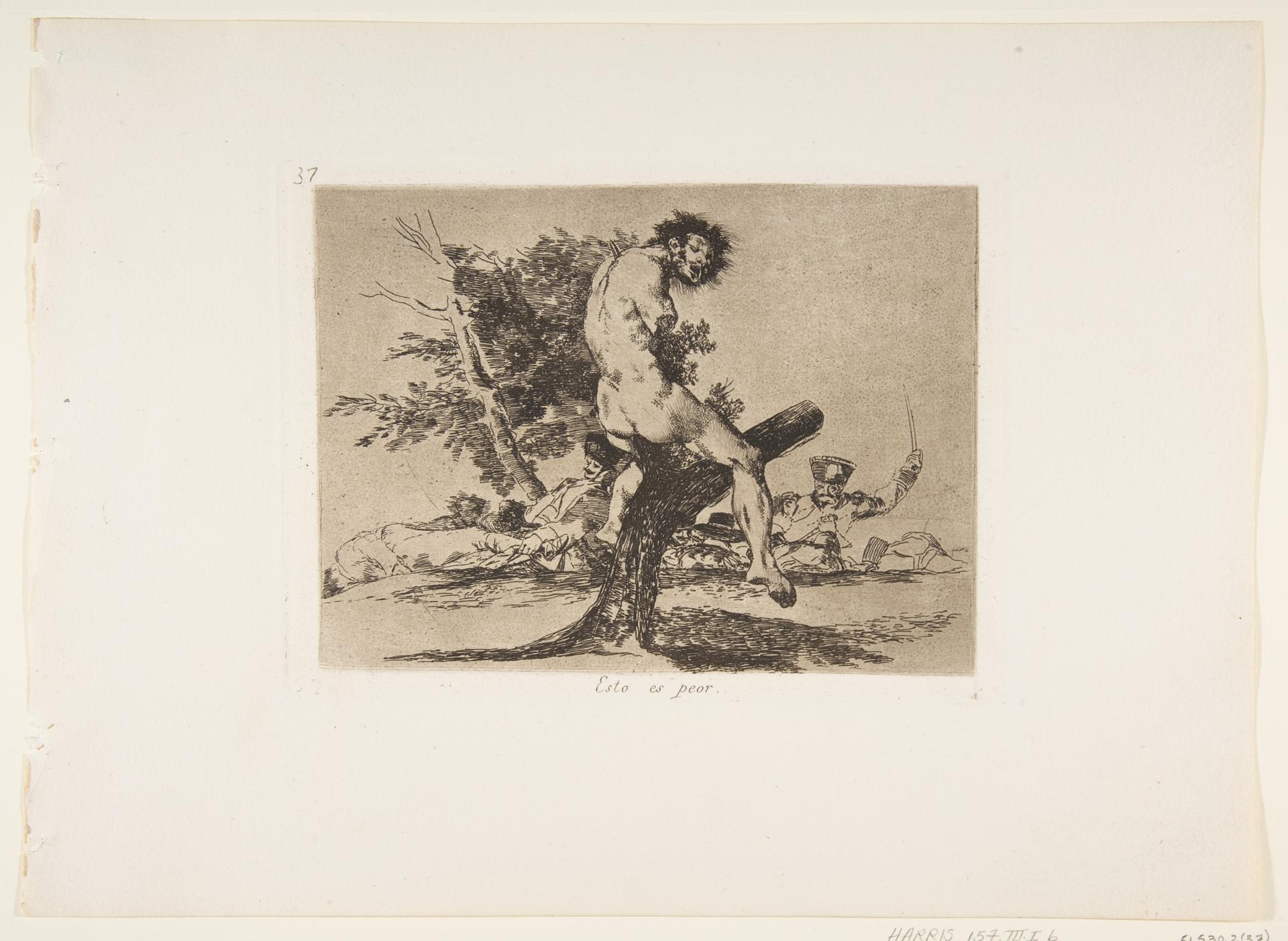
This is worse (Esto es peor), Plate 37 from 'The Disasters of War'
Original title: Plate 37 from "The Disasters of War" (Los Desastres de La Guerra): 'This is worse' (Esto es peor)
kurzbeschreibung
Unlike many war images that rely on heroic gestures, this print by Goya—plate 37 from 'Los Desastres de la Guerra', titled 'This is worse' (Esto es peor)—plunges the viewer into raw hand-to-hand combat. Created in 1810 but not published until 1863, it shows a half-animal creature bludgeoning a fallen man with a tree trunk. The etching with lavis and drypoint ranks among the series' most harrowing scenes.
Description
In the right foreground, a naked, fur-covered being with pointed ears swings a uprooted tree trunk down onto a fallen figure. The attacker crouches low, aggressive, while the victim lies on the ground. Behind this pair, other figures grapple with one another; some have already collapsed. The arrangement feels cramped and restless, with harsh contrasts of light and dark driving the drama.
Context
Between 1810 and 1820, Goya responded to the Napoleonic Wars and the Spanish War of Independence with this series. The prints remained unpublished during the artist's lifetime; only in 1863 did the Real Academia de Bellas Artes de San Fernando in Madrid issue them. Plate 37 belongs to the second group of the series, which addresses the consequences of war.
Impact
The exaggerated figures and the merciless fury of combat immediately unsettle the viewer. That human and animal blur together underscores the loss of civilization and unleashed violence. This print leaves no room for detachment.
Technique
Executed as an etching with lavis and drypoint on paper. The drypoint leaves strong, irregular lines that heighten the expressive force, while the washed ink creates soft gray gradations in the shadow areas.
AI-generated description text
Source: Metropolitan Museum of Art · Public Domain (CC0 1.0)