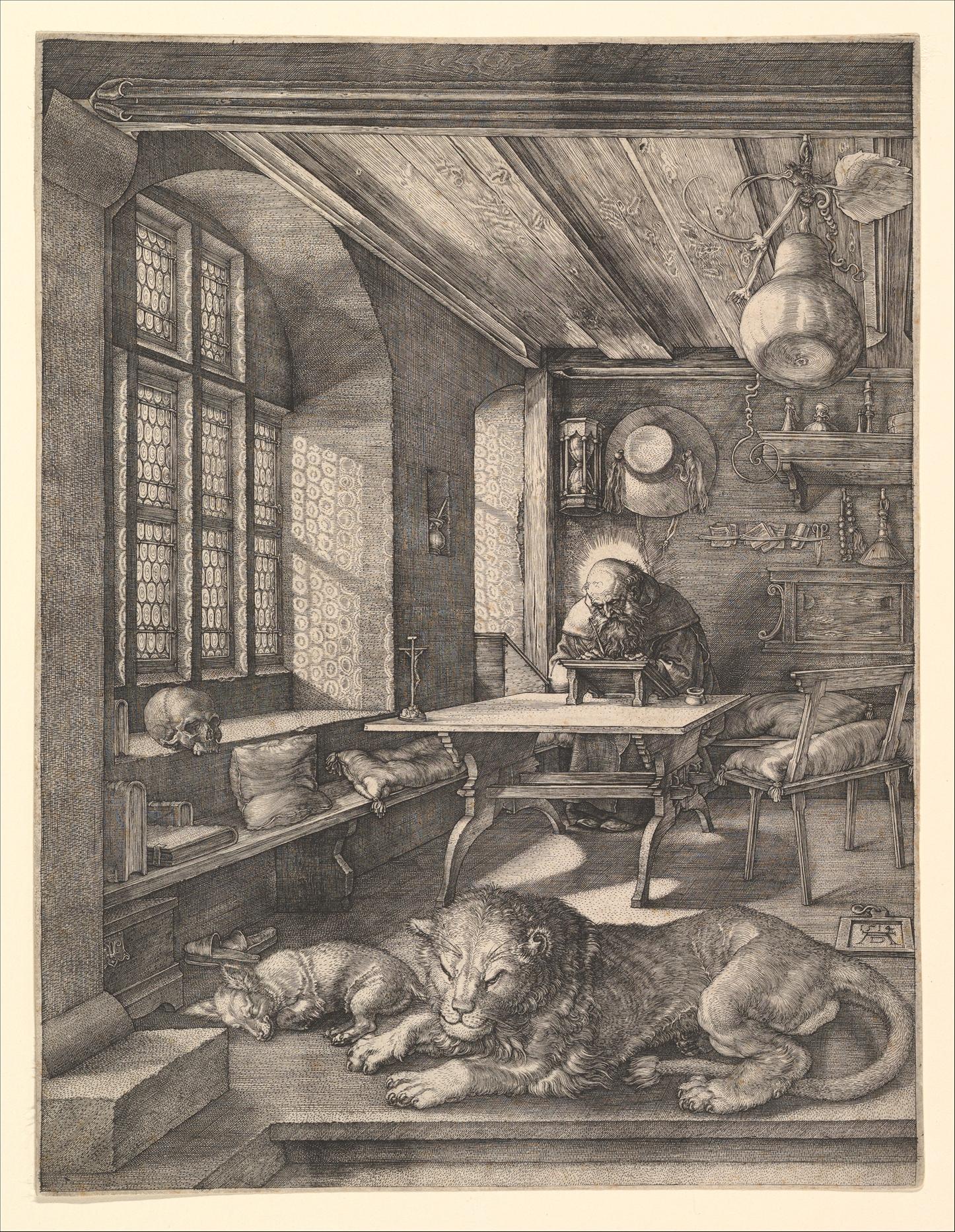
Saint Jerome in His Study
Original title: Saint Jerome in His Study
kurzbeschreibung
Albrecht Dürer's engraving from 1514 depicts Saint Jerome in a sunlit study, surrounded by symbols of scholarly life. The saint is shown writing at a desk, with a lion and two dogs sleeping in the foreground. This work is a masterful example of Dürer's technical skill in printmaking.
Description
The composition centers on Saint Jerome, an elderly man with a beard, seated at a wooden desk, writing in a large book. He wears a dark, fur-trimmed robe and a crown, while a radiant halo glows above his head. A large window on the left lets in diagonal light, illuminating the room and casting soft shadows. In the foreground, a lion lies sleeping on the right, accompanied by two small dogs, all rendered with delicate detail. The room is filled with objects: a skull and cushions on the windowsill, and on the right wall, a hanging pot, an hourglass, books, and shelves with various items.
Context
Dürer created this engraving in 1514, during a period when he was deeply engaged with humanist ideas and religious themes. Saint Jerome was a popular subject for Renaissance artists, symbolizing scholarly devotion and the translation of the Bible into Latin. The inclusion of the lion refers to the legend of Jerome removing a thorn from a lion's paw, making the animal his companion. The skull and hourglass are memento mori, reminding viewers of mortality and the passage of time, themes common in Dürer's work.
Impact
The engraving conveys a quiet, contemplative atmosphere, drawing the viewer into the saint's serene study. The interplay of light and shadow creates a sense of depth and intimacy, while the detailed textures of fur, wood, and fabric showcase Dürer's precision. The calm presence of the sleeping animals adds to the peaceful mood, making the scene feel both sacred and domestic.
Technique
This is an engraving, a technique where lines are incised into a metal plate with a burin, then inked and printed. Dürer's mastery of cross-hatching and fine line work allows for subtle gradations of light and shadow, achieving a tonal range that mimics painting. The careful composition and intricate details demonstrate his exceptional control over the medium, making this one of his most celebrated prints.
AI-generated description text
Source: Metropolitan Museum of Art · Public domain (CC0)