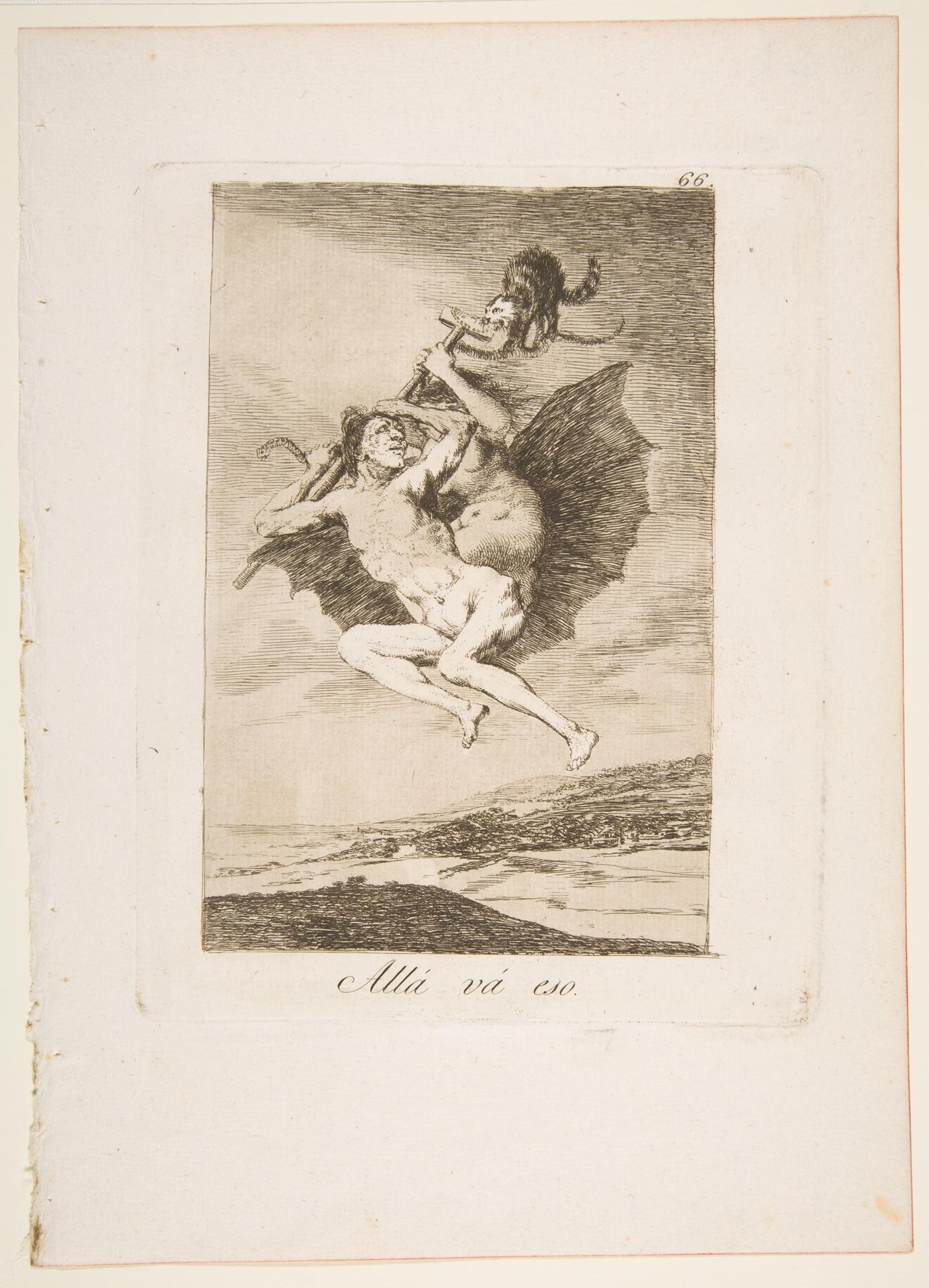
There it goes (Allá vá eso)
Original title: Plate 66 from "Los Caprichos": There it goes (Allá vá eso)
kurzbeschreibung
Plate 66 from Francisco de Goya's print series Los Caprichos, published in 1799, carries the Spanish title "Allá vá eso." The etching, enhanced with aquatint and drypoint, depicts two figures flying through the air above a broad landscape under a cloudy sky.
Description
A winged figure hovers high above the ground, clutching an arrow. On its back sits a second figure, also gripping an arrow; both appear to be in motion. Clouds and a horizon fill the background, while below a flat area with hills and a river can be made out. At the bottom edge runs the inscription "Allá vá eso." The image is rendered in shades of gray, with nuanced tonal shifts and delicate lines.
Context
Between 1797 and 1799, Goya produced the 80 plates of Los Caprichos, a satirical commentary on Spanish society of his time. Plate 66 belongs to the second half of the series, which focuses increasingly on superstition and human folly. The exact meaning of the motif remains debated among scholars; it is often interpreted as an allusion to the spread of nonsense or to a flight from reason.
Impact
The floating figures create an unsettling dynamic, intensified by the dark aquatint areas. The subdued color palette and expressive lines give the plate a menacing, almost nightmarish mood. The terse title underscores the sarcastic tone of the series.
Technique
The plate was printed using a combination of etching, aquatint, and drypoint. Aquatint provides subtle tonal gradations, while drypoint contributes bold, irregular lines. It was printed on laid paper, as was customary for the 1799 edition.
AI-generated description text
Source: Metropolitan Museum of Art · Public Domain (CC0 1.0)