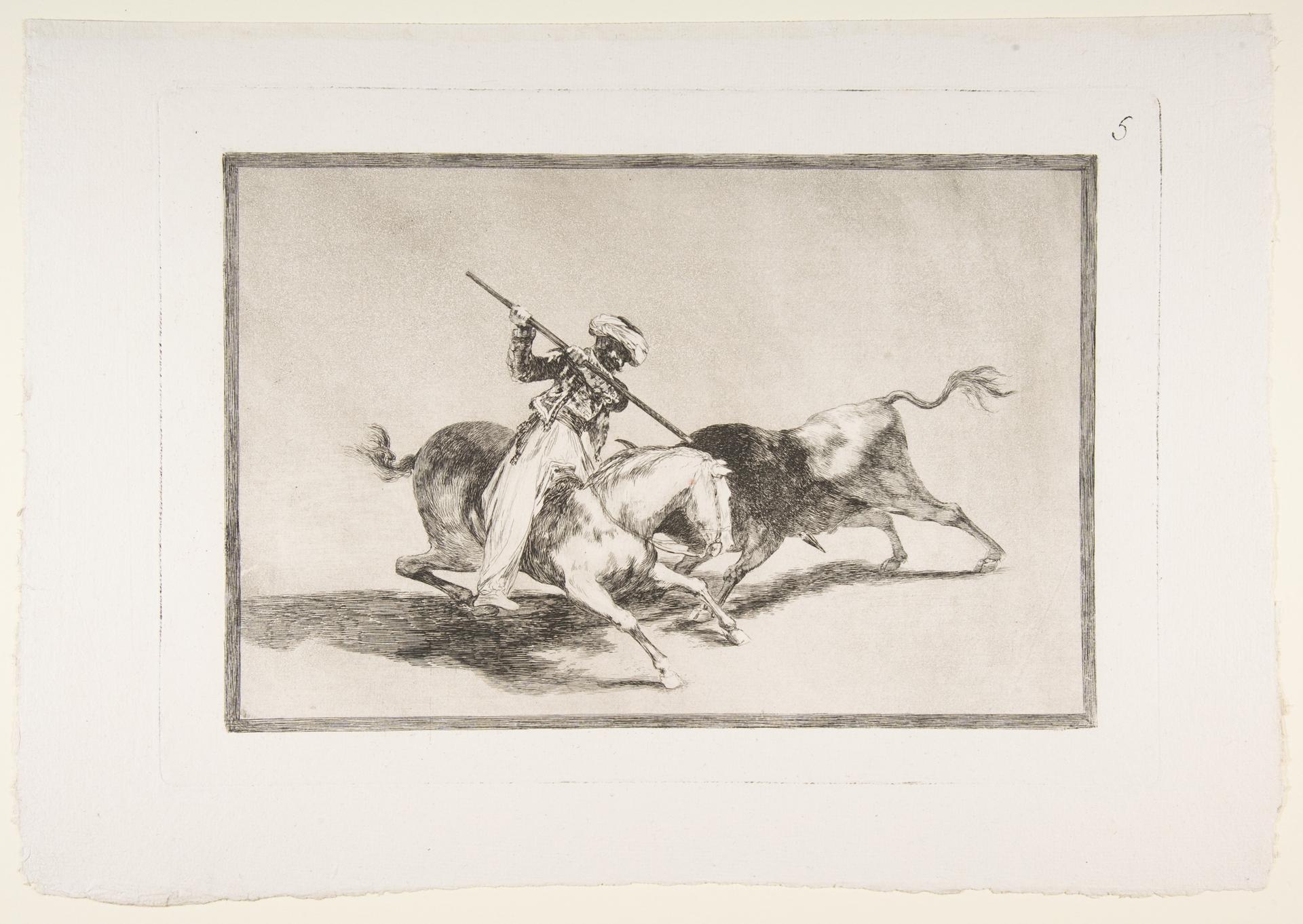
The spirited Moor Gazul is the first to spear bulls according to the rules
Original title: Plate 5 from "La Tauromaquia": The spirited Moor Gazul is the first to spear bulls according to the rules
kurzbeschreibung
In 1816, Francisco de Goya etched the moment the Moor Gazul charges a black bull on a white horse, his spear lowered. The print belongs to the series 'La Tauromaquia' and was made using etching, burnished aquatint, and drypoint.
Description
A rider in a turban and Spanish attire sits on a light horse, aiming his spear at a black bull. The bull's body seems caught mid-leap or mid-fall, heightening the tension of the instant. Sparse background areas make the figures stand out. The etching's grayscale sets up strong contrasts: sharp lines meet graduated shadows from light to dark. In the upper right, the number '5' appears.
Context
Created in 1816 as part of Goya's cycle 'La Tauromaquia', which deals with Spanish bullfighting, this print refers to the Moor Gazul, a figure from the period of Moorish rule in Spain, regarded as one of the first bullfighters to follow fixed rules. At the time, Goya was working intensely on themes of Spanish society and its customs. He often used aquatint to achieve soft tonal values and striking highlights.
Impact
From the first glance, the print generates gripping movement and suspense that pulls the viewer straight into the action. The high-contrast grayscale and precise lines give the scene a powerful, almost dramatic mood. Goya's hand lends the historical subject an intensity that goes beyond mere representation.
Technique
Etching, burnished aquatint, and drypoint combine here into a mix of precise lines and soft tonal gradations. The aquatint creates fine grains for the shadow areas, while drypoint produces strong, sharp contours. The printing plate measures 24.7 x 35.2 cm and was printed on a sheet of 31 x 44.5 cm.
AI-generated description text
Source: Metropolitan Museum of Art · Public Domain (CC0 1.0)