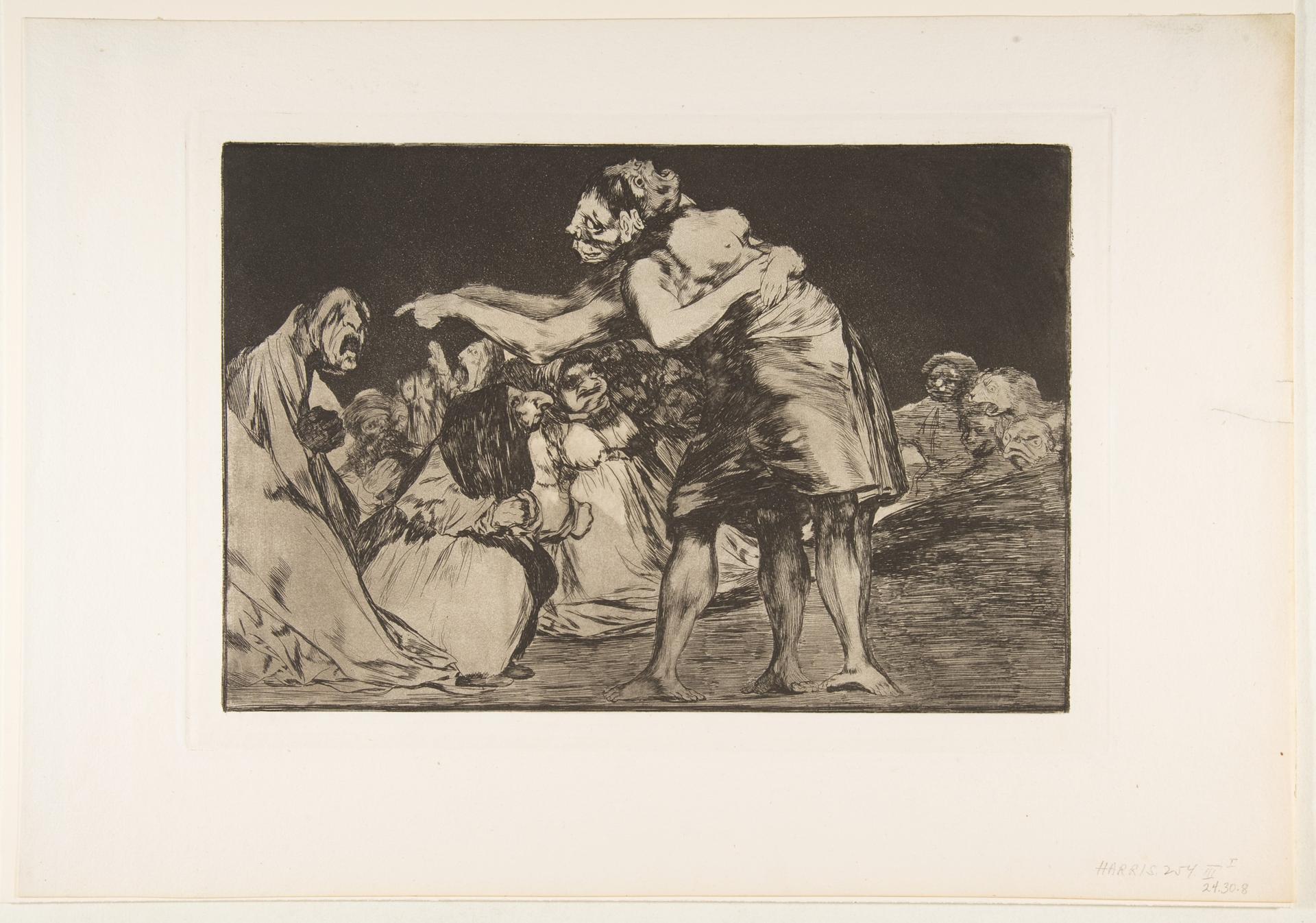
Disorderly Folly
Original title: Disorderly Folly, from "The Disparates" (Follies / Irrationalities)
kurzbeschreibung
Francisco de Goya made 'Ungeordnete Torheit' (Disordered Folly) as an etching within his series 'Los Disparates' (The Follies). It dates from around 1815–19, but the series was not published until 1864, after Goya's death. The image presents a group of figures in distorted postures and belongs to his late printmaking work.
Description
A crowd presses together in agitated disorder. In the foreground, one figure with arms flung wide braces against another, whose body twists in an almost clownish contortion. Around them, more people appear in varied poses and with diverse expressions, dressed in traditional clothing. The layout rejects linear perspective, which heightens the confusion. The etching remains monochrome black and white; light falls evenly across the surface, with no discernible shadows.
Context
In his late years, as he pulled away from court commissions, Goya worked on the 'Disparates'. These plates were only published in 1864 by the Royal Academy of San Fernando, long after his death. The series comments allegorically on social ills and human unreason. Goya made the etchings during the political restoration in Spain that followed the Napoleonic Wars.
Impact
Unease and exaggerated gestures stir a disturbing, almost grotesque mood in the viewer. Because spatial order is missing and the poses feel alien, the audience is pushed to read the image as a critical look at human folly.
Technique
Etching, aquatint, and drypoint were used. Aquatint provides fine tonal gradations, while drypoint yields sharp, detailed contours and a rough texture. The plate measures 24.3 × 35.2 cm; the sheet was printed on paper measuring 33.4 × 48.3 cm.
AI-generated description text
Source: Metropolitan Museum of Art · Public Domain (CC0 1.0)