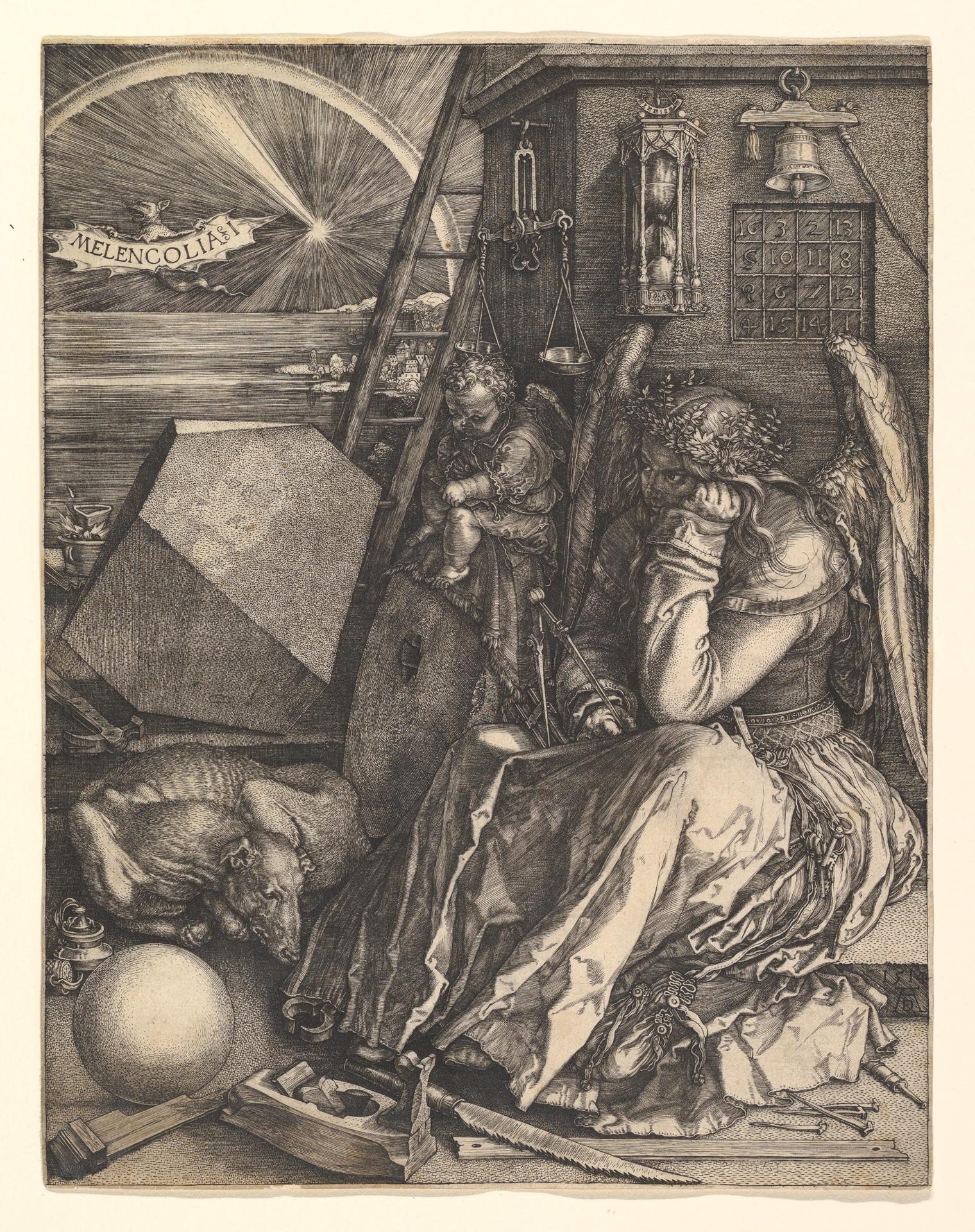
Melencolia I
Original title: Melencolia I
kurzbeschreibung
Albrecht Dürer's 'Melencolia I' (1514) is one of his most famous engravings, depicting a winged female figure in a state of deep contemplation. The work is a masterful example of Renaissance printmaking, combining intricate detail with rich symbolic content.
Description
The composition centers on a seated, winged woman who rests her head on her left hand, her gaze fixed downward in thought. She wears a leaf crown and a long robe, with a pair of compasses and a ruler resting on her lap. To her right, a small putto sits on a millstone, holding a tablet, while a sleeping dog-like creature lies in the lower left foreground. The scene is filled with symbolic objects: a sphere, a polyhedron, a magic square, a bell, and a set of scales, all set against a dark, brooding sky with a rainbow and a comet-like light.
Context
Created in 1514, 'Melencolia I' is part of Dürer's series of three 'master engravings,' which also includes 'Knight, Death, and the Devil' and 'Saint Jerome in His Study.' The work reflects the Renaissance fascination with melancholy as a temperament of creative genius, influenced by Neo-Platonic and Aristotelian ideas. The magic square and the polyhedron are often interpreted as references to geometry and the liberal arts, suggesting the intellectual struggle of the artist.
Impact
The engraving evokes a profound sense of stillness and introspection, drawing the viewer into the figure's melancholic state. The dense, almost cluttered arrangement of objects creates a feeling of intellectual weight, while the dramatic sky adds a cosmic dimension to the scene.
Technique
Dürer employed the engraving technique on copper plate, using a burin to incise fine, precise lines. The print demonstrates his exceptional skill in tonal variation, achieved through cross-hatching and stippling, which gives the image a rich, textured quality and a wide range of light and shadow.
AI-generated description text
Source: Metropolitan Museum of Art · Public domain (CC0)