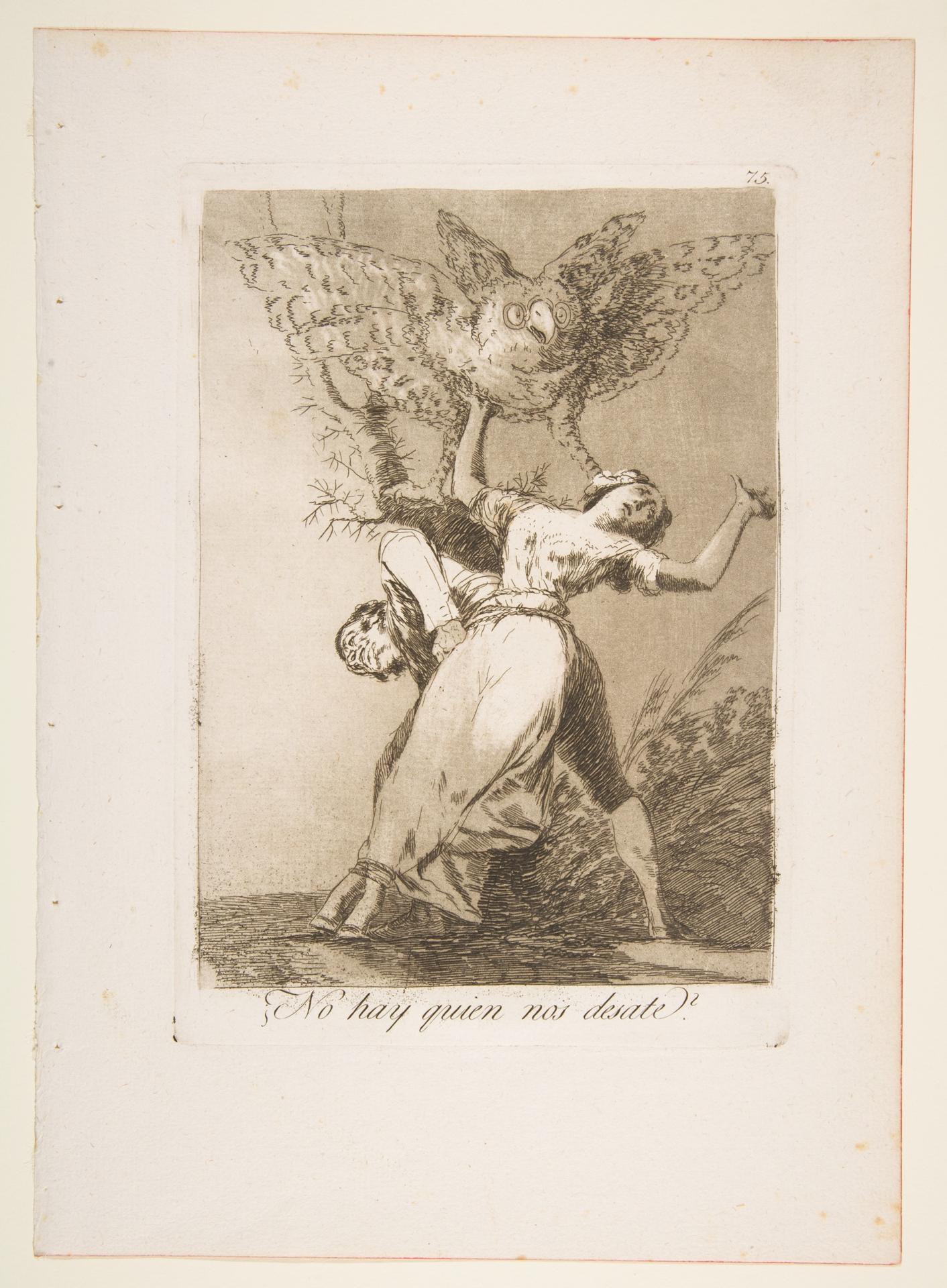
Is there no one to untie us? (¿No hay quien nos desate?)
Original title: Plate 75 from "Los Caprichos": Is there no one to untie us? (¿No hay quien nos desate?)
kurzbeschreibung
Unlike many plates in Los Caprichos that lampoon specific vices, Goya's etching "¿No hay quien nos desate?" from 1799 puts helplessness itself on stage. A woman and a man fall under the power of a large bird, likely an owl. Dark, forceful forms carry the impotence and threat that radiate from this print.
Description
In the foreground, a woman with raised arms struggles against a large bird perched on a branch she grips. A man lies on the ground, visibly overcome by the danger. The burnished aquatint casts deep shadows across the image, creating an eerie mood that the figures' violent postures intensify. Behind them, plants suggest a natural setting that offers no protection. Below the image, the title appears in Latin script.
Context
Between 1797 and 1799, Goya worked on Los Caprichos, published in 1799 as a series of 80 etchings. In them, he directed satirical criticism at superstition, social ills, and human folly. Plate 75 belongs to the later numbers of the cycle, where existential fears come more strongly to the fore. What exactly inspired the scene is not documented; it is interpreted in connection with Goya's critical stance toward Spanish society of his time.
Impact
An oppressive mood hangs over the plate and pulls the viewer directly into the action. Realistic rendering and fantastic elements interpenetrate, giving the motif something unsettling that also fascinates. Looking longer, one encounters the helplessness displayed here and is prompted to reflect on it.
Technique
For fine lines and soft tonal gradations, Goya used drypoint etching with burnished aquatint. This method opened up a broad range of gray values, crucial for the dramatic play of light and shadow. The plate measures 21.3 x 14.9 cm and belongs to a series issued in an edition of 300 copies.
AI-generated description text
Source: Metropolitan Museum of Art · Public Domain (CC0 1.0)