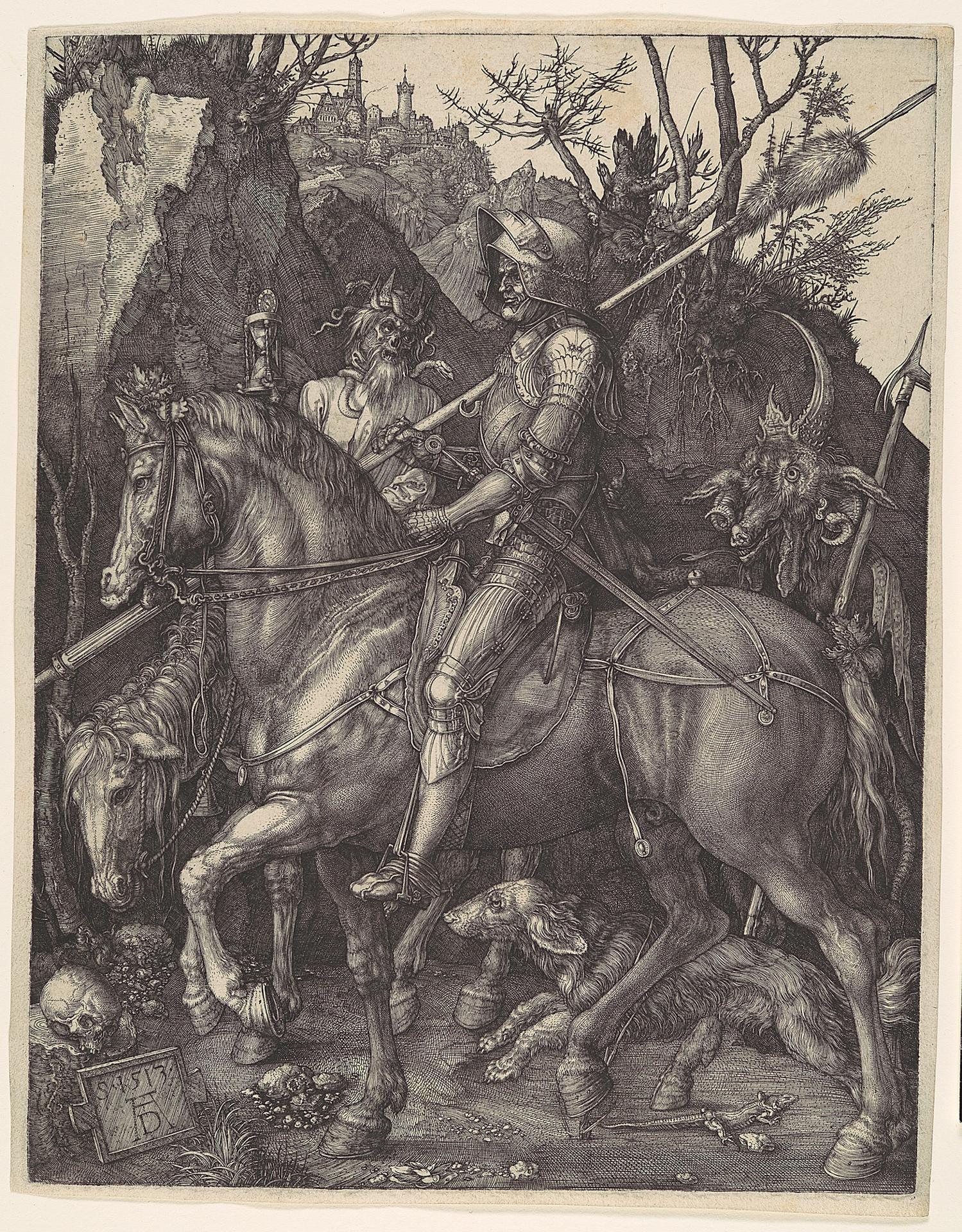
Knight, Death, and the Devil
Original title: Knight, Death, and the Devil
kurzbeschreibung
Albrecht Dürer's engraving from 1513 depicts an armored knight riding through a narrow gorge, accompanied by Death on the left and the Devil lurking behind. The work is a masterful example of early 16th-century printmaking, celebrated for its intricate detail and allegorical depth.
Description
The composition centers on a knight in full plate armor astride a horse, holding a lance pointed to the right. To the left, a skeletal figure representing Death holds an hourglass, while a horned, goat-like devil with a pitchfork emerges from the shadows behind. In the background, a castle sits atop a rocky outcrop, and on the ground lie a skull and a shield inscribed with the year 1513. A dog follows at the horse's feet, and the scene is rendered in fine black-and-white line work with lighting from the upper left.
Context
Created in 1513, this engraving is one of Dürer's three master engravings, alongside 'Saint Jerome in His Study' and 'Melencolia I'. It reflects the Renaissance interest in classical and Christian allegory, drawing on the medieval tradition of the 'miles Christianus' (Christian soldier). Dürer, a Nuremberg artist, was renowned for his technical skill and intellectual approach, and this work is often interpreted as a moral statement on steadfast faith amidst worldly temptations.
Impact
The engraving impresses with its meticulous detail and dramatic contrasts of light and shadow, drawing the viewer into the knight's resolute journey. The eerie presence of Death and the Devil creates a tense atmosphere, yet the knight's unwavering gaze forward instills a sense of stoic determination.
Technique
Dürer employed the engraving technique on copperplate, using a burin to carve fine, precise lines that capture textures of armor, fur, and hair. The cross-hatching and varied line widths demonstrate his mastery of tonal gradation, achieving a remarkable range of light and shade without color.
AI-generated description text
Source: Metropolitan Museum of Art · Public domain (CC0)