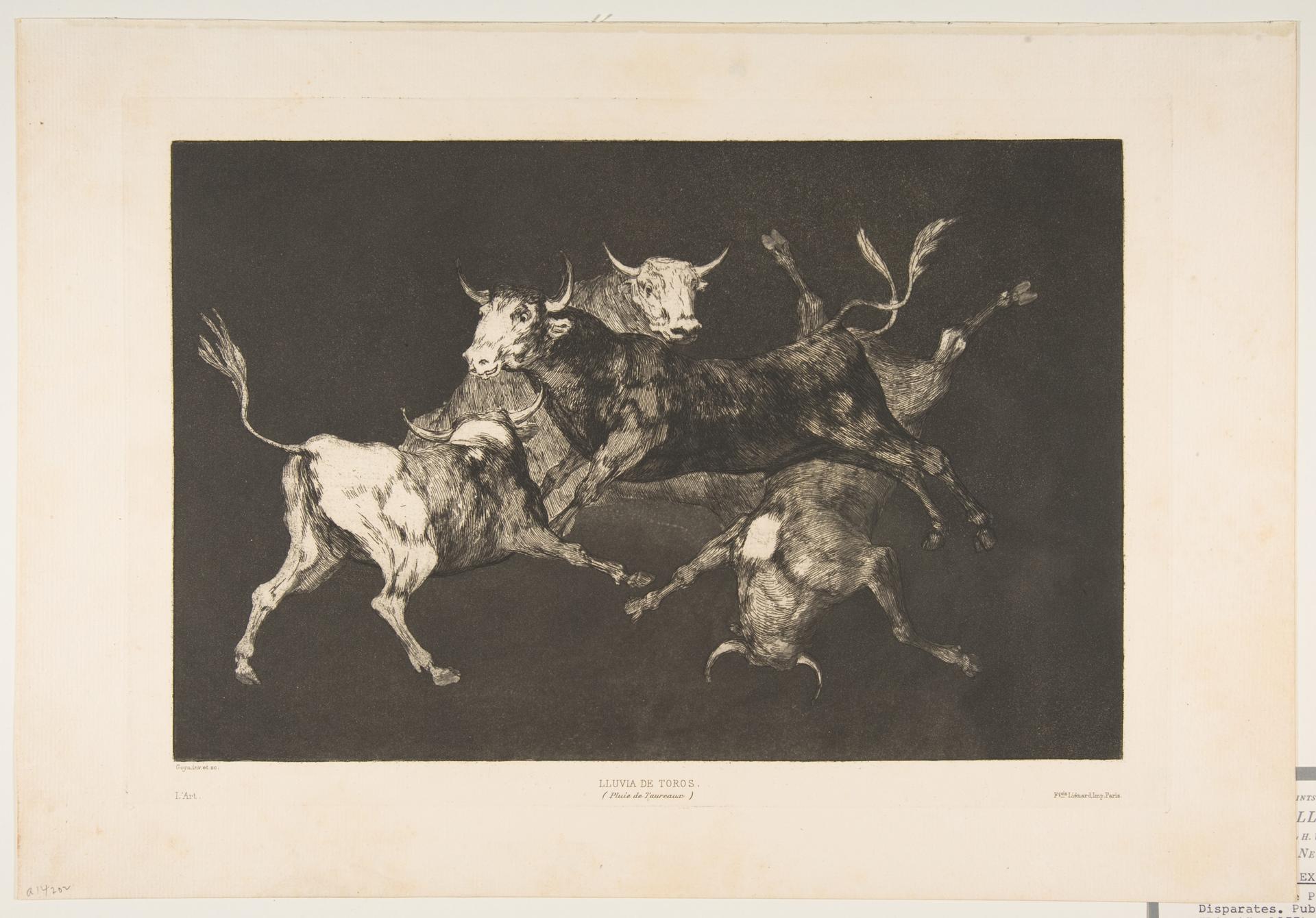
Little Bulls' Folly, from "The Disparates" (Disparates, Plate D)
Original title: Little Bulls' Folly, from "The Disparates" (Disparates, Plate D)
kurzbeschreibung
Created around 1815–19, Francisco de Goya's etching "The Folly of the Little Bulls" belongs to his series "Los Disparates" (The Follies). The print was not published until 1877. It shows four bulls in lively movement, realised in etching, aquatint and drypoint.
Description
Four bulls, each caught in a different phase of running or leaping, fill the image and create a chaotic, energetic impression. They stand out against a dark ground, which sharpens their outlines and heightens the sense of motion. The fine lines and shading of the etching techniques produce a monochrome scale of greys. The animals look in different directions, adding to the dynamism, while their central placement draws the eye to them.
Context
"Los Disparates" belongs to Goya's late work, in which he increasingly questioned social and political ills. During Goya's lifetime the etchings remained unpublished; the first edition was issued in 1877 by the Academia de San Fernando in Madrid. "Los Disparates" is considered one of the artist's most enigmatic graphic series, and its interpretation remains disputed to this day. The bulls take up a motif that recurs in Spanish culture and throughout Goya's oeuvre.
Impact
The restless, almost threatening movement of the bulls creates a tense mood that immediately draws the viewer into the action. Because the print is limited to greys and the lines are expressively drawn, it feels timeless and almost surreal.
Technique
For this print Goya combined etching, aquatint and drypoint. Aquatint produces soft tonal gradations, while drypoint yields strong, sculptural lines. In this way the artist achieved fine shadings and a rich texture that bring the animals' movements vividly to life.
AI-generated description text
Source: Metropolitan Museum of Art · Public Domain (CC0 1.0)