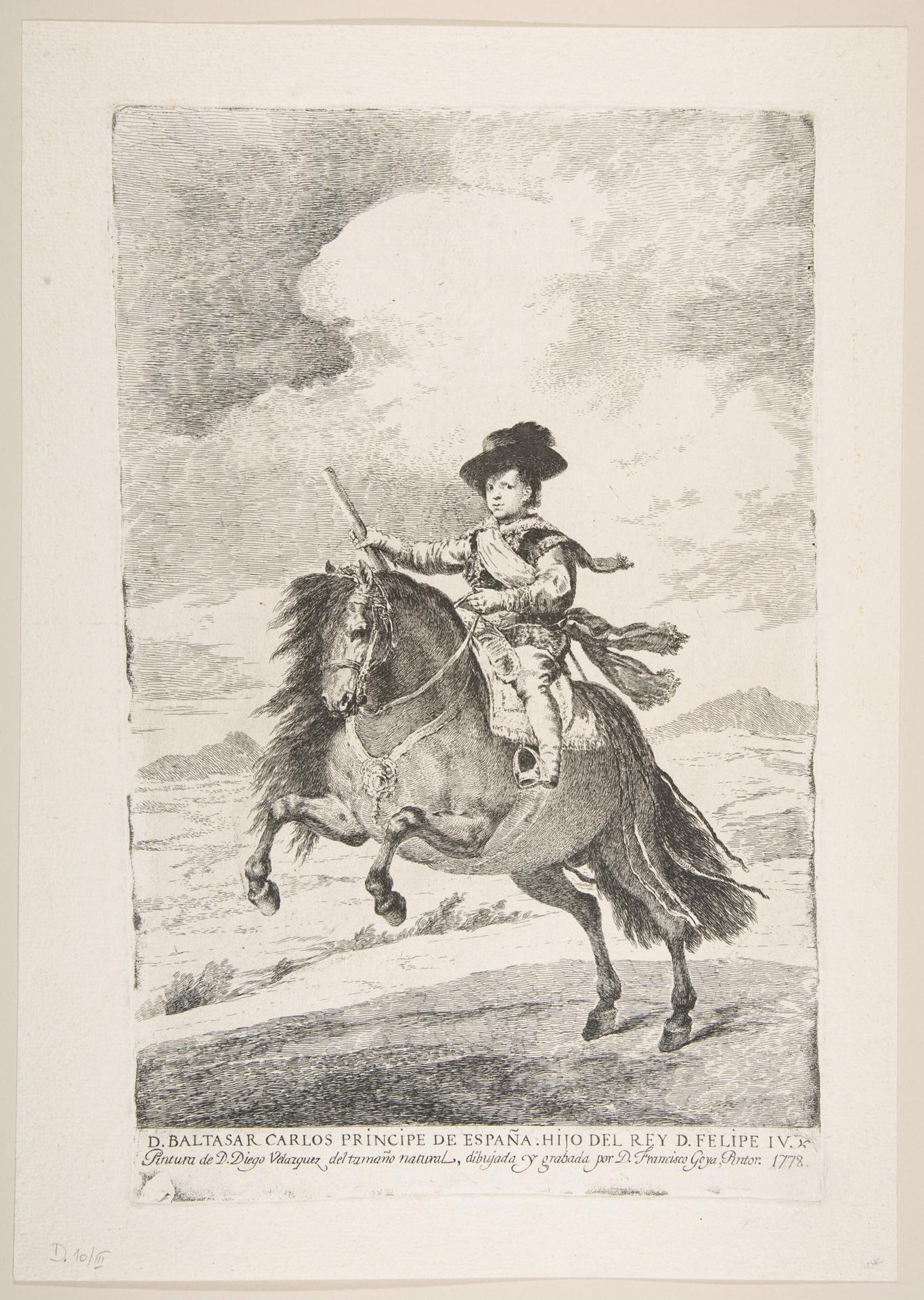
Baltasar Carlos on horseback
Original title: Baltasar Carlos on horseback
kurzbeschreibung
Prince Baltasar Carlos sits astride a rearing horse. Francisco de Goya translated this motif into an etching with drypoint in black ink in 1778, basing it on a painting by Diego Velázquez.
Description
The young prince is enthroned on the horse, whose hind legs are suspended in the air and one foreleg is lifted. He wears Spanish dress with a hat and a jacket adorned with a scarf; in his right hand he holds a lance. Behind the figure, a barren landscape with mountains opens under a cloudy sky. Everything remains in black and white, with fur and fabric rendered in finely graded textures, and a text area follows below the image.
Context
This print was made in 1778 as part of an etching series in which Goya reproduced paintings by Velázquez from the royal collection. The model was the equestrian portrait of Prince Baltasar Carlos, painted by Velázquez around 1634–35. The Count of Floridablanca commissioned the series to make the work of the Spanish court painter accessible to a wider public.
Impact
The rearing posture of the horse contrasts with the calm seat of the rider, creating an interplay of movement and dignity. Delicate hatching produces a lively surface that recalls Velázquez's manner of painting, yet does not deny the specific means of printmaking.
Technique
The print was pulled in black ink on paper, executed as an etching with drypoint. The plate measures 34.5 × 22 cm, the sheet 39.5 × 28 cm. Etched lines and drypoint passages scratched into the plate allow for fine tonal gradations and an exact rendering of textures.
AI-generated description text
Source: Metropolitan Museum of Art · Public Domain (CC0 1.0)