Adam and Eve
Original title: Adam and Eve
kurzbeschreibung
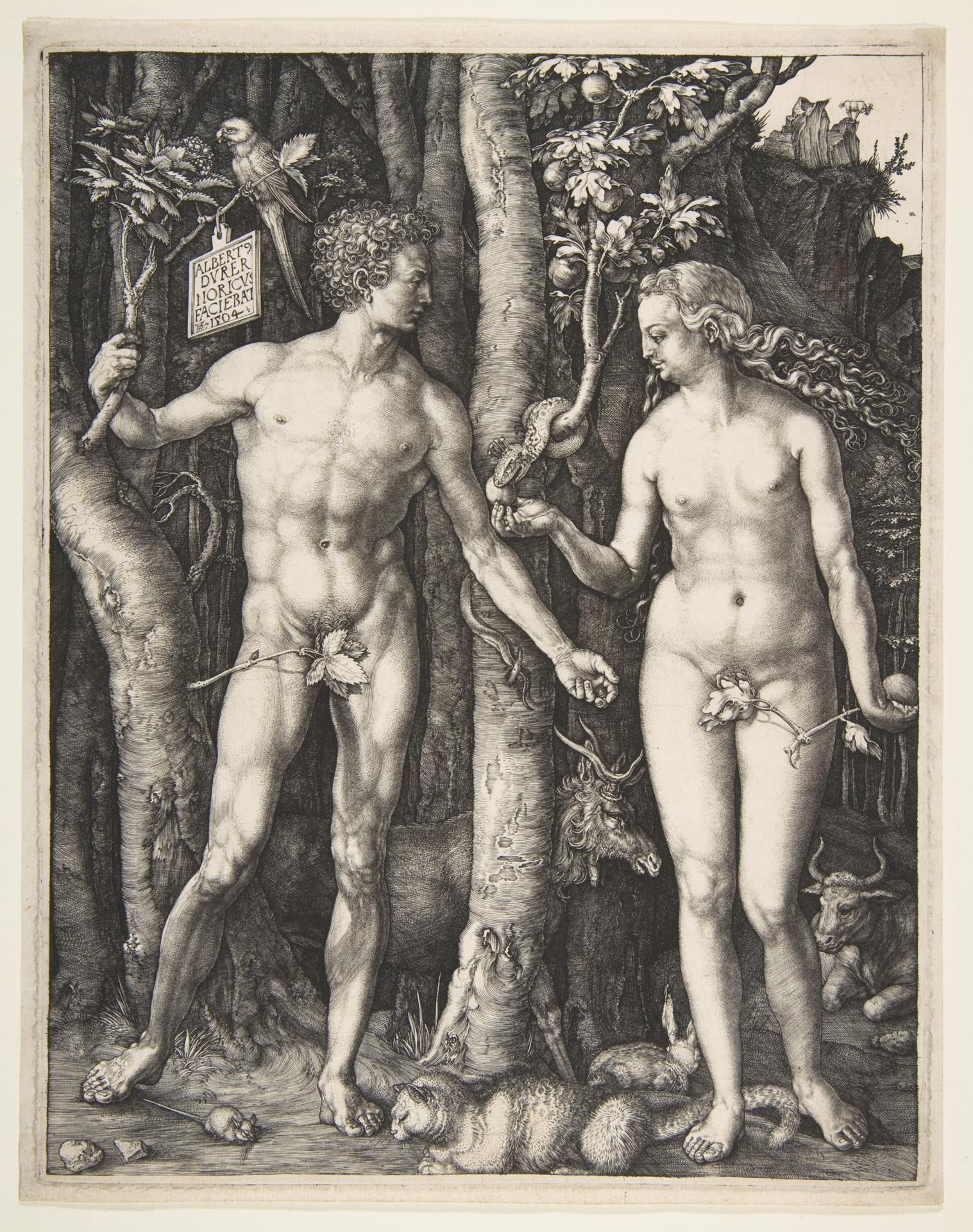
Albrecht Dürer's 1504 engraving depicts Adam and Eve in a dense forest, with Adam holding a branch and Eve offering an apple. The print showcases Dürer's mastery of engraving and his interest in classical proportion and idealized human form.
Description
The composition centers on a large tree trunk that separates Adam on the left and Eve on the right, both standing in contrapposto. Adam holds a branch with a bird and a hanging tablet, while Eve grasps the serpent in her right hand and an apple in her left. Various animals, including a dog or wolf, a rabbit, and a bull in the background, populate the scene, set against a backdrop of dense foliage and rocky formations.
Context
Created in 1504, this engraving reflects Dürer's engagement with Italian Renaissance ideas, particularly the study of classical proportions and the ideal human figure. The work was made during a period when Dürer was deeply interested in theoretical approaches to art, and it is one of his most famous prints, demonstrating his technical skill and intellectual ambitions.
Impact
The print conveys a sense of serene equilibrium, with the figures' graceful poses and the detailed natural setting creating a harmonious, almost idyllic atmosphere. The intricate linework and careful shading give the scene a remarkable depth and texture, drawing the viewer into the biblical narrative with a sense of quiet drama.
Technique
Dürer employed engraving on copper, using a burin to create fine, precise lines that build up tonal variations through cross-hatching and stippling. The technique allows for exceptional detail, evident in the textures of fur, foliage, and skin, showcasing Dürer's virtuosity in the medium.
AI-generated description text
Source: Metropolitan Museum of Art · Public domain (CC0)