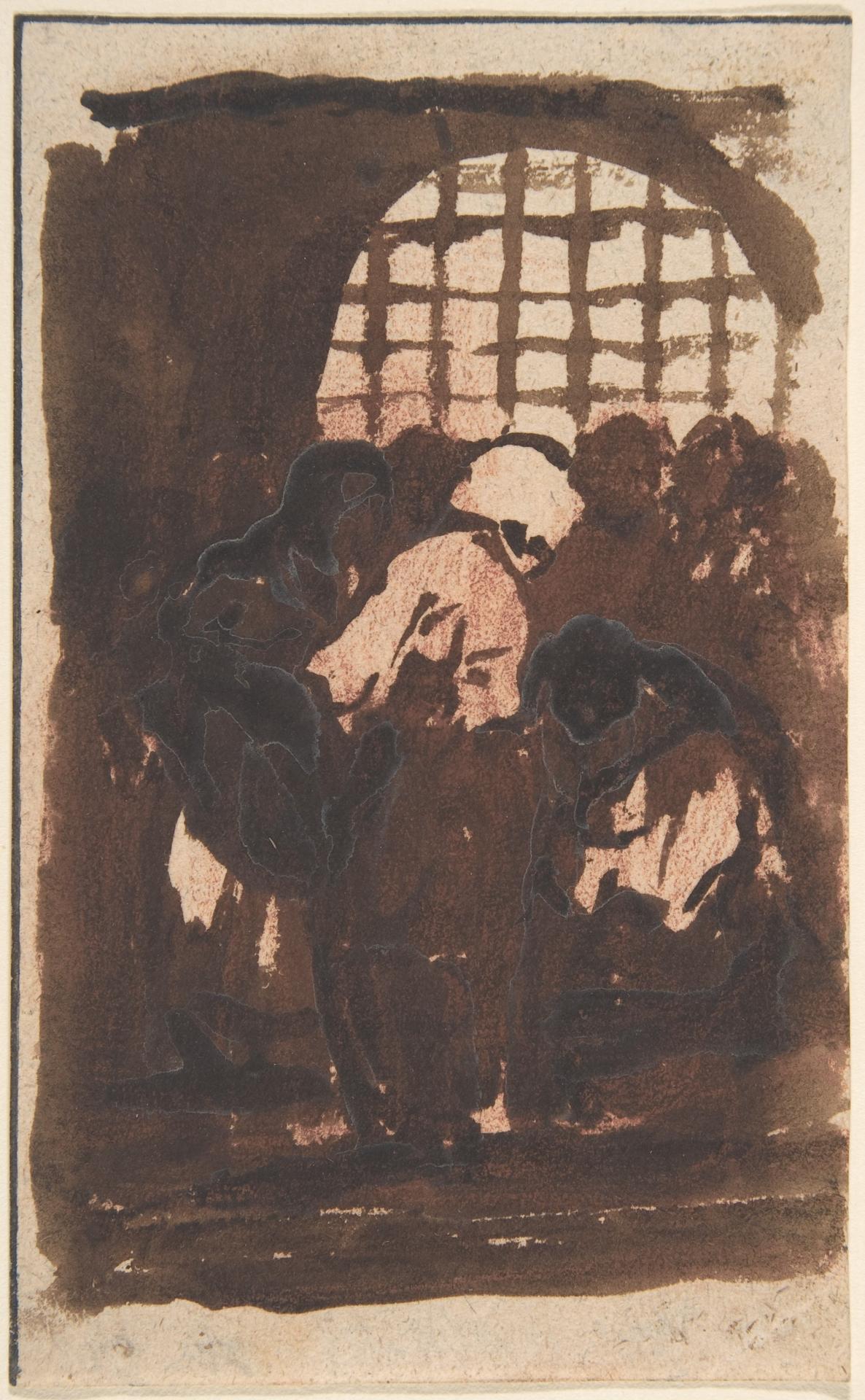
Figures inside a prison (recto), a monstrous animal (verso)
Original title: Figures inside a prison (recto), a monstrous animal (verso)
kurzbeschreibung
Francisco de Goya y Lucientes made this sheet around 1820–50. On the recto, a group of figures appears in a gloomy room with a large round window. The drawing is executed with brush in brown and black wash over red chalk on wove paper. Its small format of 15.1 x 9.2 cm suggests a private, intimate study.
Description
A large round window with grating dominates the layout and directs light into the room. Below it, several figures in dark brown tones appear, some standing, some sitting or kneeling, interacting with one another. The bright areas of the window contrast with the deep shadows on the figures, creating a somber mood. Brown and black tones with a hint of red define the color scheme and emphasize the draftsmanship.
Context
Goya made this drawing in his late creative phase, possibly during his exile in France (1824–1828) or in his final years in Madrid. The motif of prison and confined figures might refer to his experiences with political oppression and violence, which he had already addressed in the 'Disasters of War'. The verso with a monstrous animal attests to Goya's interest in fantastic and grotesque motifs, which also recurs in the 'Disparates' and the 'Black Paintings'.
Impact
An oppressive, depressing mood emanates from the sheet, reinforced by the dark wash and the enclosed figures. The round window opening acts like an eye or a gate that could symbolize hope and freedom, but is countered by the grating and darkness. The restriction to few tones and the sketchy execution give the work an immediate, raw expressive power.
Technique
Goya worked with brush in brown and black wash over a sketch in red chalk on wove paper. The wash allows fine gradations of light and shadow, modeling spatial depth and the figures. The combination of chalk and brush is characteristic of his late drawings, which often served as preparatory studies or independent works.
AI-generated description text
Source: Metropolitan Museum of Art · Public Domain (CC0 1.0)