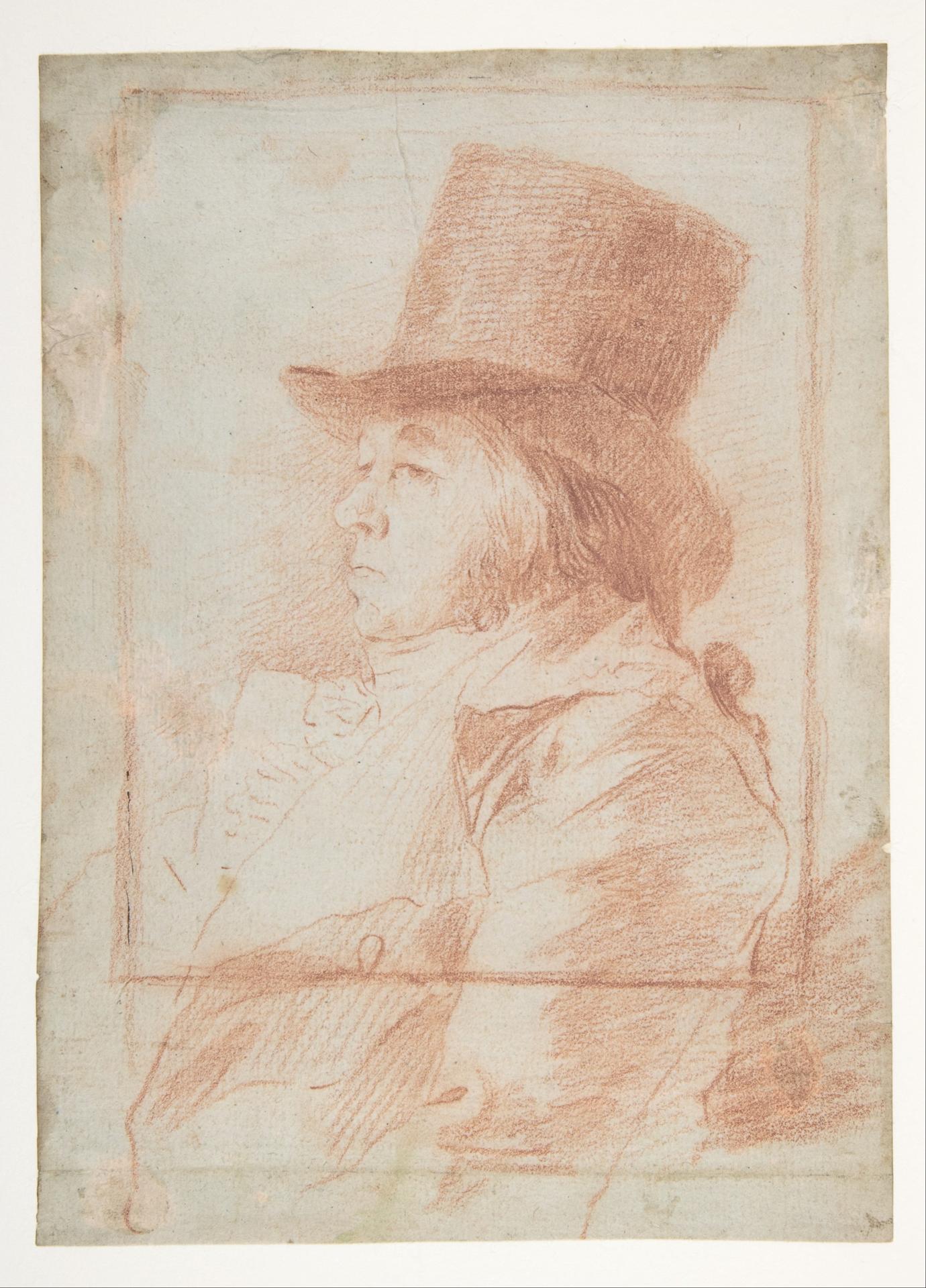
Self-Portrait; wearing a top hat facing left within a drawn frame (recto); two studies of his face (verso)
Original title: Self-Portrait; wearing a top hat facing left within a drawn frame (recto); two studies of his face (verso)
kurzbeschreibung
Around 1797–98, Francisco de Goya y Lucientes drew his own profile, topped by a tall top hat. The front of the sheet is in red chalk, while the back brings together two further studies of his face in pen, ink, and red chalk. The work belongs to the collection of the Metropolitan Museum of Art.
Description
A tall top hat sits on the man's head, turned in profile to the left. Goya's expression is pensive, his facial contours carefully worked out in red chalk. A drawn frame encloses the portrait. On the reverse are two additional studies of his face, also in red chalk, this time supplemented with pen and ink. Red governs the entire color scheme, and the light falls evenly, avoiding harsh shadows.
Context
This self-portrait emerged at a time when Goya was working as a court painter in Madrid and increasingly turning to printmaking. The small format suggests a private study, perhaps as preparation for a larger project or as an independent portrait. Red chalk was a common medium in late eighteenth-century Spain, especially for sketches and studies. The studies on the reverse show how Goya tried out his own features from different angles.
Impact
The red chalk gives the self-portrait a warm, intimate atmosphere, while the thoughtful gaze lends the artist a reserved dignity. The drawn frame underscores the portrait character and brings the facial features into focus. The reverse adds a documentary dimension, making the creative process tangible.
Technique
For the front, Goya used exclusively red chalk on laid paper, allowing fine lines and soft shading. On the back, he combines pen and ink with red chalk, which gives the facial studies more contrast and detail. At 19.8 × 14.3 cm, the paper remains small, pointing to an intimate, hand-held execution.
AI-generated description text
Source: Metropolitan Museum of Art · Public Domain (CC0 1.0)