Hanged Man
Original title: Hanged Man
kurzbeschreibung
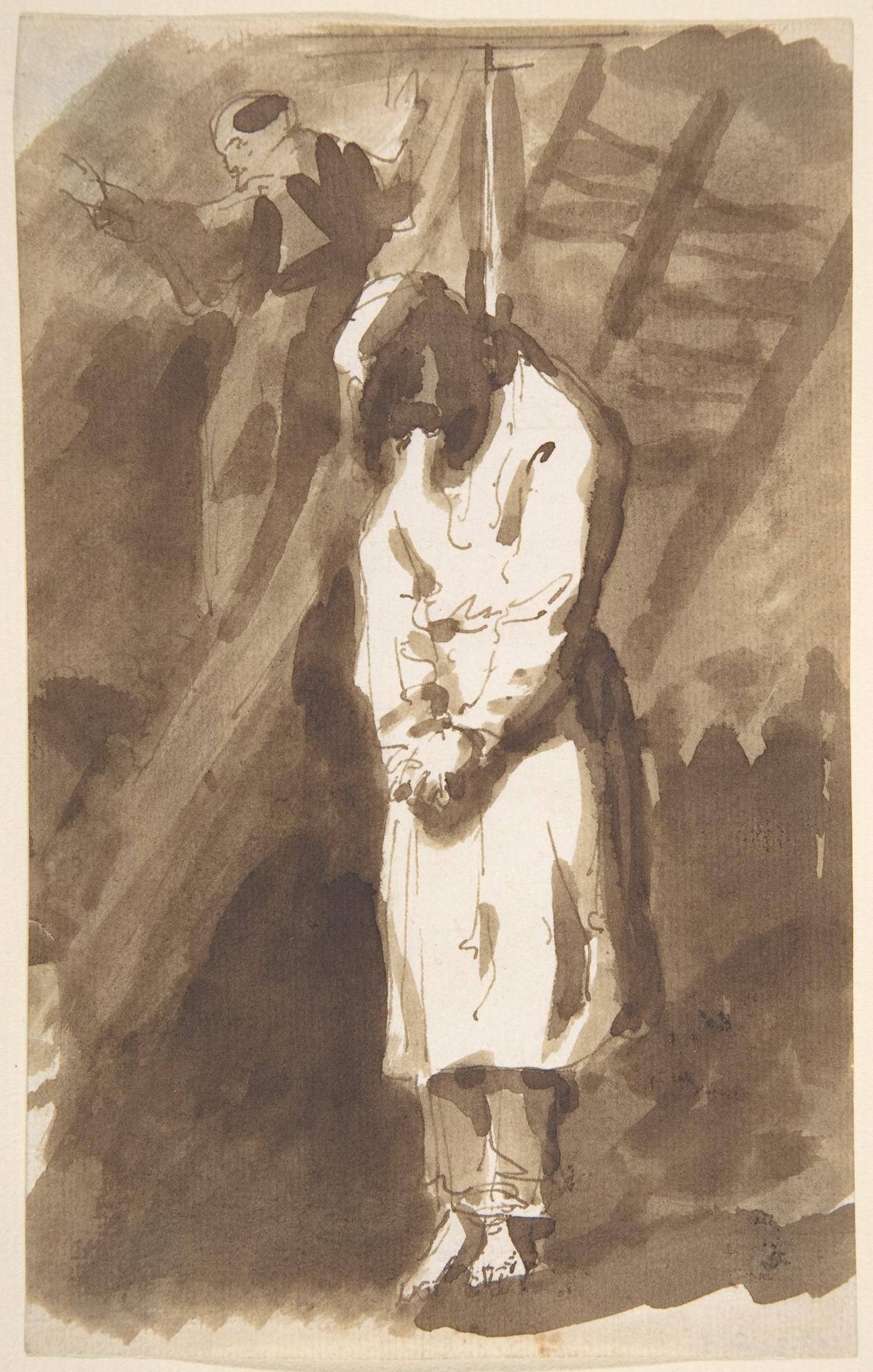
This drawing is attributed to Francisco de Goya y Lucientes and dates from around 1840 to 1900. Executed in pen and brown ink, with brush and brown wash, it presents a hanged man standing frontally with hands clasped, alongside a second figure in lively movement.
Description
The viewer's eye is first drawn to the frontal body of the hanged man, his head tilted to the left, hands folded before his torso. He wears a cloak-like garment. To the side, another figure appears in a dynamic pose, suggesting motion. The background remains abstract and dark, making the two figures stand out. Brown tones dominate, creating a somber atmosphere.
Context
The attribution to Goya is uncertain, and the date of creation may extend into the late 19th century. In his later years, Goya produced numerous drawings addressing violence, executions, and human suffering. This sheet belongs among those dark works, often interpreted as a commentary on the political and social conditions of his time.
Impact
A brooding, serious mood emanates from the drawing, reinforced by the brown palette and the dark, abstract background. The expressive, fluid strokes with bold brush marks give the image an immediate emotional force. Between the motionless hanged man and the moving secondary figure, a tension arises between rigidity and agitation.
Technique
Pen and brown ink were used together with brush and brown wash. This allows both precise lines and soft, flowing shading, giving the sheet a lively structure. The wash creates graduated tonal values that contribute to the overall somber mood.
AI-generated description text
Source: Metropolitan Museum of Art · Public Domain (CC0 1.0)