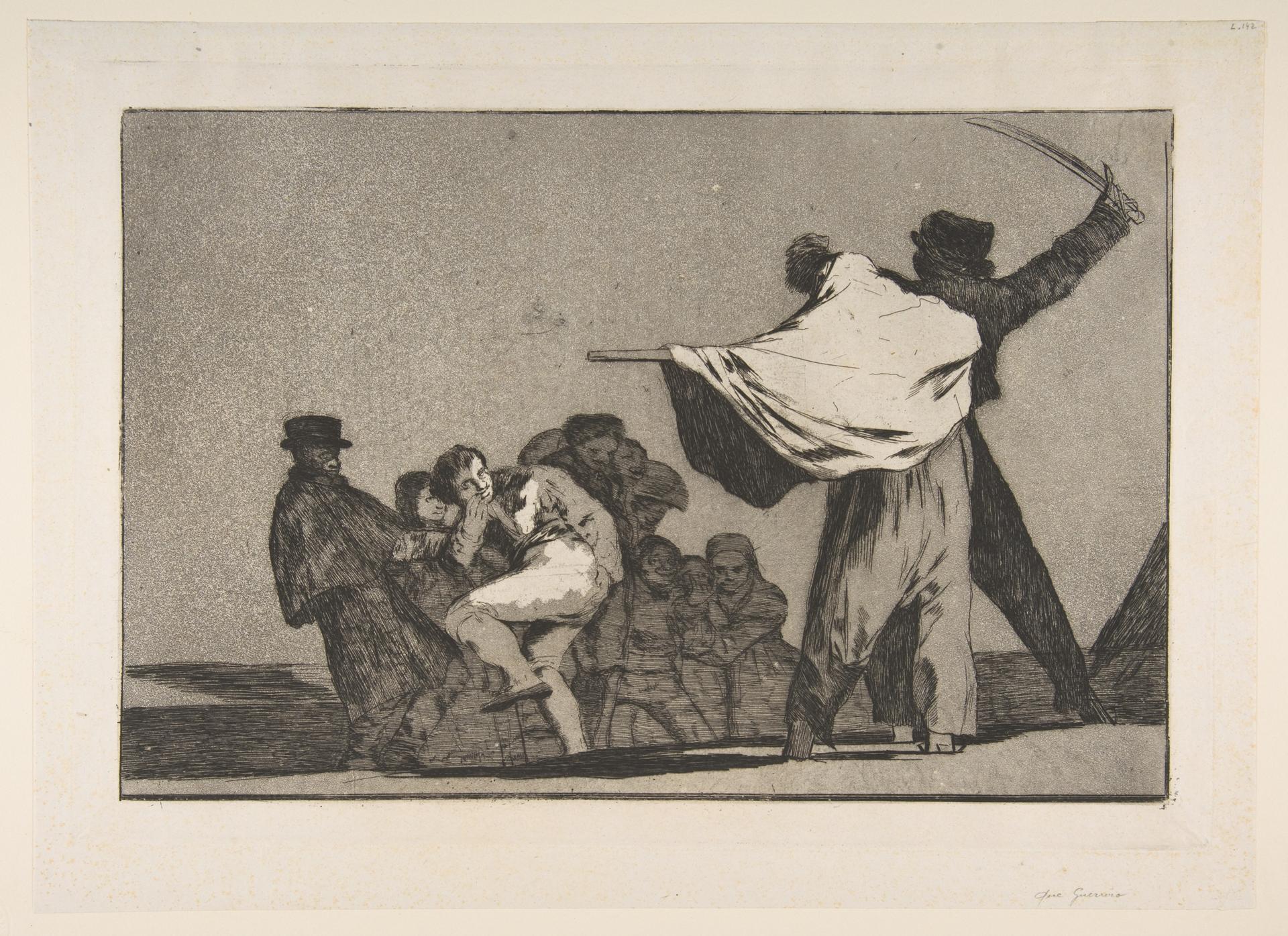
Well-Known Folly (ca. 1815–19 (published before 1877), Met-Objekt 1465)
Original title: 'Well-Known Folly' from the 'Disparates' (Follies / Irrationalities, Plate A)
kurzbeschreibung
Around 1815–19, Francisco de Goya made the etching 'Allbekannte Torheit' (original title: 'Bien conocida'), part of the 'Disparates' (Follies) series, published before 1877. The print presents several figures in a restless, asymmetrical arrangement.
Description
In the foreground, a man acts with a sword raised to strike; his posture is agile and energetic, the gesture challenging or aggressive. Close beside him crouches a second man, who appears pressed by the first figure. Further back stand several people, some watching, others looking in different directions; their expressions waver between curiosity and fear. The layout is markedly asymmetrical, the lines sharp, the shading finely graded, and gray tones dominate the sheet with even light distribution.
Context
The 'Disparates' belong to Goya's late work, created after his retreat to the country house 'La Quinta del Sordo'. The etchings were published only after his death, before 1877. The series is read as a critical engagement with the social and political ills of Spain after the Napoleonic Wars and the Bourbon Restoration.
Impact
The print generates an immediate tension that draws the viewer into the restless dynamics. The threatening gesture of the sword-bearer and the fearful reactions of those around him evoke an oppressive mood, characteristic of Goya's late dark imagery.
Technique
The work was executed as an etching with burnished aquatint on Japan paper. The combination of drypoint and aquatint techniques produces fine lines and soft tonal gradations that appear in gray tones. The plate measures 24.5 × 35 cm, the sheet 28 × 38 cm.
AI-generated description text
Source: Metropolitan Museum of Art · Public Domain (CC0 1.0)