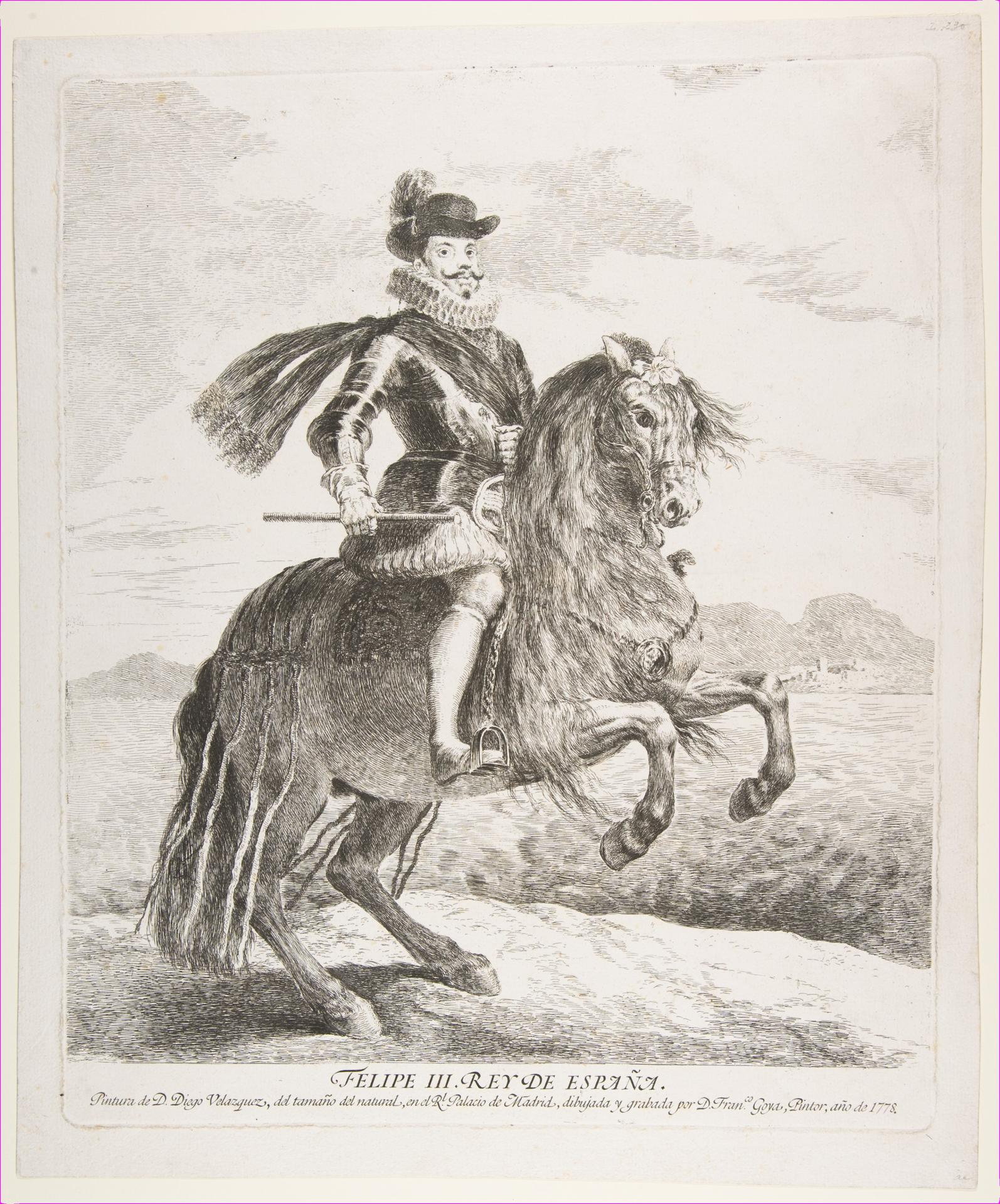
Philip III, King of Spain on horseback, after Velázquez
Original title: Philip III, King of Spain on horseback, after Velázquez
kurzbeschreibung
Unlike many contemporaneous ruler portraits, Goya's 1778 etching relies on direct proximity to Velázquez: it shows Philip III of Spain on horseback and belongs to a reproductive series after paintings by the older master. Francisco de Goya y Lucientes executed the plate as an etching with drypoint, translating a work from the royal collections into print.
Description
Philip III appears in full armor; a broad ruff sits at his neck, and on his head he wears a hat with a feather. The horse lifts its legs, bringing movement into the picture. Behind the mounted figure lie flat landscapes and mountains. The arrangement clearly pushes king and horse into the foreground, all kept in black and white.
Context
This etching was made in 1778 as part of a series of reproductions after Velázquez paintings owned by the crown. The Royal Academy of San Fernando commissioned the project to bring the court painter's work to a wider audience. For Goya, it was one of his first extensive forays into printmaking.
Impact
The precise linework and monumental conception of the king give the sheet a dignified, representative air. The horse's dynamic pose adds liveliness, while the even light creates a calm, matter-of-fact mood.
Technique
Goya used etching and drypoint; this allowed fine lines and hatching to establish contours and textures. The biting is carefully controlled and renders details of the armor and horse accurately.
AI-generated description text
Source: Metropolitan Museum of Art · Public Domain (CC0 1.0)