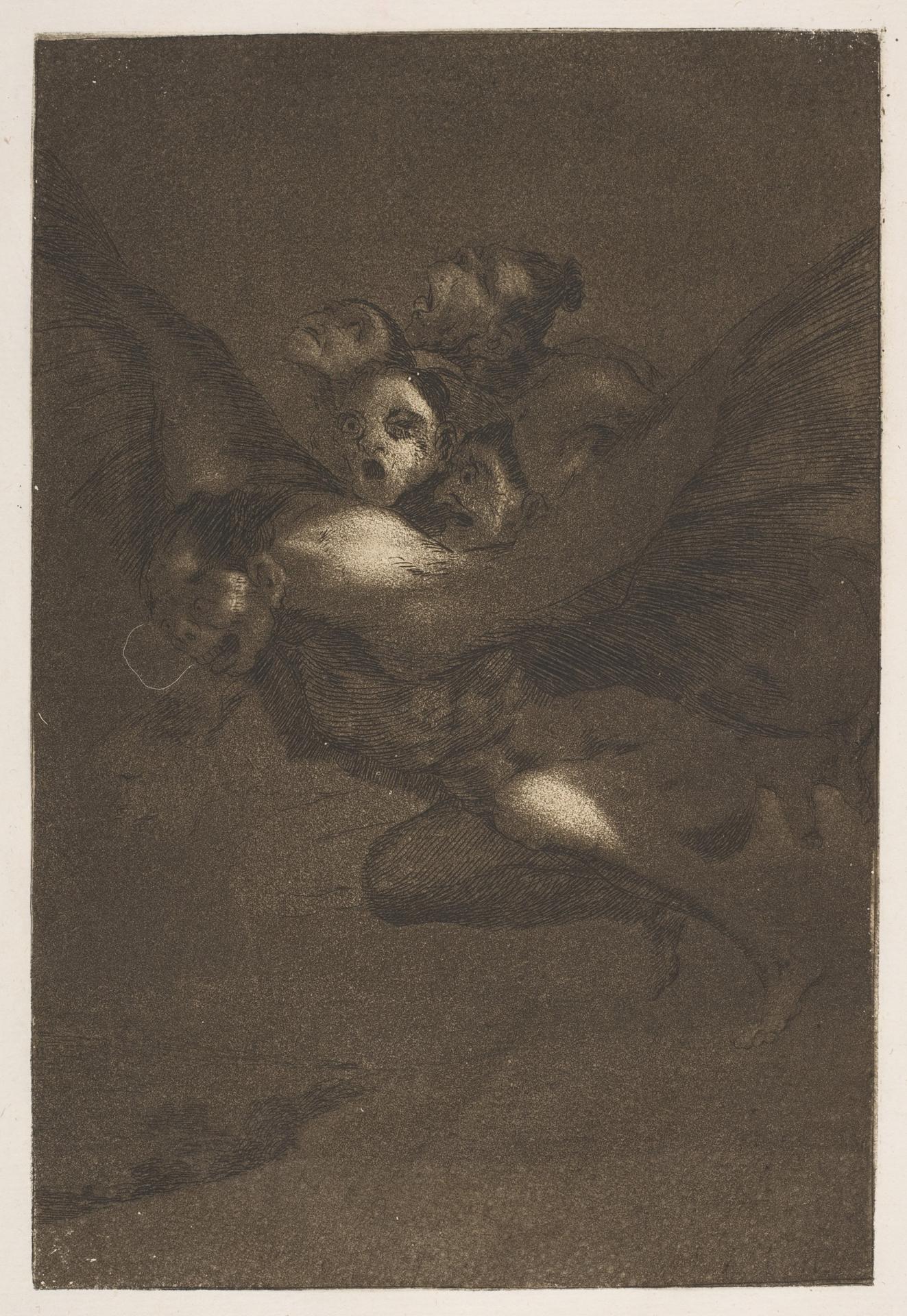
Bon Voyage (Buen Viage)
Original title: Plate 64 from "Los Caprichos": Bon Voyage (Buen Viage)
kurzbeschreibung
Buen Viage, or "Good Journey," is the 64th plate from Francisco de Goya's etching series Los Caprichos, made in 1799. Two figures come together in a situation charged with fear. Goya realized the image as an etching combined with aquatint and drypoint.
Description
Inside a room that tips almost entirely into blackness, two beings meet. The figure in front looks agitated, mouth wide open, eyes staring, arms thrust out to fend something off. The other figure seems to hover, arms spread, its face equally marked by dread. Strong, deep tones envelop both; the background recedes and leaves only the bodies standing out.
Context
With the Caprichos Goya criticized superstition, ignorance, and the social ills of the Spanish late Baroque. The etchings appeared between the Enlightenment and the Inquisition, so Goya dressed his satirical attacks in allegorical images. The 64th plate belongs to a sequence that parades the follies of human society.
Impact
The dark imagery and violent gestures produce an oppressive, threatening atmosphere. The viewer is drawn immediately into the grip of the fear the figures express. Because few, hard contrasts govern the image, the drama feels all the more insistent.
Technique
Goya executed the plate with a mixture of etching, burnished aquatint, and burin. The aquatint yields soft tonal transitions, while the burin lays in fine details and contours. This interplay makes deep blacks possible as well as delicate gradations.
AI-generated description text
Source: Metropolitan Museum of Art · Public Domain (CC0 1.0)