The Dream of the Doctor
Original title: The Dream of the Doctor
kurzbeschreibung
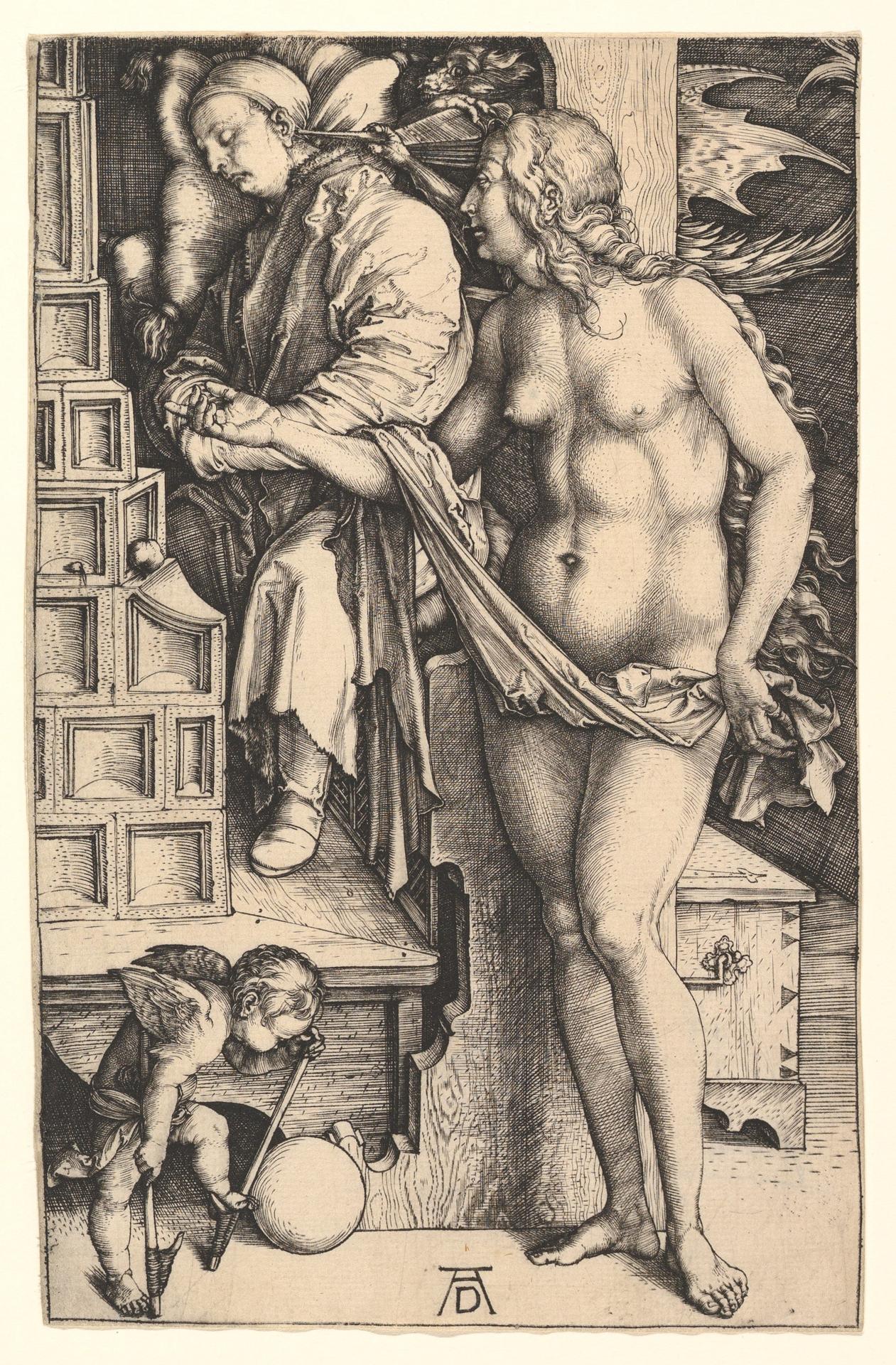
The Dream of the Doctor is an engraving by Albrecht Dürer, dating to around 1498. The work depicts a sleeping man in a domestic interior, visited by a nude woman and a small angel. It is a masterful example of early printmaking, rendered in fine black lines on paper.
Description
The scene centers on a seated man in long robes, who rests on a wooden bed frame with a book in his hands and his eyes closed, suggesting sleep or a dream. To his right, a nude woman, draped only in a cloth around her lower body, touches his forehead with a feather or thin object. Above and behind the man, dark, wing-like shapes appear in the background, adding a mysterious atmosphere. In the lower left, a small angel rolls a ball and holds a rod, while a small box with a lock sits on the right side of the bed. The composition is vertical, with the man occupying the upper left, the woman dominating the right foreground, and the angel placed lower in the left corner.
Context
Dürer created this engraving during a period when he was exploring secular and allegorical themes, likely influenced by humanist ideas from Renaissance Italy. The exact meaning of the scene is not certain, but it may reference the concept of sloth or the dangers of idleness, as the doctor sleeps while temptations appear. Similar motifs appear in Dürer's other works, such as his prints of the Virgin and the Child, which often include symbolic elements. The print was produced in Nuremberg, where Dürer had an active workshop and access to a growing market for fine prints.
Impact
The engraving draws the viewer in with its intricate detail and the tension between the sleeping man and the active figures around him. The contrast between the dark, shadowed background and the lighter foreground creates a sense of depth and mystery. The precise lines give the scene a crisp, almost sculptural quality, making the dreamlike subject feel both intimate and unsettling.
Technique
Dürer used engraving, a technique where lines are incised into a metal plate with a burin, allowing for fine, controlled strokes. The print is monochromatic, with black ink on paper, and relies on cross-hatching and varying line density to create tonal variation. The light source, coming from the upper left, is suggested through subtle shading on the right sides of the figures and objects, demonstrating Dürer's skill in rendering form and texture.
AI-generated description text
Source: Metropolitan Museum of Art · Public domain (CC0)