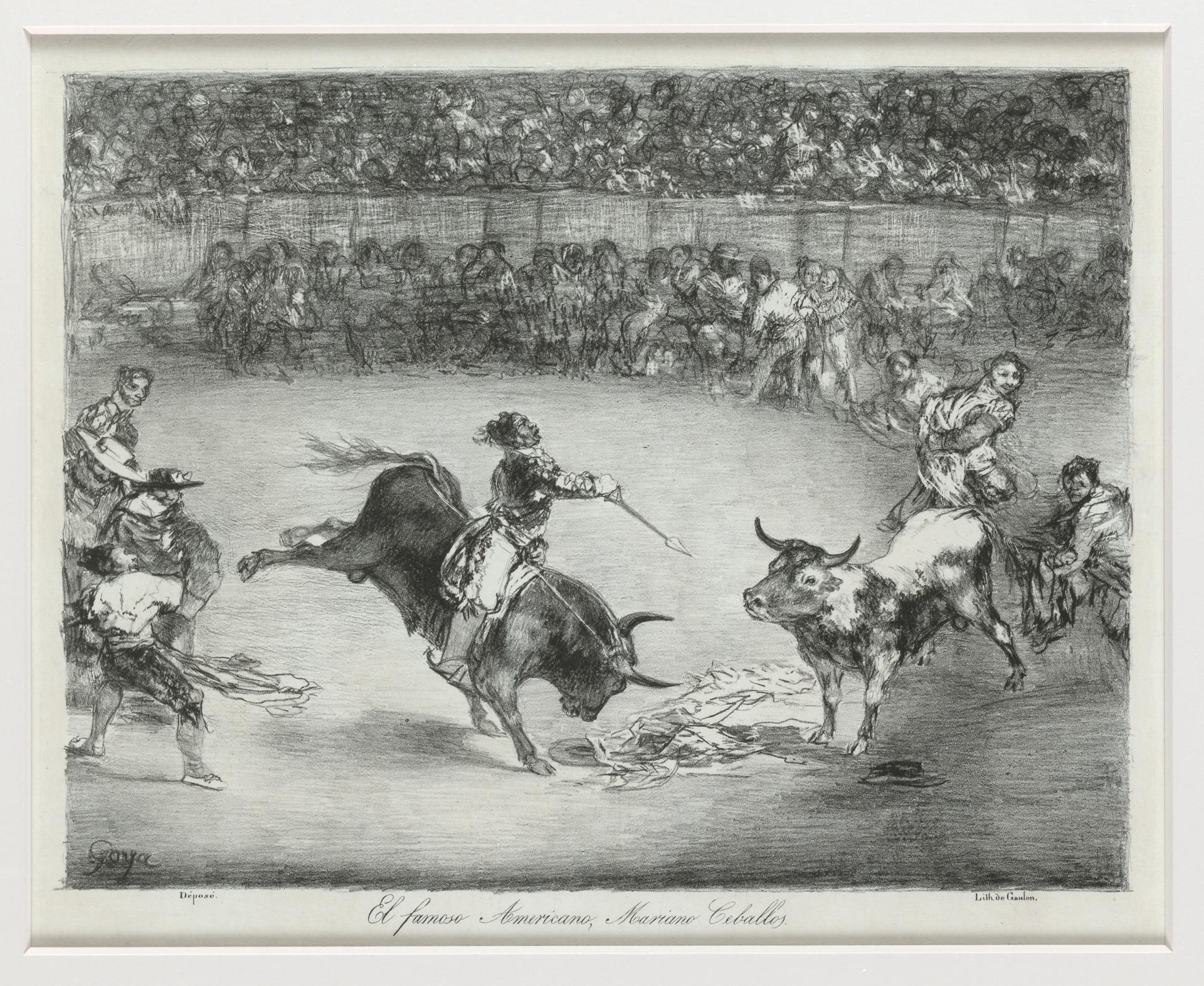
Mariano Ceballos riding a bull from the 'Bulls of Bordeaux'
Original title: Mariano Ceballos riding a bull from the 'Bulls of Bordeaux'
kurzbeschreibung
Unlike many bullfighting scenes that place a rider in combat against a single animal, this 1825 lithograph by Francisco de Goya centers on Mariano Ceballos riding one bull while aiming a lance at a second. The sheet belongs to the 'Bulls of Bordeaux' series and comes from Goya's late period, created during his exile in France.
Description
In the foreground a man rides a bull that is in motion, kicking up dust. The rider points his lance at another bull, while around him some figures in the arena stand still and others stir. A crowd of spectators surrounds the fighting ring. The image is in black and white with predominantly gray tones; shadows are almost entirely absent, and the figures are drawn in detail, which brings out the dynamism.
Context
The 'Bulls of Bordeaux' series was made in 1825, when Goya was staying in Bordeaux for political reasons, having moved there in 1824. Lithography was still a young technique at the time, and Goya explored it thoroughly in his later years. He had already taken up the bullfighting theme in earlier etchings such as 'La Tauromaquia'. The series was prompted by the art dealer Cyprien Gaulon; in 1825 it appeared in an edition of 100 copies.
Impact
Because movement is captured so immediately and every figure is rendered in detail, tension arises. The restriction to gray tones and the absence of shadows give the sheet a flat, almost graphic clarity that emphasizes the drama of the scene.
Technique
This sheet is a crayon lithograph: drawn on the stone with greasy chalk, then worked over with a scraper. This allowed fine gradations and a painterly effect that Goya used in his late prints. The dimensions are 46.5 × 55.5 cm.
AI-generated description text
Source: Metropolitan Museum of Art · Public Domain (CC0 1.0)