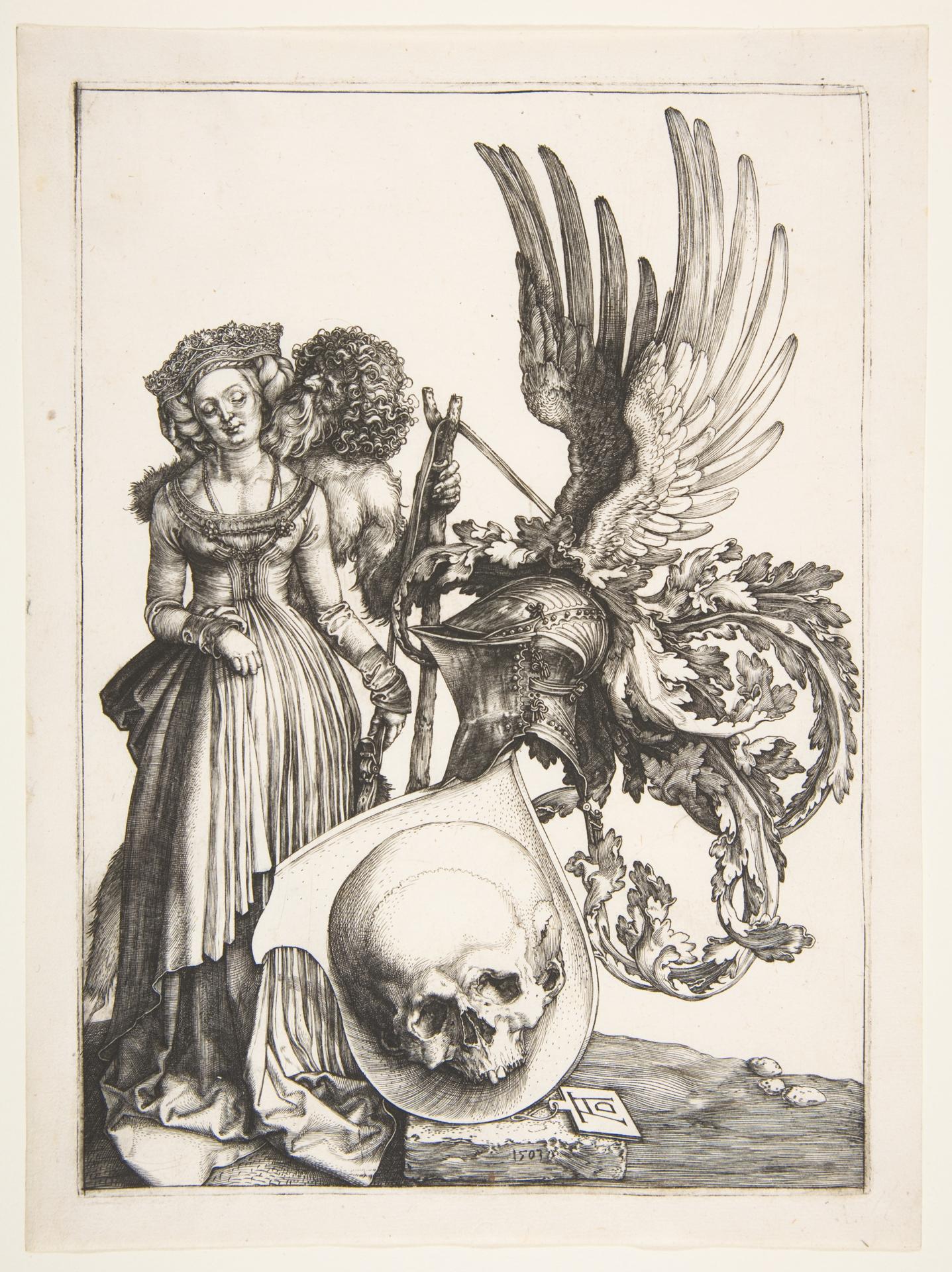
Coat of Arms with a Skull
Original title: Coat of Arms with a Skull
kurzbeschreibung
Dating from 1503, Albrecht Dürer's engraving "Wappen mit Totenkopf" is a heraldic print: a shield bearing a human skull, accompanied by a female figure, a winged putto, and an eagle. Dürer executed his engraved lines with great care and a sure feel for detail.
Description
Lower left stands a woman in a long, pleated gown with a broad belt, crown, and necklace; her gaze is slightly downcast. Behind her appears a winged figure with curly hair, holding a bow. Upper right, an eagle spreads its wings over a helmet. In the lower third, an open helmet rests on a shield, atop which sits a human skull. A stone block beneath the shield bears the date 1503 and the initials AD; a few small stones are scattered on the ground.
Context
In 1503, during his Nuremberg years as a freelance artist, Dürer devoted himself increasingly to coats of arms and allegorical motifs; this engraving also dates from that time. Combining heraldry and a skull can be read as a reference to the transience of earthly power, a common Renaissance idea. As usual for his prints, Dürer added his initials and the date.
Impact
The precisely drawn lines and careful modeling of the figures give the sheet a calm, almost meditative mood. It is reinforced by the juxtaposition of life—the woman and putto—and death in the skull. The clear layout draws the eye to the main motif and invites the viewer to trace the details.
Technique
Dürer engraved the motif into a copper plate, building light and shadow through fine parallel hatching and dense cross-hatching. This controlled network of incised lines models the forms with high precision and detail, giving the figures and heraldic elements their sculptural depth.
AI-generated description text
Source: Metropolitan Museum of Art · Public Domain (CC0 1.0)