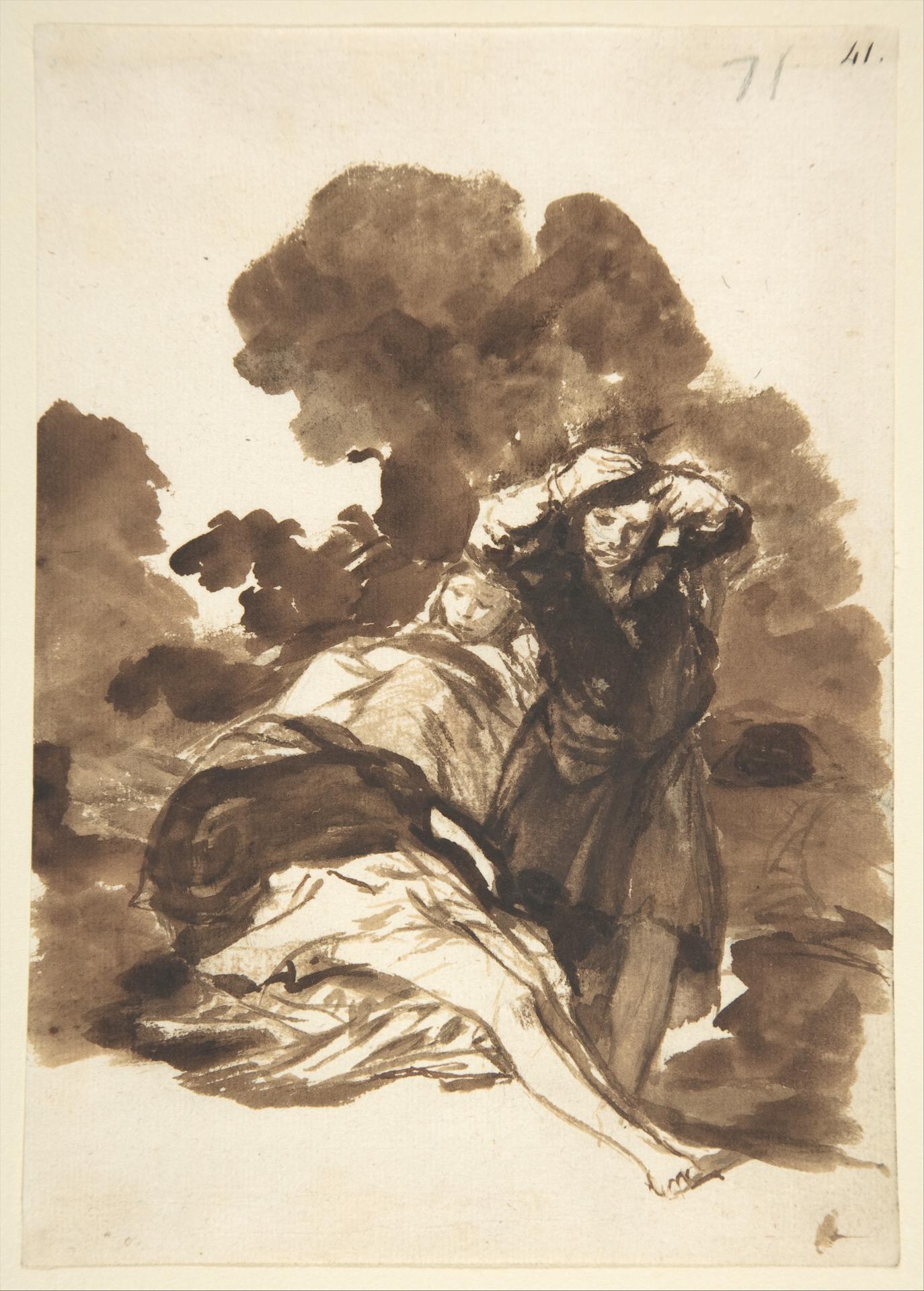
Figures waking from sleep (?); page 71 from the "Images of Spain" Album (F)
Original title: Figures waking from sleep (?); page 71 from the "Images of Spain" Album (F)
kurzbeschreibung
This sheet, titled 'Erwachende Figuren (?)', belongs to Goya's album 'Bilder von Spanien' (F) and was made around 1812–20. Executed with brush, brown wash, and touches of black chalk, it presents two figures who seem to emerge from a dark fog. It is part of a series of album works in which Goya explores the abysses of human nature and fantastic inventions.
Description
Two figures step forth from an almost black, cloud-like darkness. On the left, one lies on the ground, while a second leans over it, creating a tense encounter. Both wear garments reminiscent of historical or rural dress. The ground is bare and dominated by dark, flowing shapes that suggest mist. Brown tones prevail, interspersed with black and gray; light falling from above highlights the contours.
Context
The sheet belongs to Goya's album 'Bilder von Spanien' (F), created between 1812 and 1820—an era of political upheaval in Spain after the Napoleonic Wars. These albums were intended as private, intimate works, not for public view. Often they show fantastic, dreamlike, or gloomy scenes connected to the social and political conditions of the time. The exact meaning of the scene remains open—a hallmark of Goya's late imagery.
Impact
An eerie, floating atmosphere captivates the viewer. Figures and mist merge, blurring the line between reality and dream. The subdued colors and the interplay of light and shadow deepen the somber, enigmatic mood of the sheet.
Technique
Goya worked with brush and brown wash, supplemented by traces of black chalk. The wash allows for flowing transitions and soft shadows, while the chalk sets fine contours. This method is characteristic of Goya's late graphic works, often executed with rapid, expressive brushstrokes on paper.
AI-generated description text
Source: Metropolitan Museum of Art · Public Domain (CC0 1.0)